Love Becomes A Funeral Pyre: A Biography Of The Doors, by Mick Wall

514qxk7JaBL._SY344_BO1,204,203,200_

It’s now been 44 years since Jim Morrison shuffled off his mortal coil, and the story of his tumultuous life and early death has been told countless times. In books, magazines, interviews, and even a big budget feature film, it’s almost as if Morrison never left.

The band’s influence is still felt today, and that’s especially true of their lead singer, whose stage persona can be seen, in part or in whole, in the stylings of singers ranging from Perry Farrell to Scott Weiland to Eddie Vedder. When the Doors reunited in the late 1990s to perform on VH1’s Storytellers, there was no shortage of alternative rock gods lining up to pull on a pair of leather pants and do their best impressions of the Lizard King.

It’s a fair point, then, to ask if there’s a purpose to yet another Doors biography. Is there anything new that hasn’t been discussed before? Is there a single anecdote that Ray Manzarek, in the seemingly daily interviews he gave to everybody with a microphone or a pen in the years before he died, didn’t pontificate upon? Based on the latest, from British writer Mick Wall, the answer is no. This is the same story that was told (poorly and with a different ending) in No One Here Gets Out Alive, the Big Bang of Morrison biographies. It’s the same story that Stephen Davis told (very well) in Jim Morrison: Life, Death, Legend. It’s a similar story to the one told (bizarrely and with little regard for reality) by Oliver Stone in the movie The Doors.

This isn’t to say that Mick Wall brings nothing new to the party, but they’re mostly small anecdotes, like George Harrison inviting Morrison to Abbey Road Studios where the Doors singer met the Beatles while they were recording the White Album. But the main thrust of the story is still the same: pudgy young film student and poet discovers LSD, loses weight, starts writing songs, forms a band, becomes a sex god, has great success, and throws it all away (in one of the worst cases of alcoholism ever documented) while his band members fume indignantly (when they’re not making excuses for him).

Morrison was a star that eclipsed everything in his orbit. It’s why he appears on almost every page of this book, subtitled “A Biography of the Doors”, and the rest of the band drifts in an out. Morrison’s talent was, let’s be honest, limited. He couldn’t play an instrument, his voice was beautifully expressive when he sang in his range but that range was also very limited, his poetry was generally awful even as his lyrics, more disciplined, were often excellent. Forget Ray Manzarek’s constant talk of shamanism and Dionysian ecstasy and the fact remains that Morrison became an archetype. He was the tortured artist, doomed from day one, who transcended death and became a legend.

In many ways, Morrison was symbolic of the decade from which he emerged. He was vital and good-looking, filled with promise, bursting with creativity and a desire to challenge the established order. But, like the Sixties that began with JFK and Camelot, all of that potential was squandered with drugs, promiscuity, and alcohol. By the end of his life, Morrison was a burnt out husk. One of the last things he ever wrote was the scrap: “Last words. Last words. Out. Regret for wasted nights & wasted years. I pissed it all away. American music.” It was in his last journal, along several pages where he had written, over and over, “God help me.”

Love Becomes A Funeral Pyre is very good. It doesn’t add much to the story but it does flesh out one crucial aspect of Morrison’s life: how it ended. The story had first been told in Stephen Davis’s book, but there’s considerably more detail here. Since July 3, 1971, the story of Morrison’s death has been this: he went to Paris to get away from the rock and roll craziness and concentrate on his poetry and to be with the love of his life, Pamela Courson. One night they went to the movies and when they went back to their apartment Jim took a bath. He had a heart attack in the bathtub and passed away. That story has always seemed way too trite for me. I believed it because there was no contradicting story, but it never really seemed right somehow.

It’s not. People are talking now, including the ones who carried Morrison’s body out of the bathroom in a Parisian bar and deposited it in that bathtub. There’s far too many corroborating accounts now not to recognize the truth: Jim Morrison died of a heroin overdose while sitting on the toilet in a bar called the Rock and Roll Circus. In order to avoid police involvement and scandal, he was wrapped in a blanket and carried out the back door to a waiting car. His body was driven home at around 3:00 in the morning and carried up to his third floor apartment, dropped several times along the way. Pamela was mostly passed out, strung out on heroin. They stripped Jim, placed him in the tub, told Pamela what to do (get rid of all the drugs in the apartment) and what to tell the police, and left. Pamela did as she was told, and the French police weren’t really interested in pursuing the matter. It’s a more sordid tale than the myth, but far more believable. Morrison didn’t go to Paris to concentrate on poetry; he went because France wouldn’t extradite him back to the United States, where he was due to be sentenced for the infamous Miami concert. In Paris, he admitted that he was barely reading or writing anything. He was drinking an enormous amount, and had recently begun to try heroin. The heroin that killed him was nearly pure, supplied by Count Jean de Breteuil, Marianne Faithfull’s boyfriend (and former lover of Pamela…it was he who hooked Pam).

Mick Wall’s style is fluid and engaging, though perhaps more befitting a blog than a book. There are many asides and sarcastic comments scattered throughout, and Wall especially seems to hold an intense disdain for Ray Manzarek. While he readily acknowledges Manzarek’s musical skill and his gift of gab, he begins the book by telling how Manzarek had insinuated, in an interview with the author, the old trope that maybe Morrison was still alive somewhere. Rather than shrug it off as Ray being Ray, repeating something that he’s been saying to the punters for over 40 years, Mick Wall seems personally offended by the comment, and almost never fails to include snarky comments when he quotes Ray throughout the book. Some of the snark is funny, but not appropriate for what should be a more dispassionate biographical work. In contrast, the author holds John Densmore in very high esteem (deservedly so…Densmore’s autobiography Riders On The Storm is essential reading for Doors fans, and he is unquestionably the most level-headed and clear-eyed analyst of life with Jim Morrison).

Wall is also surprisingly critical of the music. While he thinks that Strange Days and L.A. Woman are complete triumphs, he’s strangely dismissive of a large part of the band’s brilliant first album, The Doors, and their hard-rocking return to basics, Morrison Hotel. He’s unfairly harsh with both Waiting For The Sun and The Soft Parade, admittedly the two weakest Doors albums but still containing many delights. He savages their performance at the Hollywood Bowl, which I’ve always found to be an extraordinary show, and the showcase they did on PBS (to my mind, one of their best performances on tape). But Wall is clearly a fan. As Morrison devolves, and the band starts to crack under the weight of playing with such a loose cannon, Wall finds it hard to disguise a sense of genuine anger that a band with so much talent could lose the thread so completely.

Wall also refuses to take a position on some of the many controversies of Morrison’s life. He shrugs and backs away from the idea that Morrison was bisexual, though the anecdotal evidence is very strong that the singer was, if not sexually attracted to other men, willing to overlook the gender of whoever was pleasuring him. Was he bisexual or just a drug-addled hedonist? It’s true that nobody will ever know but Wall seems to deliberately shy away from a stance. That’s fair enough, but he’s also agnostic on whether Morrison had been sexually abused as a child. Here there seems to be less room for hesitation. Aside from the fact that he exhibits almost all the signs of the abused child (the addictions, the sexual acting out, the violence toward women, etc), Morrison himself told his lawyer that he’d been abused. In No One Here Gets Out Alive, Jerry Hopkins and Danny Sugarman recall the many instances where a pre-teen Morrison had drawn sexually explicit (and often violent) pictures of children with adults in his notebooks. Sugarman, more a hagiographer than a biographer, dismissed these pictures as being wild and precocious, yet another manifestation of Jim’s towering intellect and Dionysian godhood, when they seemed to me to be a real cry for help. The evidence of Morrison’s abuse is all there, and Wall’s dismissal of it strikes me as cowardly (Wall says that the admission to his lawyer was possibly just more myth making, though by all accounts Morrison was in tears as he told the story). Stephen Davis did a much more thorough job of exploring this angle of Morrison’s life and behavior, including the story of the (male) Florida bar owner who would let the teenaged Morrison on stage to read his poetry in exchange for sex.

Throughout Love Becomes A Funeral Pyre, and most other good Doors books, Jim Morrison comes across as a man who is kind and personable, very witty, insecure (he was hesitant about meeting the Beatles—”What if they laugh at me?” he asked), and extremely intelligent. When he was sober. When he wasn’t sober, and he was drunk more often than not in the last few years of his life, a rage-filled monster emerged. In vino veritas. Today he would have managers shipping him off to rehab and therapy, but in 1971 nobody knew what to do with him, and he paid the price with his life.

Love Becomes A Funeral Pyre is a worthy, though ultimately redundant, addition to the story of the Doors. It doesn’t reach the level of Densmore’s Riders on the Storm: My Life With Jim Morrison and The Doors, Manzarek’s autobiography Light My Fire: My Life With The Doors, or Stephen Davis’s Jim Morrison: Life, Death, Legend, but it is far superior to the original Morrison biography, the grossly distorted, sycophantic No One Here Gets Out Alive. Wall has done fans a service by providing the comprehensive story of Morrison’s death, but there’s little else here that hasn’t been seen before.

The Thrill Is Gone

kin2-014

The gateway drug of the blues for me was The Rolling Stones. My initial exposure to the Stones was their early- and mid-sixties period, when they were releasing good albums and some of the greatest singles ever recorded. It was the lesser-known album tracks that opened the door. “Confessin’ the Blues”, “The Spider and the Fly”, “I Just Wanna Make Love To You” and others were raw slices of blues, and their other songs were heavily influenced by the genre. From the Rolling Stones it’s only a short walk to the Animals, the Yardbirds, and John Mayall’s Blues Breakers. It was the Yardbirds and Mayall who blew up a passing interest into a full-blown obsession because both of those bands provided the seeds for others. From the Yardbirds and Mayall came Clapton; from the Yardbirds came Jeff Beck and Led Zeppelin; from Mayall came Fleetwood Mac and the addition of the virtuoso Mick Taylor to the Stones. Hendrix was in the mix as well, playing his blues from Mars. The Butterfield Blues Band was also there. As I was listening to these bands, and others from the era ranging from Ten Years After to Savoy Brown, the originators of the style of music were unknown to me.

That all changed when the connection was made. In a record store one day I found an album called Muddy and the Wolf, featuring members of Butterfield’s band, the Rolling Stones, Traffic, and Cream. Later I found out that the album was a repackaging of Muddy Waters’s Fathers and Sons and Howlin’ Wolf’s The London Howlin’ Wolf Sessions, but when I handed over my money to the good folks at Tapeville USA I just thought it was some supergroup I’d never heard before. When I listened to it, I was hooked. Like a lot of people, I expected the old blues players to be croaking vocals about bad times while playing rudimentary acoustic guitars. I was floored by both Muddy Waters and Howlin’ Wolf. For whatever reason, at a time when the Human League and Soft Cell were all over the radio with heavily synthesized pop tunes, there was something in this primal music that grabbed me by the ears and demanded that I pay attention. This music was completely unfashionable but that didn’t matter. It was real.

Once I learned that the originators of blues music, those old black guys from down South and from Chicago were actual players and, in some cases, virtuosos, it became a quest to find out more. My first stop after Muddy and Wolf was B.B. King.

I’d heard about King from interviews with Eric Clapton. Of particular interest was Clapton’s quote from a 1968 Rolling Stone interview: “I don’t think there’s a better blues guitar player on the planet than B.B. King.” This coming from Clapton? That’s some serious high praise. My first experiment? Live in Cook County Jail. And again, I was hooked.

B.B. King had one of the purest tones on the planet. Unlike most electric guitar players, King played with little to no distortion. Each note rang clearly and cleanly, and the notes he played were amazing. King was not a particularly great guitarist if you measure skill by your depth of knowledge. King never played chords, and never played while he sang. For him, the guitar was a solo instrument, and an extension of his voice. His rich, pleasing singing was punctuated by flurries of notes from his guitar, which he named Lucille. His style was immediately recognizable. Nobody else plays like him. For millions of fans raised on a diet of guitar virtuosos from Hendrix to Stevie Ray, B.B. King’s style seems almost simple. From a technical perspective, that’s probably true. But King was never interested in playing ten minute solos at the speed of light. His guitar was his partner. He was not its master, and it was not his. A B.B. King song is almost a conversation between the singer and his instrument. He sings the blues, and his guitar whistles, sighs, moans, and cries in sympathy. His guitar playing was a response to his voice’s calling. “Every day I have the blues,” King sings, and his guitar answers “I know you do. Me, too”. There’s an almost Gospel sensibility to it, with King in the role of a preacher and his guitar playing the part of the congregation. “The thrill is gone!” “Alleluia!”

For rock fans King is known as the guy who took one of Bono’s most pretentious lyrics and rooted it in the ground on U2’s “When Love Comes To Town”. Others know him for his biggest hit single, “The Thrill Is Gone”, a fluke pop hit in the late 1960s that still retains its power all these years later. But King’s canon has many joys. The greatest is probably Live at the Regal, often considered one of the greatest live albums ever recorded. It is the concert stage where King worked best. On stage, King could play with an abandon that was often lacking in his studio work. He filled his songs with thunderous vocals, searing lightning fills on the guitar, and his often very funny stage banter (listen to “Worry Worry” from the Cook County album). And above it all, towering over everything, was THE NOTE.

The note changed, of course, depending on the solo or the song in which he unleashed it. But it was always there. The band would chug along, King would stop singing, he’d play a handful of notes, and then hit it. One note. One string. That note would never end. Each one of these, over tens of thousands of live shows, can probably still be heard by the most sensitive recording equipment. THE NOTE would ring out, louder, higher, and clearer than any note that had ever been played by any guitarist. The sustain would go on…and on…and on. The band continued playing while that single note stopped time and let everyone on that stage, and everyone listening, know who was boss.

bb-king-music-blues-guitar-demotivational-posters-1332992061

When the note finally faded, it was usually followed by another quick blast that would put Eddie Van Halen to shame. King’s virtuosity was not technical, it was emotional. He was one of the greatest of all the blues legends, a towering figure in 20th century music. His name should be revered and held in the same company as Armstrong, Sinatra, Parker, Coltrane, Hendrix, Davis, Lennon, Presley. Muddy Waters and Howlin’ Wolf made better records because they were able to capture their live sound on tape, but Riley “B.B.” King stands at the top of the list of blues musicians. He influenced every blues guitar player who came in his wake. His voice is silenced now, as is Lucille’s. The notes live on forever. RIP.

The Beatles: The Beatles

white-album-cover-serial-number04b

With Revolver and, especially, Sgt. Pepper’s Lonely Hearts Club Band, the Beatles had radically altered the sound of rock music in the mid-1960s. Rock and roll was no longer content to be short songs with a steady beat that sent teenagers running to the dance floor. Rock music now was in big, bright Technicolor. It was now art and began to suffer from some of the problems that plague the modern art world. After Pepper, orchestras started popping up on even innocuous pop songs. The idea was to harness the mighty power of oboes and violins to make these songs into Important Works Of Art, though the effect was usually to render them insufferably pretentious. As bands got more psychedelic, and more colorful, there was the inevitable backlash.

After electrifying the music world with the holy triptych of Bringing It All Back Home, Highway 61 Revisited, and Blonde on Blonde, Bob Dylan went up to Woodstock, New York and vanished from sight. He was woodshedding with his backing group, The Hawks, and writing songs that were lyrically and musically worlds apart from the thin, wild, mercury sound of his last three albums. The Beatles got deeper in to meditation, going as far as a trip to India where they played acoustic guitars and wrote songs. The Byrds, always students of country music, added Gram Parsons to their lineup. Parsons was a talent so bright that he changed the sound of the band overnight. The Rolling Stones were stung by the critical reaction to their sojourn to psychedelia and by the increasing isolation and decrepitude of their most far out member, Brian Jones, and began to plot a future without the exotic instrumentation and influences that Jones brought to their music. Cream was still releasing songs with psychedelic tendencies, but turning them into extended blues/jazz workouts in concert. Jimi Hendrix started to move away from the psychedelic freakout of his first two albums to the blues from Mars approach of Electric Ladyland.

The backlash was heralded in late 1967 with the release of Dylan’s extraordinary and criminally underappreciated album John Wesley Harding. Over the next several months the biggest players on the field began to drop their psychedelic dreamcoats and head back to basics. The Byrds released the stone cold country album Sweetheart of the Rodeo. The Stones followed the excess of Satanic Majesties with the jaw-dropping roots blues rock single “Jumping Jack Flash”. Even a lesser act like the Beau Brummels retreated to a pre-rock sound with the excellent album Bradley’s Barn. The Beatles followed the garish Magical Mystery Tour with its polar opposite. The “Hello Goodbye”/”I Am The Walrus” single with it’s heavy orchestration and cryptic lyrics was followed by “Lady Madonna” a barrelhouse Fats Domino-inspired piano rocker that was far removed from the psychedelic world. The B-side, George’s “The Inner Light” was an Indian raga that kept one foot in Pepperland, but was so rarely played that it became a track on The Beatles’ Rarities LP in the late 1970s. Their next single was “Hey Jude”/”Revolution” and the break from psychedelia was complete.

The biggest influence on all of this was Music From Big Pink, the first album by Dylan’s Hawks, now rechristened The Band. The album electrified the rock music community. It was rootsy, country, folk, rock ‘n’ roll, and sometimes all of the above. Big Pink is the Big Bang of the genre now called Americana; there is no Mumford and Sons without it. Eric Clapton went to visit The Band in the hope they’d ask him to join. Paul McCartney sings a snippet of “The Weight” during the fade of “Hey Jude” when the Beatles performed the song on David Frost’s show. Even the Rolling Stones, on the original, banned cover of their album Beggar’s Banquet slipped in a sly piece of graffiti that read: “Music From Big Brown”. The rock music world had once again shifted.

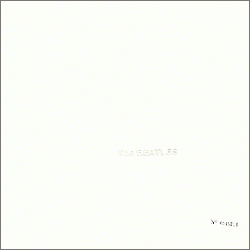
In late November 1968 the Beatles released an album called, simply, The Beatles. The statement was obvious right away. There was no orchestral band, no magical wizards. The boldness and vibrancy of the album covers, from Revolver‘s Klaus Voorman mixed media artwork to Magical Mystery Tour‘s trippy, star-spangled typography were gone. In their place was nothing.

“The White Album? What was that? There was nothing on that goddamn cover.”—This Is Spinal Tap

For all its legendary starkness, the packaging of The Beatles, packaging that immediately and forever branded the new release as “The White Album”, was actually a good deal more sophisticated than Sgt. Pepper’s. There may not have been a picture on the front or back cover, but the words “The Beatles” was embossed above a gray line of text that was a serial number (the embossed words were later replaced by gray type and the serial number disappeared). The first pressing of the White Album was a limited edition, each album individually numbered. The gatefold contained a listing of the songs and small black and white photos of the band members. It was a double album, and the records were removed from the sleeves at the top of the cover, not the sides. The inner sleeves were black. There were four color photographs on heavy stock paper that were included with the album. These were color versions of the photos that appeared on the inner gatefold. There was an enormous fold out poster that was printed with all of the lyrics on one side and a photo montage of the band throughout their history on the other. An enormous amount of attention to detail went into the packaging for an album that has somehow become famous for being “white”.

There were 30 songs stretched across four sides of vinyl, and it was clearly a continued distancing of their sound from what they had been releasing less than a year earlier. The White Album, and the two preceding singles, mark the arrival of what’s now thought of as “late period Beatles”. It was also the sound of the beginning of the end.

The most noticeable aspect of the album is how schizophrenic it sounds. For the first time on a Beatles album there are clearly “John songs” and “Paul songs”. The recording sessions were very tense. Ringo quit the band for awhile, and their engineer Geoff Emerick also quit. The Beatles were at odds, focusing on their songs and acting as sidemen for the others. This was the first Beatles album where the band didn’t sound like a group.

It’s a very difficult album to review because there are two contradictory elements in place:

  1. A lot of the songs, especially Paul’s, just simply aren’t that good.
  2. It’s the Beatles bloody White Album. Shut up.

And that’s the crux of it. George Martin begged the Beatles to make a single album. He knew that many of the songs here were half-baked. But Martin lost the argument and the Beatles released this warts-and-all double record that somehow manages to hang together in one brilliant whole. Is “Wild Honey Pie” a good song? No. Is “Revolution 9” a great piece of music? No. Is “Birthday” more than just a riff with throwaway lyrics? Not really. But on the White Album, they work. It’s the most idiosyncratic album ever released, from the jokey Chuck Berry meets the Beach Boys pastiche of “Back in the USSR” to the string-laden, somnolent “Good Night” and I wouldn’t change a note of it.

George contributed some of the best songs he’d ever written: the classic “While My Guitar Gently Weeps” with a searing lead guitar by guest Eric Clapton, the swipe at unidentified fat cats everywhere with “Piggies”, the lovely ballad “Long Long Long” and the fuzzed raver “Savoy Truffle” about Eric Clapton’s love of chocolates (the lyric “you’ll have to have them all pulled out after the savoy truffle” is probably the only lyric ever written about Clapton’s teeth). George was clearly stepping up his game. He’d written and they’d recorded another gem called “Not Guilty” that didn’t make the album, though it was far better than many of Paul’s tracks.

Even Ringo stepped up with his first song as a writer. “Don’t Pass Me By” is a country honk, both a parody and tribute. Ringo loved country music (so much so that his first solo album was country), and “Don’t Pass” is a hoot. The lyrics are silly (“you were in a car crash/and you lost your hair”) and the violin is way over-the-top but Ringo’s voice lends just the right amount of bonhomie and charm to what is, at the end of the day, a pretty mundane song. Even here, despite the fact that the one source of agreement between John, Paul, and George was that everyone liked Ringo, the only Beatle who plays on the track is Paul. No Beatle plays an instrument on “Good Night”, a straightforward lullaby by Lennon that Ringo sings over a string section. At least all four Beatles played on two of George’s songs, though Lennon skipped out on “Long Long Long” and “Savoy Truffle”.

Their recent trip to India had lit a fire under the two main songwriters, who returned to England with more songs than they knew what to do with. For Paul McCartney, though, the White Album seemed to indicate that he was running a little low on petrol. McCartney had just written one of the greatest rock songs of all time and seen it released as a single while the band was in the studio working on what would become the White Album. There’s no denying that “Hey Jude” is a masterpiece. But McCartney’s White Album tracks, while mostly good and occasionally great, were well below that standard. McCartney seemed to want to stretch out, penning songs in a variety of styles. This added to the varied nature of the album, but when these songs are taken out of context they are revealed at far below the quality of Lennon’s work.

The album begins with the sound of a jet taking off and McCartney’s loving tribute to Chuck Berry and the Beach Boys. Parodying the title of Berry’s “Back in the USA” and the lyrics of the Beach Boys’s “California Girls”, “Back in the USSR” is best described as clever. It’s not particularly substantive, but it chugs along as a happy little rocker. McCartney’s vocal is excellent, a combination of his Elvis voice and his Little Richard voice, but the words are, at best, cute. For all of it’s catchy enthusiasm and sense of fun, “Back in the USSR” is the kind of song that McCartney could write in his sleep. Yet as songs go, it’s one of his best on the album.

McCartney’s songs provide a lot of the eclecticism of the album. “Wild Honey Pie” is a throwaway experiment, “Ob-La-Di, Ob-La-Da” is a misguided attempt at reggae, “Honey Pie” is a tribute to the music of a long-gone era, “Mother Nature’s Son” is a beautiful acoustic ballad, “Helter Skelter” was McCartney’s attempt to record something heavier than The Who.

The problem is that McCartney seems to have been infected with a nasty attention deficit disorder around this time. It seems that after Pepper he was so convinced that he (and the Beatles) could do anything, that they also should do everything. This leads to many of McCartney’s songs seeming incomplete. “I Will” is a lovely ballad that doesn’t crack the two-minute mark and features a bass line that is sung by McCartney, as if he was in such a rush to record that he didn’t have the time to pick up his bass guitar. “Why Don’t We Do It In The Road?” features a thrilling McCartney vocal (the White Album has much of Macca’s best vocal work) and the complete lyrics: “Why don’t we do it in the road?/No one will be watching us”. “Birthday” is a repetitive, and simple, guitar riff that McCartney put some dreadful lyrics on. According to Paul it was made up on the spot, and it sounds like it. It’s still a highlight of Paul’s work on the album, with another superb vocal and prominent harmonies from John (who later called the song “garbage”). “Birthday” is a fun song and sounds like the Beatles were having a blast recording it, but both lyrically and musically it’s McCartney on autopilot. “Rocky Raccoon” is a fun, jokey, spoof of folk music, while the pummeling “Helter Skelter” is the heaviest slab of music the band ever recorded, though the lyrics are about a slide at an amusement park. The original jam, lasting 27 minutes, is what led Ringo to shout “I’ve got blisters on my fingers!” at the end. But for all of its power, “Helter Skelter” is another riff in search of a song. McCartney screams and wails the lyrics like his heart was about to explode out of his chest. It’s the most mercilessly savage vocal of his entire career but, once again, he’s singing about nothing.

But “Helter Skelter” is saved by the performance. “Honey Pie” is yet another pastiche (this time of 1930s-style music hall), while “Wild Honey Pie” is little more than a clanging acoustic guitar and drum. “Ob-La-Di, Ob-La-Da” gamely attempts to put a Beatles stamp on reggae, or maybe it’s a reggae stamp on the Beatles. Either way, the song’s a trifle. McCartney was obsessed with the recording, but Lennon famously hated it. According to their engineer Geoff Emerick in his fascinating book Here, There, and Everywhere: My Life Recording The Music of the Beatles, after far too many attempts to get the song right, Lennon stormed out of the session. He returned a few hours later, stood at the top of the steps leading down into the studio and announced, “I am stoned! I am more stoned than I have ever been, and I am more stoned than you will ever be! The song goes like this!” before marching over to the piano and playing the intro exactly as it’s heard on the album.

All of these songs have two things in common: The first is that McCartney wasn’t writing about much of anything; the lyrics are either tossed off as if he simply didn’t care, or they’re parodies of other types of music. The second thing they have in common is that they all work in the context of the White Album. God knows, they shouldn’t work, but they do. It’s all part of the crazy quilt that is the album. Would I listen to “Wild Honey Pie” as a standalone song? No. But I sure would miss it if it wasn’t sandwiched between “Ob-La-Di, Ob-La-Da” and “The Continuing Story of Bungalow Bill.”

And not all of Paul’s songs are like this. He also turned in a magnificent tribute to his sheepdog, Martha (“Martha, My Dear”), that is one of the catchiest songs he ever wrote. Yes, he’s singing about his dog. Who cares when the tune is that good? He also provided two stone cold classics: “Blackbird” is a magnificent acoustic ballad that uses the British slang for “girl” to make an anthem for America’s Civil Rights movement, and “Mother Nature’s Son” is a lovely back to nature song written in India with an exquisite brass arrangement, courtesy of George Martin.

The lightness of Paul’s songs stands in stark contrast to John’s material. The White Album, frankly, is owned by Lennon. His songs, for the most part, tower over the others. His opening shot is “Dear Prudence”, written about Mia Farrow’s sister who accompanied the Beatles to India and was so enamored with meditating that she refused to come out of her room. It’s one of John’s best songs, helped considerably by Paul’s throbbing bass line and rolling drums (Ringo isn’t on the song), and the intricate weaving of the guitars. John never sounded better as a singer (the high, nasal tones he’d been using since Revolver are gone), and the lyrics are gorgeous.

“Prudence” is one of several acoustic-based Lennon songs. “I’m So Tired”, “Julia”, “Bungalow Bill”, “Cry Baby Cry”, and “Revolution 1” are built on acoustic foundations. Of these, “Julia” is the standout, an uncompromisingly beautiful ballad that serves as Lennon’s introduction of his deceased mother Julia to his new lover (“Yoko” translates to “child of the ocean”) while also, somewhat disturbingly, conflating the two. But there’s no getting around the beauty of Lennon’s finger-picked guitar (learned from Donovan while they were in India) or the vocal that expresses so much pathos. “The Continuing Story of Bungalow Bill” begins not with a snippet of flamenco guitar, but with a sound sample of flamenco guitar that was played on a Mellotron before launching into a fun and funny song about a wealthy American and his mother who had stayed in India in their own private bungalow and who ended up shooting a tiger while he was there. The mockery of the lyrics was Lennon’s response to what he saw as a strange contradiction of a man coming to commune with nature and God who nevertheless found time in his day to ice a tiger. Yoko Ono appears on the song in a cameo as Bill’s mother, who was apparently enormously proud of her son’s actions. Even better was “I’m So Tired”, Lennon’s ode to the insomnia that plagued him in India, and “Cry Baby Cry”, a variation on the traditional folk children’s ballad “Sing A Song of Sixpence”. “Revolution 1” was an alternate take of the much heavier song that had been released as the flip side of the “Hey Jude” single. The single version was all rock fury, but the version on the White Album is a lazy, acoustic shuffle. Most noticeable is the lyrical switch. In the single Lennon disavows violence, instructing the audience to count him out when destruction is on the menu. On the album, the lyric is more ambivalent as Lennon mutters the word “in” after the “count me out” line. It’s a great alternate version, quite different than the more well-known single, with some gnarly electric guitar riding on top of the acoustic.

It wasn’t all acoustic for Lennon, however. His more rocking side was well-served, too. “Glass Onion” featured some of John’s typical wordplay, teasing Beatle fans who had taken to obsessing over the lyrics with allusions to recent songs. “The walrus was Paul,” John sang (even though it wasn’t). “The Fool On The Hill”, “Lady Madonna”, “Fixing A Hole” and “Strawberry Fields Forever” all get namechecked. Interestingly, most of the songs John mentions were originally written by Paul. The lyric later became one of the central tenets of the “Paul Is Dead” conspiracy and, to this day, people still think the “here’s another clue for you all/the walrus was Paul” lyric is Lennon’s commentary about that conspiracy. Unfortunately for the nutters, “Glass Onion” was written, recorded, and released before the first whispers of his band mate’s mortality started to circulate. In fact, Paul plays an amazing bass line (especially for a dead guy). As a singer, John sounds reinvigorated to be playing loud, thumping rock and roll again. “Happiness Is A Warm Gun”, its title taken from Soldier of Fortune magazine is more wordplay, though according to John the title carries a sexual meaning as well. It seems to be a more sinister cousin to “Lucy In The Sky With Diamonds”. The plasticine porters with looking glass ties are now a “man in the crowd with the multi-colored mirrors on his hobnail boots/Lying with his eyes while his hands are busy working overtime” while the girl with kaleidoscope eyes is now “a soap impression of his wife/which he ate and donated to the National Trust.” What did it all mean? Who knows? With Lennon’s more surrealist songs it’s best to just let the words flow and not ponder too deeply, especially since we know that sometimes the words were specifically designed to confuse the listener. The song breaks into three distinct movements with different melodies and rhythms, moving from the piano ballad opening to the heavier section that alludes to John’s newfound heroin habit (“I need a fix ’cause I’m going down”) to the mid-tempo, Elvis-on-drugs section (“when I hold you in my arms”). It’s a dizzying song, allegedly the favorite of all the Beatles, and a minor masterpiece in the band’s canon.

After disappearing for most of the second side (his only songs are “I’m So Tired” and “Julia”), Lennon reasserted himself on side three. “Everybody’s Got Something to Hide (Except For Me and My Monkey)” is probably the most anarchic song the Beatles ever released. It’s not as heavy as “Helter Skelter” but it swings much looser and faster, with a brutal two-guitar attack from John and George and a pulsating bass line from McCartney. Rumored to be about drugs, it’s really about the thrill and excitement of John’s relationship with Yoko (who had recently been depicted in a cartoon as a monkey clinging to John’s back), and takes it’s “come on, it’s such a joy” hook from one of Maharishi’s lectures. As with some of McCartney’s cuts, “Monkey” is less a song than it is a performance. The lyrics are repetitive and the melody is nearly non-existent, but the breathless pace and exuberance of the vocals more than compensate for any lyrical shortcomings.

It’s actually somewhat ironic that John took so much good material away from his time in India with the Maharishi. He’d written some of his greatest songs there, and the Maharishi’s lectures informed not only “Monkey” but also the beautiful “Child of Nature”, which wasn’t recorded for the album but would later turn up as Imagine‘s “Jealous Guy”. But the only song on the White Album that is really about the Maharishi is “Sexy Sadie”, and it’s a scathing indictment of the band’s erstwhile guru. “What have you done? You’ve made a fool of everyone,” Lennon sings. “However big you think you are/…you’ll get yours yet.” It’s not really a surprise. John Lennon was forever seeking answers from gurus of all sorts. From his mother to Stuart Sutcliffe to Brian Epstein to the Maharishi to Yoko to Arthur Janov, Lennon threw his lot in with anyone who promised him answers and had a good sales pitch. But he also soured on these gurus, those that didn’t abandon him, quickly, and Maharishi Mahesh Yogi was no exception. Rumors hit the camp in India that the Maharishi was pursuing some of his female guests with some very earthy intentions and that was enough for John to disavow him. The title “Sexy Sadie” was a cop-out, holding the same amount of syllables as “Maharishi”, but the intent was clear. The song itself is one of John’s best, with particularly strong piano and bass (both played by McCartney), and a typically sympathetic drum part from Ringo, with some of his trademark fills and patterns. The more one listens, really listens, to the Beatles, the more impressive Ringo’s performances sound. He never played a drum part that didn’t suit the song, and “Sexy Sadie” is one of the best examples of this.

John’s first song on side three, coming after the boisterous “Birthday”, is one of the heaviest songs the band ever recorded both musically and, especially, lyrically. John titled the song “Yer Blues” as a joke but only because he felt self-conscious. The song had been written in India when John was supposed to be relaxing and meditating but, plagued by insomnia, his crumbling marriage to Cynthia (who was in India with him), and his distance from Yoko, was instead feeling borderline suicidal. The music is something of a parody of the then-popular British blues scene, but none of the Beatles could match the instrumental prowess of the Alvin Lees, Jeff Becks, or Jimmy Pages of the world. Knowing this, the solos are intentionally sloppy to add to the parody, though the rhythm from the guitars is primal and distorted. But the lyrics cut deep. Lennon hid his pain with a jokey title but the truth comes out in his performance. “Yes, I’m lonely/Wanna die” he wails. And he did. This was truly the way he felt when he was in India. “Feel so suicidal/Even hate my rock ‘n’ roll,” he concludes with enough passion and conviction in his voice to make the hairs on the back of your neck stand up. “Yer Blues” is a blues. It lacks the formal pretensions of the British blues boom, with their five-minute guitar solos, but it harkens back to an earlier era. Much of the British blues boom was about virtuosity, especially on the guitar, but this was anti-virtuosity. “Yer Blues” is less about Cream or the Yardbirds, though it shares the heavy vibe of those bands, and more about John Lee Hooker or Blind Lemon Jefferson. “Yer Blues” is a raw howl, an ode to despair from the dark night of Lennon’s soul. This is the other divide between John’s songs and Paul’s songs. Throughout the White Album, Lennon sounds like he means every single word he’s singing, while McCartney is creating characters and hiding behind them. There’s an honesty to John’s work here that is missing in Paul’s.

It wasn’t all gutbucket emotion from John. He also is responsible for the most avant garde moment in the Beatles songbook. “Revolution 9” is unquestionably the most polarizing song among Beatles fans. It’s probably pretty safe to say that most people hate it. The White Album spends four sides of vinyl creating a crazy patchwork of sounds and styles, and it culminates with the penultimate song on the album. Leading into the string-laden lullaby of “Good Night” is the audio collage that makes up “Revolution 9”. It’s the longest recording the Beatles ever released and can’t really be classified as a song at all. The sounds of fire, sirens, the crowd at a soccer game, dissonant piano tinkles, a gurgling baby, backwards violins, a choir, and bizarre vocal intrusions paints an aural picture. The key is in the title. This is the sound of revolution. Music is a thing of the past, and Lennon (and his real partner on the track, Yoko) has dropped the listener into a post-apocalyptic landscape where the world has gone insane. A voice mindlessly, endlessly, intones the words “Number nine/number nine/number nine”, the voice rising and falling in the mix. There are no lyrics, per se. The vocals all seem to be snippets of conversation:

there’s this Welsh Rarebit wearing some brown underpants
About the shortage of grain in Hertfordshire
Everyone of them knew that as time went by
They’d get a little bit older and a litter slower but
It’s all the same thing, in this case manufactured by someone who’s always
Umpteen your father’s giving it diddly-i-dee
District was leaving, intended to pay for…

…So the wife called me and we’d better go to see a surgeon
Or whatever to price it yellow underclothes
So, any road, we went to see the dentist instead
Who gave her a pair of teeth which wasn’t any good at all
So I said I’d marry, join the fucking navy and went to sea
In my broken chair, my wings are broken and so is my hair
I’m not in the mood for whirling

George appears, the only other Beatle to do so, as does Yoko. Producer George Martin and the Apple Records general manager Alistair Taylor also make an appearance in the beginning, with Taylor begging forgiveness from Martin for forgetting to bring a bottle of wine to the producer (“Will you forgive me?” “Yes.” “Bitch.”) Throughout the track, George Martin can also be heard saying “Geoff, put the red light on” though the line is buried deep in the mix and sometimes distorted beyond recognition. Once you finally hear it you become very aware of it, but actually tracking it down requires more deep listening than most people would be willing to do. There is a rich vein of typical Lennon humor in the track: “my wings are broken and so is my hair”, or his recitation of popular dances “the Watusi/the Twist” before George Harrison chimes in “El Dorado!” His sense of wordplay is also evident: “So, any road, we went to see the dentist”, “dogs for dogging…fish for fishing/Them for themming, when for whimming”, “a man without terrors from beard to false”. The revolution culminates with:

Maybe even then
Impervious in London
Could be difficult thing
It’s quick like rush for peace is
Because it’s so much
It was like being naked

Yoko concludes the ceremony with the line “If you become naked.”

The answer to why the Beatles released this, despite the protestations of both George Martin and Paul McCartney is also found in the tapes for the song, though it’s buried so deep in the mix it’s impossible to hear: John and George repeating the line “There ain’t no rules for the company freaks.” “Revolution 9” was a startling example of musique concrete. It’s not a song in any traditional sense yet, and I know I’m in a tiny minority here, it is fascinating. It’s far more interesting than more traditional songs like “Honey Pie” or “Why Don’t We Do It In The Road?”. It’s unsettling and strange, saved from being unlistenable by the attention to detail Lennon put into it, and the grace of his innate sense of humor.

The White Album is the sound of a band without limits. There were no rules for the company freaks. They recorded whatever they wanted and overruled the protests of producers and, sometimes, each other. The album can give a listener whiplash as it switches genres and moods randomly, cascading from light to heavy, from despair to frothy fun, from achingly sincere to dadaist surrealism. It’s like the earliest version of an iPod shuffle, where you have no idea what’s going to come next. So what if some of the songs lack substance? So what if some of the lyrics could use some work? It’s the bloody White Album, one of the genuine masterpieces of the rock era not just despite its flaws but, in many ways, because of its flaws. It may not be as cohesive as earlier albums, but there was so much here to digest and enjoy. A rock album would never sound like this again, this loose and unrestrained. Today, a record company would be reduced to paroxysms of anxiety if their marquee act wanted to release something this strange. The White Album flies in the face of conventional wisdom that albums need to have a sound, a feel, a pace, a unified tone. It’s a trick that perhaps only the Beatles could have pulled off. They were a band that never really had a single, easily codified, sound. Their restless creativity and boundless imaginations led them in a dozen different directions so audiences were somewhat used to being surprised by whatever came next. But if Beatles singles gave an early indication of what to expect from the next album, the White Album also gave an early indication of what was to come: four individual talents, unleashed and no longer tied to anything that might hold them together.

Grade: A+
The Rolling Stones: Dirty Work

The Rolling Stones Dirty WorkSomewhere out there in this big beautiful world, there is a person whose favorite album of all time, the album that he or she considers the greatest album ever recorded, is Dirty Work.

That person is not me.

The Stones nearly imploded in the years following Undercover. Mick Jagger announced his intention to launch a solo career, much to the indignation of Keith Richards. The two band leaders feuded openly and bitterly in the press. Jagger’s solo album She’s The Boss, a truly lamentable slice of mid-80s pop rock was released in 1985 and spawned a couple of hits. Later that year Jagger teamed up with David Bowie for a truly embarrassing video for “Dancing In The Streets” which premiered during the Live Aid global broadcast. Jagger himself appeared at Live Aid, singing with Tina Turner. Keith Richards and Ron Wood showed up at Live Aid, as well, backing an almost incoherent Bob Dylan. All of this time, they were dogged with questions about the Stones: what’s next for the band? The reactions from both Mick and Keith were disheartening to any Stones fan. The anger was real between them, and boiling over.

The band managed to drag themselves into the studio in mid-1985 to begin work on Undercover‘s successor, but the bad vibes between Mick and Keith continued. Jagger wasn’t particularly interested in the project, and wanted to spend the time promoting his solo album. This led to several songs being credited to Jagger-Richards-Wood, as Ronnie picked up the slack from Jagger’s disinterest. Credits to the contrary, none of the songs were actual Jagger/Richards collaborations.

The result was an album that was full of inchoate passion. It’s unquestionably the angriest album in the Stones canon, from the opening “One Hit (To The Body)” and “Fight” to “Had It With You” and “Dirty Work”. Dirty Work is certainly the effort of a band that was being riven by animosity.

That could have worked for the band if the songs themselves hadn’t been so lackluster. There’s a feeling you get when listening to the album that the band spent most of the time in the studio thinking, “Let’s get this over with.” The result is a largely unlikeable listening experience.

To be fair, there are a few true gems buried on the album. “One Hit (To The Body)” features some slashing guitar work from guest Jimmy Page. Jagger roars his way through “Fight”. “Dirty Work” and “Had It With You” straddle the line between pissed off and funny. “Sleep Tonight” is a nice Keith ballad that ends the album on a quiet note. There’s a brief coda by Ian Stewart.

And then there’s the rest of the album.

Dirty Work is mercifully short, with only ten songs clocking in at 40 minutes, and as dysfunctional as the band may have been at this point they were at least savvy enough to start strong and finish strong. “One Hit (To The Body)” starts the album in a welter of slashing electric and acoustic guitar chords from Richards and Wood. Charlie Watts plays one of the most uninteresting drum parts of his career while Jagger shouts the lyrics, backed by a chorus of guest stars (including Bobby Womack, Bruce Springsteen’s then backup singer, now wife, Patti Scialfa, and Kirsty MacColl). There’s a sloppy guitar solo played by Jimmy Page, at the time wasting his career with Paul Rodgers in The Firm. The song, along with the one that follows it, is an attack. The experimentation of Undercover is gone here, replaced by an in-your-face production that sounded raw on a first listen but still retains the overly bright sheen that hid the rough edges of rock music in the mid-80s. “One Hit” is good, but not great. It is the hardest rocking Stones song in many years (in some ways, Dirty Work is their hardest rocking effort since Some Girls), but it doesn’t sound like the work of a real band. There’s no real sense of interplay in the music, and Jagger’s “So help me God!” lyric is embarrassing. The anger behind the song was clearly real, but this song also marks the first time the Stones don’t sound like a real group. “One Hit”, like the rest of Dirty Work, is faceless.

If anything, “Fight” takes it up a notch. “Gonna pulp you to a mass of bruises/Is that what you’re looking for?” shouts Jagger. “Got to get into a fight/Gonna put the boot in.” The song rocks relentlessly hard, putting even “One Hit” to shame. Like the earlier song, this one is credited to Jagger/Richards/Wood, meaning that the music was written by the two guitar players and represents their anger at the singer, who reciprocated with his lyrics and abrasive performance. At first listen, it’s thrilling. But then you listen closely. Charlie’s keeping a steady beat as he always did, but he sounds like a metronome. There’s a very good, raw, guitar solo and God knows the chords are hit like anvils, but the only thing the song really convinces you of is that it’s played by angry musicians. The band members were all at odds and, amazingly, the components of the music sound the same way.

Perhaps sensing that they were overdoing it, the third song completely retrenched. It’s a cover of Bob and Earl’s R&B classic “Harlem Shuffle” and, surprisingly, is one of the most cohesive songs on the album. It’s not a great cover. Their versions of R&B chestnuts from “Pain In My Heart” and “That’s How Strong My Love Is” up to “Ain’t Too Proud to Beg” and “Just My Imagination” throw the weakness of “Harlem Shuffle” into sharp relief. It’s not helped by Steve Lillywhite’s neon production. The fact that “Harlem Shuffle” was the leadoff single for the album is testament to how both the band and the record company felt about the original songs. This was the first time the Stones had released a studio-recorded cover song as a single since “Ain’t Too Proud To Beg” in 1974, and only the second time they’d done this since 1965, when they were still learning to write originals. Once again Charlie hits a metronomic beat that drags the song down. The beat on these songs is steady, but Charlie Watts is never boring and the drum tracks on these songs is flat and lifeless. What Stones fans didn’t know at the time was that Charlie, long considered the “straight” member of the band, was deep into a nasty heroin addiction at this time (Jagger later said he didn’t want to tour after Dirty Work because he was concerned about how it would affect Charlie). Chalk it up as yet another source of tension within the band and in the record’s grooves.

“Harlem Shuffle” was one of the more musical numbers on the album. It still had that disconnected feel between the instruments, but at least Jagger was singing. On “Hold Back” Jagger is angry, my friends, like an old man sending back soup in a deli. Over a tuneless musical accompaniment, Jagger offers words of wisdom that sound an awful lot like he’s lecturing Keith about his reasons for putting out a solo album. But who knows? You can’t actually understand the lyrics because Jagger shouts them without any regard for melody or rhythm. Jagger bellows like he’s been brushing his teeth with an X-acto knife. “Hold Back” is a full-on assault that will leave the listener cowering in a corner…and not in a good way. By the time its interminable four minutes have ended you feel like you’ve just gotten life advice from some pilled-up lunatic who spends his days screaming about chemtrails and his nights hitting himself in the groin with a plank of wood.

After this sensory overload, the Stones again step back to a cover song. “Too Rude” is the first of Keith’s spotlight moments on the album. Jagger is nowhere to be found. The song is another attempt at reggae from the band, who really hadn’t done a particularly good job at this style since “Luxury” in 1974. “Too Rude” is no exception. Drums with heavy echo can’t disguise another flat beat, and unlike their previous attempts at reggae “Too Rude” sounds nothing like the Stones. It’s clearly a Keith solo song, slapped on the album as filler to close out side one of the record. And yet, despite that, it towers above the two songs that opened the second side of the record.

“Winning Ugly” was the second single, and is almost certainly the worst single the Stones have ever released. Astoundingly, it received an enormous amount of radio exposure in the spring and summer of 1986, reaching number 10 on the rock charts. Once again, Mick’s angry. This time he’s mad at people who will do anything to come out on top. The most obvious targets of the lyrics are the Wall Street fund managers (this was the ’80s, after all) and politicians, though nobody specific is named. Still, a listener could easily think that this is another swipe at Keith with lyrics like

I wanna win that cup and get my money, baby
But, back in the dressing room
the other side is weeping

It’s another largely incoherent rant lyrically speaking but what really kills the song is the production that’s brighter than the pants Jagger’s wearing on the album cover. If “Too Rude” was a solo Keith number, “Winning Ugly” has all the hallmarks of a mid-80s Jagger solo song: the heavy use of female backup singers, the shiny keyboard sound, the prominent disco funk bass (by John Regan, not Bill Wyman). Ever-so-slightly better is “Back To Zero”, another in an endless parade of 80s pop and rock songs about impending nuclear annihilation. Credited to Jagger, Richards and Chuck Leavell, it’s another faux funk track that simply screams “solo Mick”. Listening to it, it’s nearly impossible to imagine that the Rolling Stones are playing on the track (in fact, the guitar is being played by Bobby Womack). Once again Charlie Watts sounds like he was propped up behind the drums with an elaborate pulley system to raise and lower his hands as he held the drumsticks. Dirty Work is like the musical equivalent of Weekend At Bernie’s, with Charlie taking the place of the movie’s titular character.

But all is not lost. Dirty Work concludes with the three best songs on the album. The title track is another broadside at an unnamed person that could easily be about Keith’s abdication of responsibility during his heroin addiction and his Jagger’s subsequent unwillingness to turn the reins of power back over to his band mate. But damn if “Dirty Work” doesn’t swing like a prime slice of vintage Stones. Even Charlie sounds like he’s been roused from his torpor, though most of the swing comes from the guitars. Jagger’s vocals are again shouty and harsh. By this time almost all evidence of the guy who once sang, really sang, ballads like “Wild Horses” or “Love In Vain” is gone in a storm of affectations. But “Dirty Work”, unlike the songs the precede it, has a sense of humor: “You let somebody do the dirty work/Find some loser, find some jerk/Find some greaseball.” The song sounds like the band is once again an actual unit. The tension between Jagger’s vocals and Keith and Ronnie’s guitar is palpable, more than in “One Hit” or “Fight” certainly.

This sudden and dramatic increase in quality gets even steeper with the next cut. “Had It With You” got a bit of radio play in the week leading up to the album’s release because it was the far superior flipside of “Harlem Shuffle”. Then the album came out, with a lyric sheet, and “Had It With You” would never be played on commercial radio again. “I love you dirty fucker/Sister and a brother/Moaning in the moonlight” sings Jagger over a Chuck Berry-style guitar riff. Lyrically it’s the culmination of the entire album. All of the anger that was fuelling Jagger and Richards erupts here: “Loved you in the lean years/Loved you in the fat ones/You’re a mean mistreater/You’re a dirty, dirty rat scum/I’ve had it with you.” Yet, oddly, there’s almost joy in the music. It’s the sound of the Stones playing to all their strengths and sounding, ironically, like they’re having fun. Even Jagger delivers the closest thing to a traditional Mick vocal on the track. His voice is still raspy and filled with odd growls, as if he was chewing sandpaper, but at least he’s not shouting like someone hit his toes with a hammer, like he is on the rest of the album.

The last song on the album is “Sleep Tonight”, a lovely Keith Richards piano ballad that is a bit too long, but still endures. Keith’s been rewriting this song ever since, but never as well as he did here. The production hurts the song as it does the entire album. The drums are too loud and clean (played by Ron Wood, who shows more verve here than Charlie Watts has shown through the rest of the album), and the backing vocals are too prominent. However, it’s a fine ballad that would have fit perfectly on Keith’s later solo album Talk Is Cheap. The song is followed by a raw, bluesy boogie-woogie piano for 30 seconds, a brief excerpt from “Key To The Highway”. Sadly, it’s easy to imagine this being the only thing on the album on which the band could all agree: a brief tribute to Ian Stewart, the straight arrow blues master and sixth Stone who had kept them in line for over 20 years before dying of a heart attack in December of 1985. Dirty Work is dedicated to Stewart, and his piano coda is a genuinely touching moment on an album not known for sentimentality.

Dirty Work was not an interesting experiment gone awry, like Their Satanic Majesties Request. It wasn’t a freeform guitarist audition like Black and Blue. It wasn’t a disinterested filler album like Emotional Rescue. Dirty Work was a bitter, invective-filled divorce-in-progress that left an acid taste in people’s mouths, including the band themselves. It was easy to dismiss Majesties, Black and Blue, or Rescue as anomalies in the band’s storied career. It was much harder to dismiss this album because for the first time it seemed that the Stones were trying really hard to be the Stones, but that they didn’t know what that meant any more. Dirty Work is the album where they lost their identity and ended up sounding almost like a parody of themselves. Afterwards, Jagger went right back to work on his second solo album, and Keith eventually followed that route with far better results. For all practical purposes, the band split up. When asked about the band, they took turns ripping each other and shrugging off the possibility of a future. But the band did have a future, although it would be markedly different from the past it had shared. This was a good thing because it meant that the nadir of their recording career would not be their last gasp.

Grade: D+

Elegies To A Monument: Smashing Pumpkins, Expectations, and the Trap of Nostalgia

monumentsLate last year the musical entity that is called Smashing Pumpkins released their latest album, Monuments to An Elegy. The Pumpkins were never really more than a band in name only. During their heyday the “band” consisted of guitarist/singer/songwriter Billy Corgan, drummer Jimmy Chamberlain, bassist D’Arcy Wretzky, and guitarist James Iha, but that was really just the public perception. Smashing Pumpkins was always a mask for Billy Corgan’s musical ambitions and it’s the worst kept secret in alternative rock that their classic albums were written and performed almost entirely by Corgan and Chamberlain. D’Arcy and Iha were trotted out for live shows, and had the odd vocal or songwriting credit that furthered the illusion that this was more than a band in name only.

But Smashing Pumpkins is Billy Corgan. Now, even Jimmy Chamberlain is gone (as is his replacement, a 20-year-old prodigy named Mike Byrne), and his presence is sorely missed. Chamberlain is one of the greatest drummers who ever held a pair of sticks. He’s the Ginger Baker of alternative rock, a jazz drummer who plays rock with an intensity that can not be believed or duplicated. Unlike other great drummers like Dave Grohl or John Bonham, Chamberlain had swing. On Monuments to an Elegy the drumming is handled by former Motley Crue drummer Tommy Lee who is as far removed from swing as he is from Pluto. Lee’s a basher, whose style fit his former band but who sounds woefully inept with Corgan’s more intricate music. Where Chamberlain added texture to his rock-solid beats with intricate, rapid-fire fills, Lee thuds with hands like hams. It’s as if he spent more time rehearsing his drumstick twirls than his paradiddles.

Lee’s iron-fisted drumming is not the only problem with Monuments. Hey Billy, 1985 called…they want their synthesizer sound back. The synthesizer sound on the album is atrocious. Corgan’s always been an unabashed fan of synth-bands like Depeche Mode, but here the sound is closer to the synth pop of the 80s. I recently saw the video for ABC’s “The Look of Love” and thought, “Same sound as the new Pumpkins record”.  The song “Run2Me” sounds as if the last thirty years never happened, with one of the most obnoxious synth riffs since “The Final Countdown” polluted the airwaves. Yes, there’s an ocean of guitars on Monuments to an Elegy, but they’re an undifferentiated mass. There are no riffs that truly stand out (like, say, Mellon Collie and the infinite Sadness‘s “Zero”) and there are no solos that burn the grooves off the vinyl (like, say, Gish‘s “I Am One”). This is a shame because Corgan is one of the greatest guitarists of the past thirty years.

This doesn’t mean there aren’t some good songs on the record. The first two, “Tiberius” and “Being Beige”, and the last song, “Anti-Hero” are very good. “Drum + Fife” captures some of the old Pumpkins vibe. “One and All” is excellent, and the only song that sounds like it could have fit on Mellon Collie. The rest of the album is a goop of uninteresting synth rock. Which begs the real question: whatever happened to the Smashing Pumpkins we knew and loved? Where’s the “Cherub Rock”, “Zero”, “Bullet With Butterfly Wings”, “Bury Me”? Hell, where’s “Ava Adore”? What happened to Billy Corgan?

The answer is unsettling. Nothing happened to him. Corgan is now twenty years older than the snarling, rage-filled, angst-ridden songwriter who spit out lines like “Despite all my rage I am still just a rat in a cage” over a crushing musical background that made most heavy metal acts (like, say, Tommy Lee’s old outfit) sound like the Bay City Rollers. What happened to him is that he grew up, mellowed, and hopefully got a bit wiser. The music is still heavy, but the rage is gone. Corgan sings now, he doesn’t snarl. His melodies are poppy, almost upbeat. He’s writing love songs. Maybe he’s happy. I certainly hope he is.

The problem with this is the expectations. Corgan famously broke up the Pumpkins and formed a new band called Zwan, whose sound was closer to the more recent Pumpkins. When Zwan crashed and burned, he went solo while simultaneously saying he wanted his old band back. But he didn’t want Smashing Pumpkins back. He wanted the name. D’Arcy and James Iha were not invited to the reunion and the resulting album, Zeitgeist, was a noisy, headache-inducing affair. It was as if Corgan was telling his fans, “You didn’t like my synthesizer-driven solo album? You want guitars? Here. Have a billion of them.”

The Smashing Pumpkins is a brand name, and what fans expect from that brand is very different from what they are hearing in the 21st century. That’s really unfair, but it’s a result of nostalgia. People don’t mind when a band grows organically as the Beatles or R.E.M. did, but that’s not what happened here. Corgan made a huge show of getting the band back together but he kept the sound of his later projects. Pumpkins fans who had skipped Zwan and Corgan’s solo The Future Embrace were disoriented, and Monuments to An Elegy has already slipped into some cyber discount bin.

But is that Corgan’s fault? Yes, and no. What many of the fans of his band don’t realize is that even if it were still the original four members on the latest album it would still sound the same (except for the drums, which would be a billion times better). Because Corgan is the Pumpkins. Musically, lyrically, emotionally, psychologically…Monuments is where the guy is in 2015. What fans are expecting (and I’m as guilty as anyone, and maybe more guilty than most) is not the Smashing Pumpkins. They’re expecting to feel the same way they did the first time they heard Siamese Dream. There is almost nothing Billy Corgan can do at this stage of his career to appease the people who heard “Cherub Rock” on the radio and saw “1979” on MTV and who expected more of the same in 2014. So yes, it’s Corgan’s fault because of the hype he built up surrounding his reignition of the Smashing Pumpkins brand. He created a set of expectations for his new music without any sort of acknowledgement that his new music wouldn’t be the same. It’s possible he wasn’t even aware of the change because to him it was completely organic.

But no, it’s not Corgan’s fault. The Smashing Pumpkins are now, and always have been, Billy Corgan. They were his vessel. He’s grown up and matured. His attitudes have shifted and the music has shifted accordingly. That doesn’t mean it’s good, mind you. Monuments to an Elegy is a pretty lousy album no matter who did it. But it does mean that Corgan is writing the music he’s capable of writing at this point (which doesn’t mean he won’t write better music in the future). The fact that the fans expect something different is a trap. Corgan is trapped by expectations, and the fans are trapped by nostalgia. It is easier for Corgan to escape: as long as he likes his music, that’s all that truly matters. But the trap means he’ll probably never sell millions of records or sell out stadiums again.

It appears Corgan has seen the writing on the wall. A recent article in Rolling Stone finds the singer sounding as if he knows the end is near. A new album is projected for September, but after that? Only time will tell. Corgan is right to think about hanging up the band name and striking out on his own again. The Pumpkins were a band that was extremely popular (and great) twenty years ago. Today it’s just a monument to that band. The new album by William Corgan may not generate as much publicity or hype as a new album by the Smashing Pumpkins, but it’s far more likely to be accepted for what it is: the work of an artist still plying his trade.