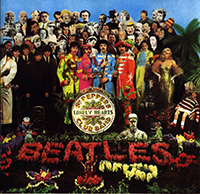
With Revolver the Beatles were openly flouting the pop music rule book. They were sending an early notice that they wouldn’t be bound by convention. Sgt. Pepper’s Lonely Hearts Club Band ripped up the rule book, burned it, buried it, and sowed the earth with salt. It’s really not too big a statement to say that Sgt. Pepper redefined the musical landscape almost completely…for good and for bad. The significance of the album’s release in the rock music firmament can not be overstated.
But Sgt. Pepper didn’t come entirely out of the blue. In February of 1967 the Beatles released a double A-sided single of “Strawberry Fields Forever” and “Penny Lane”. These songs were such a radical departure for the band that they might as well have been recorded on Mars. Swirling Mellotrons, horns, strings, seemingly cryptic lyrics (which aren’t that cryptic if you know the back story)…this single was as great a departure from Revolver as that album had been from Help! Musically, lyrically, and stylistically, it was a huge leap forward (or backwards, I suppose, if you liked your Beatles as four lovable Mop Tops).
That single had originally been recorded for inclusion on the project that would become Sgt. Pepper. It was released early under pressure from the record label who had not released a new Beatles track in months. It seems odd to think about now, when bands routinely take years between releases, but in 1967 if a band didn’t release a new single every few months they were considered washed up. Rumors were circulating that the Beatles, holed up in EMI Studios, were out of ideas and probably going to break up. They’d quit touring in 1966, which is something bands never considered doing until that time, to focus on recording. But the recording process for the new album was taking months, an almost unprecedented amount of time in the history of rock music. Reporters routinely staked out the studio, ready to ask the Beatles “Are you finished?” whenever the band arrived at EMI’s door. The band even looked different. All four had grown moustaches.
The Beatles were not out of ideas. Sgt. Pepper was part of an extraordinarily creative period for the band and was, in many ways, the apex of that creativity.
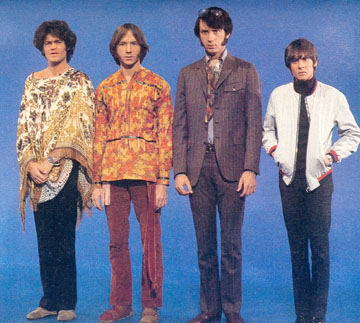
When the album was released in June of 1967 it became the soundtrack for what was called the “Summer of Love”. It was as if an earthquake had shaken the musical world to its core. It was the first Beatles album that Capitol Records released without removing tracks and substituting others. The Beach Boys’ Brian Wilson, crafting Smile, his band’s response to Revolver, heard Sgt. Pepper and had a nervous breakdown. Paul Kantner has talked about how you could hear Sgt. Pepper blasting out of every window at Haight-Ashbury. Even the Monkees paid tribute: in one of the musical sequences on the show, when the band is seen running around in an Old West town, Davy Jones has a copy of Sgt. Pepper tucked under his arm.
The album dominated the charts for the entire summer and sent other bands reeling. The Rolling Stones responded with Their Satanic Majesties Request, a drugged out, bleary copy of Pepper. Less well-known, Arthur Lee’s Love responded with Forever Changes, an album that nearly matches Pepper on every level and surpasses it on some. The Doors heard an early acetate of the album before its release and were similarly floored by the notion that they could do anything they wanted in the studio. Frank Zappa brilliantly parodied the cover on his We’re Only It It For The Money. Jimi Hendrix opened his show by playing the title track, only 48 hours after the album was released. The rule book was gone and every band in the land suddenly realized they could go wherever their talents and muses would take them. This created the unfortunate idea in every songwriter that they needed to release “their Sgt. Pepper“. But these other bands were not the Beatles, and the result was usually an awful, overindulged, mess.
So much has been said of the album that it’s almost easy to overlook the music. The first album to have the lyrics printed on the back sleeve; the first to have a design on the inner record sleeve; the first to come with a sheet of cutouts; one of the first single album gatefold releases (maybe the first); the first to have a “legitimate”, well-known artist, Peter Blake, design the cover. The splashy, colorful cover that seems to be a graveside service, features wax figures of the “old” Mop Tops standing next to the latest incarnation of the band, who are dressed in brightly colored pseudo-military uniforms. Behind them, arranged in a crowd of life-size cutouts, are the band’s personal choices for heroes and influences. Tucked away on one side is Stuart Sutcliffe. Right up front is a doll wearing a shirt that says “Welcome The Rolling Stones Good Guys”. (The Stones repaid the compliment by hiding the Beatles’s heads in the 3-D cover of Majesties.) The album title is spelled out on a bass drum, and the name “Beatles” appears as a floral arrangement…right in front of a row of marijuana plants.
So yes, it’s easy to forget that this is an album of songs. And as an album of songs, Sgt. Pepper is not the greatest rock record ever released. It’s extraordinarily good; great even. But the songs are so decked out in their psychedelic finery that it’s easy to miss the fact that they’re not the band’s best songs. It was certainly thought so at the time, but Sgt. Pepper succeeds mainly because of its innovation, its playfulness, its experimentation, and its ruthless rule-breaking. As recordings, this is the best the Beatles, or any other band, got. As songs, on the other hand…a case could easily be made that Pepper doesn’t compare with Rubber Soul, Revolver, the best of the White Album, or even Abbey Road.
Paul McCartney’s concept for the album was that the band could pretend to be another band. That way they could do whatever they wanted without being hemmed in by whatever was expected of the Beatles. This “concept” lasted all of two songs. The opening, eponymous, track and the introduction of “Billy Shears” to sing “With A Little Help From My Friends”. But Billy Shears sounded a lot like Ringo Starr, and the idea of the Beatles pretending to be Sgt. Pepper’s Lonely Hearts Club Band quickly fell apart, only to be briefly revived on side two with a reprise of the title track.
So what of the music? The title track, clocking in a barely two minutes, is a brief introduction to the concept. It’s not so much a song as it is a fanfare, but it does have a great vocal from McCartney and some searing guitar work on both the stinging lead and the thick, heavy rhythm riffs. It ends with applause and the introduction of “the one and only Billy Shears” before blending into “Friends”. The song is Ringo’s finest performance on a Beatles album. He gives the lyric a warmth and bonhomie the elevates the entire recording. Sung by Lennon or McCartney, “With A Little Help From My Friends” wouldn’t work as well. (Sung by Joe Cocker, it worked even better.) For the first time, Ringo was given a song to sing that was neither throwaway (“I Wanna Be Your Man”) or novelty (“Yellow Submarine”). “A Little Help” is one of the crown jewels of Pepper.
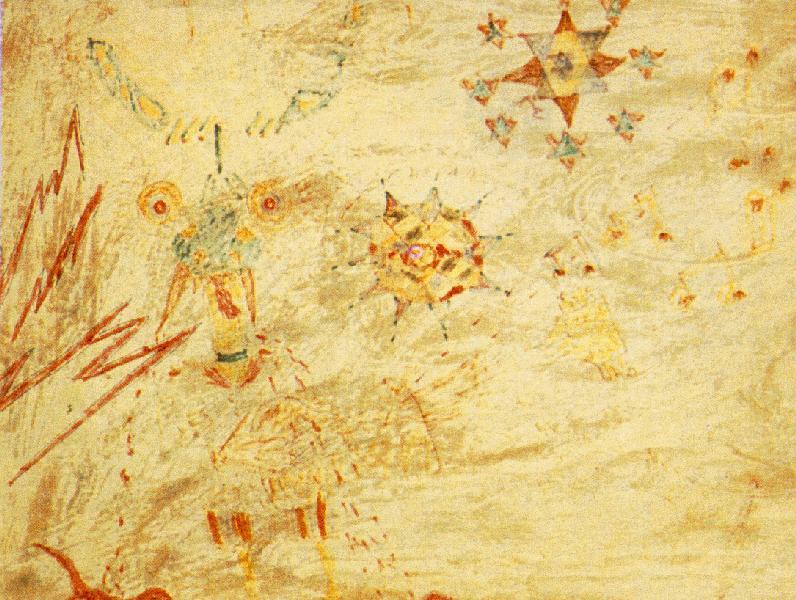
The next track, “Lucy In The Sky With Diamonds” is even better, and the album is off to a roaring start. John’s acid-drenched lyrics and nasal vocal provide the musical equivalent of an LSD trip. John would, of course, deny that “Lucy” “Sky” and “Diamonds” were intended as code for LSD. The claim was that it was based on a drawing his son Julian had done of his classmate, Lucy, flying through the air with diamonds drawn as stars. When John asked his son what the picture was called, Julian told him that it was “Lucy, in the sky, with diamonds”. It’s possible. I’ve seen pictures of the drawing. But Julian was only three years old when John wrote the song, and it’s entirely possible that the title was grafted onto a drawing made at a later date (the drawing itself seems more the work of a precocious five-year-old than a three-year-old).

Could you draw this when you were three?
Lennon stuck with the story of the song’s origin until his dying day, long past the point when anybody cared if he was winking at the audience with the title. And regardless of the title’s beginnings, the lyrics themselves were unmistakably about acid. Lennon later said that at this point in time he was taking LSD “like candy”. George and Ringo were also enthusiastic takers and McCartney was starting to dabble in the drug, though his drug of choice was always pot. “Newspaper taxis”, “tangerine trees and marmalade skies”, “rocking horse people” eating “marshmallow pies”…it’s all a trip in a psychedelic wonderland, led by your tour guide John Winston Lennon. McCartney’s bass is amazing throughout and Ringo’s pounding that leads into the chorus tether Lennon to the earth even as his phased and echoed vocal takes him higher and higher.
Pepper is McCartney’s album. The concept was his idea, and it was his work ethic that kept John focused. But after Lennon’s journey into Acidland, McCartney responds with three straight songs that are fairly conventional. “Getting Better” is a good song that is saved from its faceless optimism by John’s sarcastic “it can’t get no worse” backing vocal and George’s tamboura in the last verse. “Fixing A Hole” is better, but similarly faceless. Like many of the songs on this album, if it had not been on Sgt. Pepper it would likely be considered a second-tier Beatles song.
“She’s Leaving Home” is the third McCartney song in a row (Lennon helped in the writing). His output at this point was outpacing John, who was consumed with consuming drugs and was besotted by a Japanese avant-garde artist he’d met in late 1966. “Home” is a magnificent track, with a sensitive but not cloying string section orchestrated by Mike Leander. It’s a story song, telling a tale that was all too common in 1967. Tom Wolfe told the same story in his book The Electric Kool-Aid Acid Test in what became known as “the Beautiful People letter”:
“Dear Mother,
I meant to write to you before this and I hope you haven’t been worried. I am in [San Francisco, Los Angeles, New York, Arizona, a Hopi Indian Reservation!!! New York, Ajijic, San miguel de Allende, mazatlan, Mexico!!!!] and it is really beautiful here. It is a beautiful scene. We’ve been here a week. I won’t bore you with the whole thing, how it happened, but I really tried, because I know you wanted me to, but it just didn’t work out with [school, college, my job, me and Danny] and so I have come here and it is a really beautiful scene. I don’t want you to worry about me. I have met some BEAUTIFUL PEOPLE and …”
But even on “She’s Leaving Home” it is the production and the performance that sells the song. McCartney’s lyrics are sentimental without being precious and the string section fits the mood perfectly. But the hidden star of the song is John Lennon. Lennon and McCartney are the only two Beatles on the track, and neither plays an instrument, but Lennon’s vocal steals the show. In the tale of a runaway girl, John plays the role of the parents, underpinning McCartney’s high chorus vocal. “What did we do that was wrong? We didn’t know it was wrong,” John sings in the same nasal tone he used on “Tomorrow Never Knows” and “Lucy In The Sky With Diamonds”. The vocal slices through McCartney’s lead and adds a perfect amount of pathos to the song. The dueling lead vocals of Lennon and McCartney on the chorus are a primer on how to sing a counter-melody.
Lennon’s “Being For The Benefit of Mr. Kite” closes the first side of the album. The lyrics were taken, almost verbatim, from an old-time circus poster John had hanging in his home. In the context of Pepper the song was assumed to be psychedelic, along the lines of “Lucy”. In fact, it was banned by the BBC who mistakenly believed “Henry the Horse” was a heroin reference. It’s not that, however. Hogsheads of fire, hoops, garters, somersets, the Hendersons, Mr. Kite…they’re all there in the poster. There’s an atmosphere that matches the lyric perfectly; steam organs, calliope sounds, tape loops, and various harmonicas fill out the piano/bass/drums musical accompaniment (there are no guitars on the track). After many failed attempts to achieve the desired results through conventional recording, the carnival sequence in the break was achieved by cutting the tapes into small sections, throwing them in the air, and then putting them back together in random order (some backwards). It worked beautifully, with the carnival sounding out of control. The effect was of being on the fairway with your senses radically altered. Nearly the whole of the album was an aural manifestation of disordered senses.
The second side of the album begins with George Harrison’s “Within You, Without You”. In the context of the kaleidoscopic Pepper, it works. Out of context, the song is an Indian drone with ponderous lyrics. It’s George’s longest Indian-style song, and far less effective than Revolver‘s “Love You To” or the Indian/psychedelic mashups “Blue Jay Way” and “Only A Northern Song”. As the song ends, there is a break of laughter. It shows good sense on the band’s part that they would follow the track with a laugh to lighten the oh-so-serious tone of the song. George’s heavy-handed mysticism is followed by one of McCartney’s lightest tracks. “When I’m Sixty-Four” is a staple at weddings now, but was written when McCartney was just fifteen years old. It displays both his overly sentimental side and his love for English music hall. What saves the song from being treacle is that descending line “You’ll be older, too” followed by Lennon’s wordless backing vocal that adds just a bit of edge to the song. Lennon and Harrison’s backing vocal of “We shall scrimp and save”, modulating the last vowel are the perfect complement to Paul McCharmley’s happy vocal. The backing adds just the right touch, reminding the listener that “scrimping and saving” isn’t necessarily easy or fun.
Fortunately, the song is followed by “Lovely Rita”, Paul’s ode to hooking up with a meter maid. The piano-driven track is an old-style rocker, but even here the Beatles were playing with the recording. The piano purposely slips in and out of tune, John’s backing vocals are once again very prominent, and the song ends with a not-very-subtle simulated orgasm, the music and a breathy, wordless, moaning vocal rising and getting more intense until the piano suddenly drops off and John is heard saying “Believe it.”
“Good Morning Good Morning” continues the rebound on side two. It’s a heavy rocker with a punchy brass section, scorched earth guitar fills by McCartney, and lyrics inspired by a commercial for corn flakes. The lyrics would have fit in perfectly with the original concept for Pepper’s songs. The original idea, represented by the “Strawberry Fields”/”Penny Lane” single, was that the songs be a nostalgic look at their childhoods in Liverpool. “Good Morning Good Morning” plays on that theme with its tale of a man’s day, not wanting to get up and go to work, taking a walk by his old school, heading home to watch television (“Meet the Wife” was a British TV show). Lennon captures the frustration of everyday living with typical Lennon bile in the lines “Everybody knows there’s nothing doing/Everything is closed it’s like a ruin/Everyone you see is half asleep/And you’re on your own you’re in the street”. Only when the sun starts to set does the song’s protagonist start to come alive, flirting with the girls and acknowledging the people around him as “full of life”. In many ways, it’s the sequel to Revolver‘s “I’m Only Sleeping”, taking that song’s character and seeing how the rest of his day plays out. It’s a straightforward track, but still has some of the Pepper artifice. Aside from the horns and multiple time signatures there’s the ending, where a series of animal noises are heard, each sound representing an animal that could kill or frighten the animal before it.
On the stereo version of the album, the last of the animal sounds is a two-note guitar lick that mimics a clucking chicken. In reality, that was added in later to cover a terribly bad edit between “Good Morning Good Morning” and the following song, a reprise of the title track. The original, bad edit is heard in the mono version of the album, and is a clear example where the stereo mix being better than the mono. Both the mono and stereo mixes have their selling points and despite Lennon’s insistence that mono was the best way to hear the album, the stereo mix is far superior to that of any pre-Pepper Beatles album. The “Sgt. Pepper” reprise is brief, a reminder that there was once a concept behind the album. Its inclusion still leads people to believe that Pepper has a unified theme. Like the title track, it’s a fine rave up, but there’s really nothing much to be said about it. It’s main purpose is to serve as the gateway to “A Day In The Life”.
The last track on Sgt. Pepper is also the best. It is, to my ears, the best song the Beatles ever did, and arguably the best song of the rock era. With a finale like this, it’s easy to forgive the superficiality of any of the preceding tracks. It is this song that sticks with the listener more than any of the others, and elevates Pepper to the top of critical lists. “A Day In The Life” is essential listening. For this song alone, Sgt. Pepper is a necessary addition to the collection of any serious fan of rock music.
Here the Beatles transcend rock music. The song has all the conventions of rock, but the recording is something else entirely. The verses are simple: a lightly strummed acoustic guitar, a stately, near classical piano, and Ringo Starr’s brilliant drum fills. Anyone who says that Ringo is not a world-class drummer needs to listen to this, and then forever shut up about it. Floating over it all is Lennon’s voice. In the first two verses he tells the story of the car crash that killed the Guinness heir Tara Browne, in the third he pays tribute to the movie How I Won The War, in which he had taken a supporting role in 1966. But it’s at the end of the third verse that the song takes off. As Lennon sings a line written by McCartney, “I’d love to turn you on”, the music swells underneath, an orchestral rush that rises and rises until it seems like it will explode out of the speakers. The orchestra, recorded with the musicians wearing fake noses and various costume parts to get them in the right frame of mind, had been instructed that they had 24 bars to go from the lowest note on their instruments to the highest, and how they did it was up to them. The sensation one gets listening to it is the same as taking off in an airplane. There’s a rush and a feeling of inexorable rising…until the 24th bar when the orchestral orgasm abruptly ends with the sound of an alarm clock and McCartney’s voice taking over the lead from Lennon. This section by McCartney was part of a song he’d been writing for the “childhood” concept of the album. It recounts his days riding on the top of the bus, smoking cigarettes, and daydreaming. In the context of the song, though, it is from the perspective of an adult, probably running late for work. Still, the lines “found my way upstairs and had a smoke/Somebody spoke and I went into a dream” was enough to get the song banned by the BBC for referring to drugs.
It’s hard to argue that those lines are not about drugs. At the moment McCartney finishes the word “dream” the music again shifts from the rock piano to a brass section that sounds impossibly deep. The brass builds from the bottom, becoming more prominent before ending in a five-note flourish that transitions back into the music of the first three verses. Overriding the brass is Lennon’s wordless wail, providing another melody on top. His voice on that elongated “Ahhhhhh” modulates and turns, drifting from speaker to speaker, before fading. And just like that we’re back to softly strummed acoustic, stately piano, and Ringo’s ever-changing fills. The last verse is nothing more than a poetic retelling of a news story about the number of potholes in the road (“four thousand holes in Blackburn, Lancashire”). But as Lennon ends the verse he circles back to that infamous line “I’d love to turn you on” and the orchestral rush begins again. This time the surge ends not with an alarm clock, but with what is probably the most famous chord in the history of 20th century music. It’s a simple E Major chord, played simultaneously on three different pianos by Lennon, McCartney, Starr, and roadie Mal Evans and on a harmonium by George Martin. As the sound of the chord started to dissipate the engineers in the studio turned up the recording levels until they were capturing not only the resonance of the chord but the ambient studio sounds. like the squeaking of a chair. The result is a massively rich chord that sustains for over 40 seconds before finally disappearing. Buried in the fade is a dog whistle, undetectable to human ears (and probably undetectable to recording devices, so who knows if it’s really on there or not).
Sgt. Pepper’s Lonely Hearts Club Band ends with a snippet of studio dialogue and noise, sped up, backwards, and on an endless loop for record players that do not have an automatic return on the stylus. It’s the last touch on the album, a hidden nonsense track less than 5 seconds long that continued playing on a loop until the listener lifted the needle off the groove.
Sgt. Pepper changed the musical world. It opened the doors for musicians to be more creative and take more chances. It also led to the mistaken belief that brass and strings were enough to turn a pop song into an artistic statement. We still listen to music in the world that Pepper created but the fact is that, with some exceptions, the songs on the album simply aren’t as good as the ones on Revolver, or even Rubber Soul. Sgt. Pepper’s Lonely Hearts Club Band is the most important rock album ever released, and my grade reflects that. But is it The Greatest Album Ever Made as so many claim? No. It’s not even the best Beatles album.
Grade: A+

 shabby-road.com