The Beatles: Help!

Of all the Beatles’s classic albums, it is probably Help! that gets the short end of the stick. This is due to a couple of different factors: 1) it was quickly overshadowed by Rubber Soul, 2) the movie was not as good as A Hard Day’s Night, 3) the American version of the album was cluttered with movie theme music and left off many of the best songs.

It wasn’t until the CD era, in 1987, when Help! was released in America the way the Beatles intended, and the result is a revelation. Help! is the first full-throated embrace of Bob Dylan and, to a lesser extent, the Byrds. This is the clear warm up to Rubber Soul. It bids a final goodbye to the happy little rockers the Beatles had been and definitively steps towards what the Beatles would become.


U.S. EditionU.K. Edition
1. James Bond Theme (Instrumental)
2. Help!
3. The Night Before
4. From Me To You Fantasy (Instrumental)
5. You’ve Got To Hide Your Love Away
6. I Need You
7. In The Tyrol (Instrumental)
8. Another Girl
9. Another Hard Day’s Night (Instrumental)
10. Ticket To Ride
11. The Bitter End/You Can’t Do That (Instrumental)
12. You’re Going To Lose That Girl
13. The Chase (Instrumental)
1. Help!
2. The Night Before
3. You’ve Got To Hide Your Love Away
4. I Need You
5. Another Girl
6. You’re Going To Lose That Girl
7. Ticket To Ride
8. Act Naturally*
9. It’s Only Love**
10. You Like Me Too Much***
11. Tell Me What You See***
12. I’ve Just Seen A Face**
13. Yesterday*
14. Dizzy Miss Lizzy***
*Released in America on the LP Yesterday…And Today
**Released in America on the LP Rubber Soul
***Released in America on the LP Beatles VI

I will confess a weakness for one aspect of the US edition over the UK edition. I grew up listening to the brief snippet of the James Bond theme leading into “Help!” and that part of the listening experience is hardwired into my DNA. Otherwise, there’s simply no contest here and it is clear why Help! wasn’t recognized in America as being the great album it is.

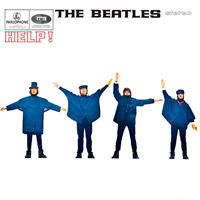
Incidentally, the two versions of the album had remarkably different packaging. The UK edition was packaged as an album, the US edition as a soundtrack complete with lots of photos from the movie and no small amount of marketing hype about the film. Also, the order in which the Beatles are standing on the front cover is different for some bizarre reason.

The first seven songs are the new Beatles songs from the film, and are as good or better than almost anything the Beatles had done to this point. The title track, written as a ballad by John Lennon, is given an air of desperation by the sped up arrangement. Deceptively toe-tapping good-time music underpins a lyric that is every bit as harrowing as any of Lennon’s later primal scream epics on John Lennon/Plastic Ono Band. Trapped by the confines of Beatlemania, Lennon turned his pen inward and wrote a lyric dripping with pathos. Lennon had done this before with songs like “I’m A Loser” from Beatles For Sale, but he had blurred his tortured emotions in the guise of a love song. With “Help!” it was all out in the open, a cry in the wilderness of Beatlemania.

It’s easy to forget that Lennon was only 24 years old at this time and one of the four most famous people in the world, and the demands of band mates and fans must have been nearly unbearable for the fiercely independent songwriter. “Help!” is the first of John’s truly mature songs and one of the finest arrangements the Beatles had produced. Listen to the backing vocals, actually preceding the lead vocal, and the way they are sung. Lennon sings the lead quickly, full of vigor. The lead vocal does not sound like a man on the edge of a nervous breakdown. But the backing vocals are sung more slowly, in fragments of lyrics. It’s almost as if the backing vocals represent the sadness and insecurity Lennon felt, while the lead vocals are the full howl of pain that finally burst forth. I don’t know how much of this is intentional, but listening to the vocals on “Help!” is like being privy to both the private interior monologue and the desperate public cry of a man whose soul is roiling with emotional torment. The effect, especially when coupled with the ringing Byrds-like guitars, set a new standard for Beatle songs.

Anything after that opening is bound to be a let down in some ways. But it’s only in comparison to the title track that the other songs suffer. “The Night Before” and “Another Girl” are standard issue Paul McCartney songs: lyrics about love (lost and found, respectively), great melodies, etc. They become great Beatle tracks because of the arrangements. From Lennon’s organ to McCartney’s bass stepping gingerly throughout the song, the stinging lead guitar (also by Paul), and the call-and-response vocals, “The Night Before” is triumphant. Similarly, “Another Girl”, the happiest-sounding kiss off to a girl ever recorded, is nothing really special until the absolutely irresistable hook rises out of the chorus.

George’s contribution to the soundtrack portion of the album is his best song thus far. “I Need You” (by George Harrison—that’s a joke fans of the film will get) rides a simple two chord guitar riff manipulated by a volume pedal and the best use of a cowbell prior to “(Don’t Fear) The Reaper”. Lyrically it’s nothing special, but it’s the first time George was able to craft a melody that could stand along those produced by Lennon and McCartney. For the first time, a George-penned track didn’t sound like a throwaway or an afterthought. It sounded like the work of a rapidly maturing songwriter.

The rest of the film songs belong to Lennon. They’re not as nakedly emotional as the title track (though the gorgeous “You’ve Got To Hide Your Love Away” comes very, very close), but the words mostly reflect Lennon’s state of mind during this time, what he called his “fat Elvis” period.

“You’re Going To Lose That Girl”, with Ringo’s stunning bongo work, is the darker flip side of “She Loves You.” While the earlier track and its ebullient “Yeah yeah yeah” hook are a reassurance of a woman’s love, “You’re Going To Lose That Girl” warns that if the loved one does not act quickly, the lover will be stolen…by the same guy who was shouting “Yeah yeah yeah”, no less. The “yeah yeahs” are here replaced by a more sinister-sounding “Yes yes.” The one instance where the word “Yeah” pops up is as a snarl after the line “I’ll make a point of taking her away from you.” It’s a deceptively dark song that, like “Help!” is married to a joyful racket.

The title of “You’ve Got To Hide Your Love Away” could refer to the fact that Lennon was under strict orders to keep his marriage to Cynthia a secret, lest it should break the hearts of teen girls across the globe, but the lyric is a very straightforward lament for lost love. What matters here, is the spare acoustic instrumentation and the “feeling two-foot small” lyric. Although the lyric was just a flubbed line, Lennon left it in because he preferred it to the actual “two feet tall”. Both the instrumentation and the surrealism of that lyric (and the “gather round all you clowns” line) are direct imitations of Bob Dylan. The Beatle music in this song comes at the end, in the form of a flute solo played by British composer John Scott. Again, it shows the Beatles thinking outside of the traditional rock box.

Throughout the album, Dylan’s influence is very strong. This is the most acoustic album the Beatles had done. Acoustic guitars are prominent in the rhythm tracks, even as Dylan (influenced by the Beatles) was plugging in for the first time. As such, this is also the most different Beatles album yet. Dylan’s influence had reared its head earlier on songs like “I’m A Loser”, but there the Beatles appeared to be copying the Bard of Greenwich Village. Here, for the first time, it sounds like the Beatles have fully absorbed the sound and run it through the filter of their own budding genius.

“Ticket To Ride”, described (incorrectly) by Lennon as “the first heavy metal record”, is the last of the film songs. The chiming guitar riff does sound like the Who as played by the Byrds, and Ringo plays the hell out of the drums. (You think Ringo’s not a great drummer? You’re an idiot. Shut up and listen to this.) Paul’s bass is straightforwardly simple, probably because this was the first song where Paul handled not just a solo but lead guitar, leaving George and John to handle the rhythm. Heavy metal it isn’t, but it’s one of the heaviest songs the Beatles ever did.

The non-film songs that make up side two of the record are a little more problematic. “Act Naturally”, a country hit for Buck Owens, was given to Ringo to sing as a nod to his surprisingly good performance in the Hard Day’s Night movie. As with most of the songs given to Ringo, it’s fun and fairly lightweight. As four young men from Liverpool, the Beatles were far from country music. They play the notes well enough, but it never sounds like anything more than a lark.

Lennon’s “It’s Only Love” returns to acoustic rhythms with a loose lead. The lyrics are nothing special, but the vocal sells it, especially John’s falsetto swoop at the end. This song ended up as the first song on side two of the American version of Rubber Soul, and it fit better on that album. Here, sandwiched between the faux country of “Act Naturally” and the unremarkable George-penned “You Like Me Too Much”, the song sounds out-of-place.

The same fate falls on Paul’s considerably better “I’ve Just Seen A Face”. The propulsive, yet folky, song was the first song on the American Rubber Soul and set the tone for that album. Here, in its original (and, I suppose, proper) place, it’s between the nothingburger “Tell Me What You See” and the masterpiece “Yesterday.” The placement of this song on Help! makes one of McCartney’s best songs lose the impact it had on American audiences when it kicked open the door to Rubber Soul.

Tribute must be paid to “Yesterday.” Thousands of cover versions (it’s one of the most widely recorded songs in history, with versions by everyone from Sinatra to Liberace) may have dimmed its light, and the George Martin-arranged string quartet is a little mawkish, but that’s hindsight. At the time, “Yesterday” was a radical departure for the Beatles (Paul is the only Beatle on the record, which is why they did not approve it as a single, though Capitol Records overruled them in America and released it). As Lennon was starting to break out of the confines of Beatle music lyrically, McCartney was now doing so musically. It was a Beatles record because they said it was a Beatles record. It was a rock song because they said it was a rock song. In truth, it was neither. It was a Paul McCartney solo effort, and musically it harkened back to the standards that Sinatra used to sing, and that the Beatles grew up hearing. It’s far closer to “Til There Was You” than “Ticket To Ride.”

Still, it’s brilliant. It’s a new standard in 1965, and recognized as such immediately. There was no need for “Yesterday” to stand up to the rigors of time. It was clear the first moment the needle hit the groove that McCartney was writing for the ages on this one. People who loved rock and roll accepted it as a great ballad. People who hated rock and roll fully embraced it. The kids loved it and so did Mom and Dad, ensuring that the Beatles could appeal across generational boundaries. More than any one song, “Yesterday” buried the image of the Beatles as the Mop Tops. This was a serious song, with a serious arrangement. To really appreciate the greatness of the song, the version on Anthology 2, before the string section had been added, makes the song sound fresh again. This version presents the song as McCartney wrote it, with just his guitar and vocals. For this listener, this alternate take is the best version of the song.

“Yesterday” was so masterful and so different that including a souped-up cover of “Dizzy Miss Lizzy” sounds wildly out-of-place. It’s a great version—probably the definitive version of this song—but it’s obviously a place-filler for a band that needed to release an album but didn’t have quite enough songs ready to go. Following all the acoustic introspection that preceded it, the effect of the slashing guitars and wailing vocal from John is, to say the least, jarring. It’s a great performance. It also is what it is: a by-the-numbers cover of a song by a writer who, at his best, was nowhere near the level of Lennon and McCartney. Help! deserved a better ending than a song that would have sounded redundant on With The Beatles.

Help! pointed in the direction the Beatles were going. The best was still ahead.

Grade: A

The Listening Post: May 2012

A remarkably good month for listening.

  • BlunderbussJack White. It’s as simple as this: Jack White’s first solo album is so good we should all buy him a gift this Christmas. The leadoff single, “Love Interruption”, was so uncharacteristic of White’s career that questions were immediately raised about what the sound of a White solo album would be. Despite that he was the guiding power of the White Stripes, that was clearly a sound that contained him. It was a punk version of blues, and Meg White’s primitive drumming was as much a part of the sound as White’s guitar. The Raconteurs, with their neo-classic rock leanings, allowed White to embrace the pure rock/pop side of his career. The Dead Weather were different yet again: industrial, Goth, techno blues rock. Will the real Jack White please stand up? On Blunderbuss, he does, and the result is the best album I’ve heard since 2008’s Consolers Of The Lonely, or maybe even 2003’s landmark Elephant…both of which featured two different sides of Jack White. As rock performers go in the 21st century, there’s Jack White and everybody else. Nowhere is this more clear than on Blunderbuss, which is White’s Revolver. That’s a comparison I don’t make lightly and it deserves some explanation. Like Revolver, Blunderbuss touches on many styles: the Stripes-ish guitar skronk of “Sixteen Saltines”, the acoustic loveliness that underpins the devastating lyrics of “Love Interruption”, the melancholy dirge of “On And On And On”, souped up R&B in the Little Willie John cover “I’m Shakin'” (which also gives a quick glimpse into White’s humor as he squeals “I’m noy-vous!”), the swirling country-tilted lullaby of the title track, the multi-layered, multi-faceted gem of “Take Me With You When You Go.” Yet also like Revolver, the album holds together as the coherent vision of a singular artist.

    Much is made of the lyrical content of the album, with comparisons to Bob Dylan’s Blood On The Tracks. White divorced singer and model Karen Elson last year, and the lyrics on Blunderbuss could easily be seen as emanating from the broken-hearted aftermath of a marriage gone wrong. That may be too simple. If true, then Karen Elson gets the Good Sportmanship of the Year award for singing backup on the album. Whatever her singing talents are, it is simply impossible to imagine Sara Dylan singing backup vocals on “Idiot Wind”. Of course, breakups happen in other ways, too, and the other relationship of White’s that ended last year is the White Stripes. In some ways, it’s easier to see Blunderbuss as an embittered reaction to the ending of that relationship: “you betray your dead brother with another hypocritical kiss,” “black hat, white shoes, and I’m red all over”, “and you’ll be watching me, girl/taking over the world/let the stripes unfurl” all could tie back to the myths and image of the White Stripes. At the end of the day, though, it’s not that important. What is important is that the words are good, and the music is restlessly inventive and creative. For a Jack White record, what is possibly the strangest thing is that the main instrument is Brooke Waggoner’s gorgeously cascading, tinkling piano runs. Waggoner eschews the traditional rock piano sound of banging chords or Jerry Lee Lewis-style freneticism in favor of elegant runs. Also of note is drummer Carla Azar who plays everything with a wild, shuffling sound. Even on the heavier, rockier songs Azar provides a groove that simply will not quit. Her drumming is astounding throughout as she, as Waggoner does on piano, avoids rock music drumming clichés. Where almost any drummer would pound, Azar glides effortlessly. Waggoner and Azar, as much as White, make the sound of the album, and their refusal to play in the way a million rock pianists and drummers before them have played, makes Blunderbuss prime material for multiple listens. It’s difficult to imagine a better album than this coming out this year, or maybe this decade. Blunderbuss towers over its competition. The rich, subtle, and powerful instrumentation, the timeless lyrical concerns, the stubborn refusal to sound like any other rock album within earshot make this one a modern classic that will most likely stand the test of time. You know…like Revolver.
    Grade: A+
  • What Kind Of WorldBrendan Benson. Sometimes it’s difficult not to feel bad for Brendan Benson. His solo career has never risen past the small cult status, and the band in which he’s an equal partner (the mighty Raconteurs) is routinely referred to as a “Jack White side project” as if Benson didn’t write and sing half the songs. Now he’s released one of his best albums and it comes out the same day as…well, there’s that Jack White fella again, hogging the spotlight. But Benson has no reason to hang his head. What Kind Of World is an excellent album. As is typical of Benson albums, there are a couple of songs could have been better. “Keep Me” is a good little ditty that never rises past faint praise. “Bad For Me” swings perilously close to late 70s MOR and isn’t helped by a lackluster vocal and occasionally clumsy lyrics (“she sucks my soul”? Really?). But as downers go, both of these songs are pretty darn good. They’re just not up to the standard of the rest of the album, where Benson lets his hard-charging power pop flag fly. The album has more hooks than a tackle box, and Benson’s great achievement is remembering that “power pop” is supposed to have “power”. So in between the hooks are plenty of charging guitars, slinky bass grooves, and raucous vocals. Benson’s tunes are as catchy as the Spanish flu, but he never fails to remind you that he’s a rocker to the core. What keeps the album interesting are the brief detours like the country-flavored album closer “On The Fence” or the synth textures on the twisted tone poem “Pretty Baby”. Elsewhere, songs like “Here In The Deadlights”, “Met Your Match”, and “Come On” are more than ample evidence that Benson is a performer to be reckoned with and it is his sound and vision that the “Jack White side project” most closely emulates.
    Grade: A
  • Medium RareFoo Fighters. This is a largely unknown collection from Dave Grohl and company. It was released as a vinyl album in 2011 to celebrate Record Store Day, and it was a CD for subscribers to Britain’s Q magazine. This is a collection of cover songs that, with three exceptions, have all been released as single B-sides, soundtrack songs, and random non-Foo compilations. It shows the depth of the influences that run through the Foo Fighters. Kurt Cobain, despite his admitted Beatle fixation, would probably be appalled at Grohl’s choices here, but then Kurt sadly never took the opportunity to mature out of his indie/punk credibility issues. Grohl, however, has always been less shy about acknowledging his debt to rockers of the past. On Medium Rare he tips his hat to classic rock (Paul McCartney’s “Band On The Run”, Thin Lizzy’s “Bad Reputation”, Cream’s “I Feel Free”, Gerry Rafferty’s “Baker Street”, a beautiful acoustic version of the Zombies’s deep cut “This Will Be Our Year”, and Pink Floyd’s “Have A Cigar”), 80s New Wave (Gary Numan’s “Down In The Park”), early MTV (Joe Walsh’s “Life Of Illusion”), funk (Prince’s salacious “Darling Nikki”), old school punk (“Danny Says” from the Ramones), and both the melodic (Husker Du’s “Never Talking To You Again”) and blistering (“Gas Chamber” by the Bad Brains) sides of hardcore punk. There’s also a sloppy but reverent live version of Mose Allison’s “Young Man Blues” that the band did for VH1 Rock Honors The Who. Of the tracks, only “Darling Nikki” misfires. The band plays it well, trading in Prince’s funk for Foos rock, but Grohl’s vocal—especially his throat-shredding screams of “Nikki!!!”—don’t serve the R-rated humor of the lyrics. Otherwise, these are all excellent covers. Drummer Taylor Hawkins sings “I Feel Free”, “Life Of Illusion”, and “Have A Cigar” and it’s a shame that the Foos don’t use him to sing one or two tracks per album. Vocally he could be the Keef to Grohl’s Mick. There’s really nothing mind-blowing on Medium Rare, and yet this is one of the most consistently good albums in the band’s repertoire. There is nothing that will make you reach for the “skip” button, either. The best of these performances are, no surprise, the best songs. “Band On The Run” is heavier than McCartney’s original, but Grohl wisely allows the arrangement to remain unaltered, and while “Baker Street” misses that justifiably famous saxophone hook, the guitar that takes its place does no harm. The songs are great and well-chosen, the performances are rock solid. What’s not to like?
    Grade: A-

The Listening Post: April 2012

  • Electric DirtLevon Helm. No rock group did Americana music better than The Band. What makes this ironic is that they were all Canadian, with the exception of drummer Levon Helm. While Robbie Robertson wrote the majority of songs, the heart and soul of The Band was behind the drum kit. Aside from providing great drumming that was always sympathetic and never unnecessarily showy, Helm was one of The Band’s three great vocalists. His voice was never as pure and clean as Richard Manuel’s or Rick Danko’s, but it was an incredibly evocative instrument, full of grit, dirt, and Arkansas dust. When he was diagnosed with throat cancer, it was believed that he would never sing again and while it’s true that his voice is not as strong as it was in 1969, what’s striking on hearing this album is how good he does sound. Helm was 70 years old when he recorded Electric Dirt, and the album sounds like the dream release of a million Americana singers half his age. The songs on the album are built on the groove. This is music that sounds timeless, like one of the world’s best bar bands on their third set, a little drunk, maybe a little high, and playing their favorite songs, from Randy Newman’s swampy “Kingfish” to Muddy Waters’s “You Can’t Lose What You Ain’t Never Had”. There’s even a Grateful Dead cover (“Tennessee Jed”) that proves once again that the Dead were better writers than performers. But there is a disconnect on the album as well. If you were sitting in Levon’s barn, watching Helm perform these songs on one of his Midnight Rambles, you’d be in heaven. Hearing an album of it reminds you that some music works better live than on tape. This is a fine album that would have been a fantastic live set for a great band, played in a small venue, with lots of drinks and a buzzing crowd. Take away the venue, the drinks, and the excitement of a crowd, and there’s simply something indefinable missing. The best moments on the album, “Move Along Train”, “Kingfish”, “Can’t Lose”, and “When I Go Away” transport the listener. The rest of the album, while very good, is like watching a concert film. The music is there, but the atmosphere is missing something.
    Grade: B+
    Shortly after I wrote this, word arrived that Levon Helm was in “the final stages” of cancer. He kept on rocking right up until the end. Godspeed, Levon Helm.
  • Unearthed III: Redemption SongsJohnny Cash. The third disc of outtakes from Johnny Cash’s Rick Rubin-produced sessions is further proof that Cash’s best years were when he began and when he ended. Rubin had a great ear for picking material and sympathetic arrangements for Cash’s still powerful voice. Most of these songs are culled from the earlier years of their collaboration, when Cash’s voice was still a formidable weapon. The songs include covers of Bob Marley (a great duet with Joe Strummer on “Redemption Song”), Rodgers & Hammerstein’s “You’ll Never Walk Alone,” Stephen Foster, and Jimmy Webb. Only an early pass at “The Man Comes Around” came from Cash’s pen. It’s an excellent version, though it lacks the apocalyptic tenor of the version that appeared on American IV. Still, many of these songs are outtakes for a reason. “Singer of Songs,” “He Stopped Loving Her Today,” “Wichita Lineman” and “You’ll Never Walk Alone” never quite hit the target, and what might have been an excellent version of Cat Stevens’s “Father and Son” is not merely ruined, but absolutely destroyed by Fiona Apple, whose flat, emotionless harmony is only highlighted by how out of sync she is with Cash’s vocal. It almost sounds like she’s singing a different song, and the effect is to make this song almost unlistenable. More successful are the collaborations with Strummer, Nick Cave (on the traditional “Cindy”), and Glen Campbell (“Gentle On My Mind”). The best moments belong strictly to Cash and the man behind the scenes, Rick Rubin. Marty Robbins’s “Big Iron” is custom-made for Cash, “The L & N Don’t Stop Here Anymore” is another evocative train song from the man who once lamented the passing trains from Folsom Prison, and “You Are My Sunshine” gets a brief, heartbreaking reading.
    Grade: B
  • Sound AffectsThe Jam. The fifth album from The Jam is built around the devastating one-two punch of “Start!” and “That’s Entertainment” that crop up halfway through the album. Everything else both builds up to, and gradually descends from, that peak. Those tracks are so strong that, in some ways, they define the sound of the band: “Start!” is all angular bass riffing, choppy guitars, and Weller’s ability to craft a distinct pop melody over such un-pop instrumentation. “That’s Entertainment” is the flip of the band, the heavy acoustic guitar and Bruce Foxton’s pulsating bass underpinning Weller’s sharp eye for detail as he sings of life in 1980’s London. As always, the musical touchstone for the Jam is pre-Tommy Who and the Small Faces. It’s easy to forget that before the stadium-ready anthems the Who were once one of the greatest power pop bands, and it is this that the Jam emulates. “But I’m Different Now”, “Boy About Town”, and “Man In The Corner Shop” all hearken back to 1967 Pete Townshend and Steve Marriott/Ronnie Lane. There are a couple of misfires on Sound Affects. “Music For The Last Couple” spends a full third of its running time just starting, and the music isn’t all that interesting when it eventually does begin. Similarly, the closing “Scrape Away” is very dated, the sound locked into a 1980 time capsule. Most of Sound Affects is what the Jam does best: short, spiky songs with huge hooks, played with passion and intensity.
    Grade: B+
  • Tepid Peppermint Wonderland: A RetrospectiveThe Brian Jonestown Massacre. One of the rock music documentaries that I consider essential viewing is Dig! It traces, over seven years, the friendship and rivalry between the cult bands the Dandy Warhols and The Brian Jonestown Massacre. It’s a fascinating story, and the reason is Jonestown singer and songwriter Anton Newcombe. He’s talented and volatile, acting as champion for both his own band and for the Warhols before disintegrating into an increasingly erratic, angry, and unreliable performer as the Warhols achieve some mild success. At times, I wondered whether Newcombe was bi-polar. He is the champion for his band, and his band’s worst saboteur. What would make the story transcendent is if the Massacre was the greatest band you’ve never heard, but the fact is that they’re not. They have a great sound, but the sound doesn’t deviate all that much between tracks. The songs don’t rock hard, nor are they soft. This is edgy, shoegazing, groove music. It’s all atmosphere. Playing in the background of a party or club, this would fit the bill. Listening to a lengthy collection, like this two-disc compilation of their best songs, reveals the limitations. Too much of this sounds the same. The good news is that most of it sounds good. The bad news is that it’s simply too much of a reasonably good thing. There are a few songs that I would consider great: “It Girl”, “Vacuum Boots”, “Prozac Vs. Heroin”, “Nailing Honey To The Bee”, “That Girl Suicide”, “Hide And Seek”, “Mary Please”, “Talk-Action=Shit”, and their crowning glory (aimed directly at their friends and rivals) “Not If You Were The Last Dandy On Earth”. Most of the rest is of a consistently high quality, as befits a good “best of” collection. But the songs are best appreciated in short doses. Clocking in at over two hours, the songs start to blend into each other because they nearly all share that same sound. As a result, it’s a difficult album to rate. Basing it on each song, the album should probably rate a notch higher than the grade I’m giving it. With a couple of exceptions, like the dreadful “She’s Gone”, the songs are solidly in the B+ category. But as a listening experience, Tepid Peppermint Wonderland lives up to its title.
    Grade: B

Thanks, Levon

When I was about twelve years old I was in the living room of my parents’ house when I heard music coming from my sister’s bedroom upstairs. At the time my musical tastes ran the gamut from the Beatles to the Beatles. There were radio songs I liked, of course, and it’s possible that by this time I’d discovered my brother’s scratchy copy of Hot Rocks, the seminal greatest hits album by The Rolling Stones. But having no money of my own with which to buy records, and a general distaste for most of the newer songs that played on the radio (disco was starting to become big), my tastes were very limited.

Which is why I still remember how the music coming from my sister’s bedroom was like a punch to the solar plexus.

Virgil Caine is the name
And I served on the Danville train
‘Til Stoneman’s cavalry came
And tore up the tracks again
In the winter of ’65
We were hungry, just barely alive
By May the tenth, Richmond had fell
It’s a time I remember oh so well

I was absolutely floored. Knocked. Out. Then when the chorus kicked in I ran up the stairs. I had to know what this song was, who was singing it, and I had to know right that minute. It was a song I’d heard before on the radio, but it was years past its time on the Top 40 station I listened to and my memory of the song was a distant one. Hearing it that day I instantly recognized it, and it touched a chord deep inside of me.

My sister showed me the album cover, which struck me as very strange. Five wet, scraggly men standing on a muddy road, and on the back cover a photo that looked like it had been taken in 1876, with a lyric from “The Dark Town Strutter’s Ball.” And was that really the name of the group? The Band? Really? On the inside of the gatefold, more photographs that looked so out of time.

My sister dutifully played some of the songs for me, including “Rag Mama Rag” because I was taking piano lessons at the time and that song had fantastic piano playing in it. At the time, a lot of the album went over my head, but “Rag Mama Rag”, “The Night They Drove Old Dixie Down”, and “Up On Cripple Creek” reached into my soul. They’re still there, though by now they’ve been joined by the rest of that extraordinary album, unquestionably one of the greatest of the rock era.

I don’t think it’s a coincidence that the three songs that resonated so deeply with me were sung by Levon Helm. That raspy, gravelly, yet powerful, voice added so much weight to the songs he sung. This was a man who sang with authenticity. Not pretty, his voice was real. It was the voice of the South, of cotton fields and scorching heat, of the ghosts of rebels long forgotten. Richard Manuel sang like an angel, and Rick Danko sang like a fallen angel, but Helm was the voice of the soil, never even trying to hide that Arkansas twang. So strong was his presence that it is sometimes forgotten that he was the sole American in a rock band that virtually invented Americana. A Canadian wrote the Civil War song “The Night They Drove Old Dixie Down,” but he relied on the American in the band to bring the song to life, to invest in the words a dignity and pride in the enormous heritage of the Old South. It was a new voice for most rock listeners in 1969. It was not the yokel voices of the old-fashioned country singers, nor the voice of the slack-jawed redneck caricature in which so many non-Southerners believed. It was the voice of pride, not in slavery, but in sticking up for beliefs. It was the voice of defeat, and carried an unheard acknowledgment that defeat may have been necessary. It was stately and grand, overflowing with gravitas. It was the voice of Levon Helm, who gave the song a seriousness that neither Richard Manuel nor Rick Danko could approach. And the fact that this same voice could be turned to rip-roaring, rafter-swinging effect in joyful, bawdy, life-affirming songs like “Rag Mama Rag” and “Cripple Creek” only made Helm that much more valuable to both his band and rock music in general.

Recently I’ve been listening to Helm’s solo album Electric Dirt (review to follow in the April Listening Post). His voice on the 2009 album is not as strong as it once was, but considering that it was once believed he would never sing again after he was diagnosed with throat cancer in the late-90s, it is remarkable how good he sounds. The album itself is a fine one, full of the fire and vigor of a man half his age with none of his health problems. To see him do these songs in one of the Midnight Rambles he staged in his barn would have been amazing. I’ll always regret not going to one of the Rambles.

Levon Helm has died, joining his Band-mates and fellow singers Richard Manuel and Rick Danko. One of the greatest rock and roll singers of all time is silent now, but the music he left behind tells his tale.

Listen to it.

The Listening Post: March 2012

Spring comes early, bringing much in the way of change.

  • Born Under A Bad SignAlbert King. The first Stax LP by Albert King is really a compilation of his earlier singles. It’s also one of the great blues albums of all time. From the indisputable classics of “Born Under A Bad Sign” and “Crosscut Saw”, both perennials of bar bands everywhere, to lesser-known but equally compelling songs like “Personal Manager” and “As The Years Go Passing By” Born Under A Bad Sign is the sound of one of the great bluesmen at his peak. One listen and it’s immediately clear how much debt Eric Clapton owes to King. The debt is so deep that it would be easy to mistake almost any one of King’s tight, high wire leads for Clapton’s solos on the Disraeli Gears album. King is a deep, rich singer, and his stinging guitar work can be heard in almost all subsequent electric blues. When you combine this with the fact that his backing band on the album is Booker T & The MGs, one of the greatest, most sympathetic, bands in rock history, you’ve got a combination of blues and soul that can’t be beat. It is soul that is the secret ingredient here, replacing the grit and howls of traditional blues with a texture that makes these songs stand out in a crowd. Many of the songs here have been covered to death, but these are the versions that will last. Cream’s version of “Born Under A Bad Sign,” or Free’s version of “The Hunter” may be more well-known, but these are the timeless originals that will still be here long after the covers have faded.
    Grade: A+
  • Sloe GinJoe Bonamassa. Most blues performers are eager to flaunt their intimate knowledge of Robert Johnson, Muddy Waters, and Howlin’ Wolf. With good reason, I might add. Joe Bonamassa is something of an exception. He’s far more beholden to Cream, Free, and the British Blues Boom of the 1960s than he is to the founding fathers of blues. Bonamassa is a blues-rocker, the likes of which we really don’t see much anymore. As a performer, he’s considerably better than latecomers like the pedestrian Kenny Wayne Shepherd and the execrable Jonny Lang. However, he’s also not the 21st century’s Great White Hope for blues. Stevie Ray Vaughan, he’s not. What Bonamassa is, is a decent, if somewhat sterile, singer and virtuoso guitarist who is completely besotted with late-1960s blues rock. Sloe Gin suffers from the same malady that affects too many albums in the CD era—it’s too long. That problem can be solved by eliminating the eight plus minutes of the title track, a go-nowhere cover of a song once recorded by Tim Curry (!). Minus that particular time suck, Sloe Gin is a rock-ribbed exercise in simulated British blues, of a type not heard since the heyday of Rory Gallagher. In fact, if there’s a single guitarist whom Bonamassa most closely resembles, it’s Gallagher. Like the celebrated Irish guitarist, Bonamassa mixes his hard electric blues rock with acoustic guitar workouts. Perhaps somewhat ironically, it is these acoustic tracks the provide many of the highlights of this album. “Around The Bend” features magnificent finger-picking and a vocal that comes as close as anything he sings to true soulfulness. “Jelly Roll” is a fine, funky take of a song by John Martyn. “Richmond” is truly beautiful, mixing light acoustic picking with subtle accompaniment. “India” is an acoustic/electric raga that Michael Bloomfield would be proud of, and a track that owes some debt to Mountain’s “For My Friend” in its alternation of gentility and ferocity. It is these acoustic tracks that add flavor and texture to the album and that elevate it to a higher level. There are some great electric workouts, like “Ballpeen Hammer”, “Another Kind Of Love”, and the blistering “Black Night” and the balance of the album is smartly chosen songs played with lots of fire. Bonamassa may be lacking in some authenticity, but so were the majority of British bluesers that he calls his influences. But for those (like me) who complain that nobody’s making music like Cream, Blodwyn Pig, Led Zeppelin, or Free anymore…well, Joe Bonamassa is proof that such music still exists.
    Grade: B+
  • Other Worlds (EP)Screaming Trees. Even the best bands have to start somewhere. Screaming Trees started in 1985 with this 6-track EP, which is very much a product of the times. Far from the dark, swirly, guitar-heavy crush of their later albums, Other Worlds is nearly a tribute to Chronic Town-era R.E.M. It’s practically a parallel universe version of the début EP from Athens’s finest, right down to the herky-jerky rhythms that border on danceable, high vocals (good Lord, is that really Mark Lanegan singing?), and subtle lyrical psychedelicisms. Other Worlds doesn’t hold up as well as Chronic Town, mainly because R.E.M. emerged as a mature band with a distinct sound while Screaming Trees are still searching for their sound at this point. But “The Turning” (a different version of which would show up on their début LP, Clairvoyance, in 1986) and “Now Your Mind Is Next To Mine” (great title, that) are excellent examples of the early Trees sound, while “Like I Said”, “Pictures In My Mind”, and “Other Worlds” are very good. Only “Barriers” is lackluster. Screaming Trees did some great work later in their career, but this is the sound of a young band having fun and trying to figure out their path. Very good on the merits, but hardly essential listening.
    Grade: B
  • Live On Ten LegsPearl Jam. I have never seen Pearl Jam in concert, though I’ve seen all the films, videos, etc. They are an astoundingly good live band, maybe the best since the prime of The Who. As players, they are some of the best in rock music today. Matt Chamberlin is a ferociously good drummer, and Mike McCready doesn’t get anywhere near the recognition he deserves as a guitar player. Add in Jeff Ament’s bass, Boom Gaspar’s keyboards, and Stone Gossard’s rhythm guitar and you’re talking about a level of musicianship that most bands would kill for. And then there’s Eddie Vedder who brings a raw level of excitement and passion to his performances that remind you of Roger Daltrey. Vedder is not the stadium showman, à la Mick Jagger, Robert Plant, or Freddie Mercury. It’s abundantly clear that Vedder’s idol is Daltrey, whose powerhouse vocals and intense, contained sense of impending violence was like a bonfire on the Who’s stages. Live on Ten Legs is the band’s second live album, not counting the dozens (hundreds?) of “official” bootlegs they released as tour souvenirs in a successful effort to beat bootleggers at their own game. This album is not as feral as 1998’s Live On Two Legs, but it’s close. It gathers highlights from their 2003-2010 tours, and takes pains not to overlap any songs with the earlier album. What that means is that some of their live showstoppers like “Even Flow”, “Black”, and “Do The Evolution” are not here. But it also means that “Alive”, “State Of Love And Trust”, “Rearviewmirror”, “Jeremy”, and “Yellow Ledbetter” finally get an official live release. There are also two cover songs: Joe Strummer’s “Arms Aloft” works perfectly since there is a lot of similarity between Strummer’s music and Pearl Jam’s. Less successful is an attempt at “Public Image” featuring Vedder trying his best to mimic John Lydon’s snotty vocal delivery. It’s not a bad attempt, but it doesn’t really work. Pearl Jam and Public Image, Ltd. are very different bands. Similarly, a lengthy jam on “Porch” serves only to sap the power from the song. There are other flaws: the version of “Yellow Ledbetter” is surprisingly ramshackle, and “Jeremy” suffers from overexposure…even the band sounds like they don’t really want to hear it. On the other end of the spectrum, “World Wide Suicide”, “Love and Trust”, “Alive”, “Animal”, and “Unthought Known” are amazing, surpassing the studio versions in almost every instance. Mike McCready really shines on “Nothing As It Seems”. There is also a great version of “I Am Mine”, one of the most tuneful Pearl Jam songs ever recorded, and a song that deserved to be a huge hit single, but was released at a time when Pearl Jam’s star was receding. The album is a notch below Live on Two Legs, but it is conclusive proof that Pearl Jam is still one of the most incendiary live acts in the world.
    Grade: A
  • After The Flood: Live From The Grand Forks Prom June 28, 1998Soul Asylum. The Minneapolis band doesn’t get enough credit. They were so much more than “Runaway Train.” They had the good fortune of sticking around long enough to come through the door that Nirvana opened, unlike their real peers (and betters) The Replacements and Husker Du. Fortunately for Soul Asylum, their writing and playing peaked just at the time when alternative rock was becoming mainstream, and their hard-edged melodies were suddenly radio-friendly. Sure the awful video for “Runaway Train” was built for heavy consciousness raising rotation on MTV, but they actually found a few kids from that video, so all sins are forgiven. Besides, it was a truly great song until MTV beat it into your head every hour on the hour. In 1998, a huge flood hit Grand Forks, ND, destroying much of the town. As the waters receded, area high schools had a collective prom in an Air Force hangar that had been used as a refugee center. The prom band was Soul Asylum, which is the coolest thing I’ve ever heard since my brother’s high school class pooled their prom money and instead staged a concert by Edgar Winter’s White Trash. If you know the studio albums, there’s not much on here that you haven’t already heard in versions that are equally good or even better. Soul Asylum has always had a reputation of being a great live band, and it’s abundantly clear that they’re having a good time here. The songs are tight, loud, and bursting with exuberance. What elevates the album are the cover songs. The opener is a ferocious version of Alice Cooper’s “School’s Out” and the set closes with the all-time great prom song “To Sir, With Love” and a fantastic version of “Rhinestone Cowboy.” In between they work in a stellar version of “The Tracks of My Tears,” and a poignant “I Can See Clearly Now”. One can only imagine what the teachers and parents thought of their kids’ prom band covering Marvin Gaye’s “Sexual Healing,” inserting the F-word into “Rhinestone Cowboy,” and declaring that “suits are a pain in the ass.” But it’s Soul Asylum, and you can take the Minneapolis guttersnipes out of the gutter, but you can’t take the gutter out of the guttersnipes. This is a really solid album, with great cover songs, and well-played, well-chosen originals. The only misstep is not going further back in their repertoire, at least to some of the great tracks from their Hang Time album, but that strikes me as likely a record company decision.
    Grade: B+