The Beatles: Magical Mystery Tour

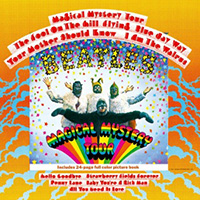
TheBeatlesMagicalMysteryTouralbumcover

Released less than six months after the glory of Sgt. Pepper, Magical Mystery Tour is not really an album. At least, it wasn’t at the time. It was never released in England until the compact disc era. In truth, it was another money-grabbing effort from Capitol Records to milk a little more cash out of the audience. Ah, but what an effort…

In England, Magical Mystery Tour was released as an EP consisting of six songs on two slabs of vinyl. The songs were the soundtrack to a new movie made by, and starring, the Beatles. Since the EP market didn’t exist in America, Capitol Records took the six songs and added three recent singles, including the pre-Pepper “Strawberry Fields Forever/Penny Lane” single, the post-Pepper “All You Need Is Love/Baby You’re A Rich Man” single, and “Hello Goodbye” the A-side of the current single. But in this case, the desire for more sales accidentally created a masterpiece. There’s really no comparison: the American version of the Magical Mystery Tour soundtrack is so much better than the officially released EP that even the Beatles were forced to acknowledge it by making the American version the official version in 1987.

U.S. Edition U.K. Edition
1. Magical Mystery Tour
2. The Fool on the Hill
3. Flying
4. Blue Jay Way
5. Your Mother Should Know
6. I Am The Walrus
7. Hello Goodbye
8. Strawberry Fields Forever
9. Penny Lane
10. Baby You’re A Rich Man
11. All You Need Is Love
1. Magical Mystery Tour
2. Your Mother Should Know
3. I Am The Walrus
4. The Fool On The Hill
5. Flying
6. Blue Jay Way

Everything about the American version works better. Even the sequencing of the six soundtrack songs has a far better flow and pace than the double EP version. The packaging of the album, a gatefold with a 24-page booklet featuring a bizarre Beatles cartoon story and a series of extremely odd photographs, also benefits from being the larger LP size. It should be remembered how strange this must have seemed to the American audience. The Magical Mystery Tour movie was made specifically for the BBC and was never shown in America (lucky us), which means that the photographs and cartoon story had no real context outside of the album art. Why is there a photo of John Lennon dressed as a waiter shoveling mounds of spaghetti and what look like rags onto the plate of a large woman? Why is Paul McCartney in a military uniform? Why are there cartoons of the Beatles dressed as wizards? Who the hell is Little Nicola and why is she so adamant that I am not, in fact, the Walrus? Why are the Beatles, if it’s really them, dressed up like animals on the front cover?

The answer, of course, is that it was all part of a trippy mess of a movie, but the Americans didn’t know any of that, aside from a brief mention in the gatefold. What they knew was the music, most of which was sublime.

The title track serves much the same purpose as the title track of Sgt. Pepper. It’s a grand fanfare and an introduction. Separated from the movie, the song still works as an album intro, promising a journey to lands unknown in the songs that follow. It’s a loud, brassy song with simple lyrics that can be read two ways: the literal interpretation of a magical tour, and the metaphorical reading that reveals the drug references. “Magical Mystery Tour” is a drug song, starting with John Lennon’s carnival barker shout of “Roll up for the Magical Mystery Tour!”, a line that uses a common English phrase as code for the act of rolling a joint. The entire concept of the song, written by Paul McCartney, is based on the notion of tripping, taking the common British bus tour and using it as a metaphor for a journey to magical lands. But it is, in the end, still just a fanfare. The lyrics are simple and repetitive, saved from banality by the McCartney’s lead vocal and by the driving, propulsive music. Lyrically it’s even simpler than Sgt. Pepper‘s opening salvo, though the song itself is longer. Removed from its context it’s not a great song, but it’s a world-class album opener. It’s short enough that it doesn’t wear on the listener, punchy enough to force you to pay attention, and catchy enough to leave it stuck in your head. “Magical Mystery Tour” is less a song and more a mission statement. As such, it’s the perfect introduction to the songs that follow.

“The Fool On The Hill” is the first Beatles song to reflect their newfound admiration for the Maharishi Mahesh Yogi, a short, bearded guru with a girlish giggle who turned the Beatles on to Transcendental Meditation. At this point, the band was still enthralled with the diminutive Indian and McCartney’s “The Fool On The Hill” is a loving tribute, portraying the Maharishi as a misunderstood wise man while playing with the imagery of the man with the answers to life’s questions being seated at the top of a mountain. It hearkens back to the literary convention, used most famously by William Shakespeare, of having the Fool be the only person who can speak the truth that others don’t want to hear. The powerful brass of the preceding song is here replaced with flutes and woodwind instruments that float throughout the song, lending an airiness and a baroque sense of sophistication to the music that perfectly complements the naïve lyrics.

This is followed by a song that is one-of-a-kind in Beatles history. “Flying” is the only song credited to all four Beatles, and is the only instrumental they ever officially released. In the film, “Flying” is the soundtrack to a collection of unused footage that had been filmed for the trippy “stargate” sequence of 2001: A Space Odyssey, and it’s one of the few parts of the movie that genuinely works well. On record, distanced from the visuals, “Flying” still manages to achieve its desired effect. The title clues the listener in to what to expect, and the music doesn’t disappoint. The music glides and swirls. Keep the title in mind and close your eyes and you will see landscapes below you and clouds ahead. It’s very brief, just a bit over two minutes and the last thirty seconds or so is some Mellotron  squealing and backwards tapes that provides a perfect segue into George Harrison’s “Blue Jay Way”.

One of the key elements to Beatles music has always been humor. All four of the them were very, very funny. “Blue Jay Way” sounds mysterious and dark, psychedelic and moody. But the lyrics are actually typical Harrison humor. The song was composed when Harrison was waiting for Derek Taylor to arrive at a house he had rented in Los Angeles. Taylor was late, and had gotten lost. Harrison, at the point of exhaustion, passed the time by playing a Hammond organ and making up lyrics about his friends. The mysterious, atonal, psychedelia of the music is paired with lyrics that could have come from a Monty Python song:

There’s a fog upon L.A.
And my friends have lost their way
They’ll be over soon, they said
Now they’ve lost themselves instead
Please don’t be long

It’s the “they’ve lost themselves” that makes it, a wonderfully eccentric turn of phrase. The music on “Blue Jay Way” is probably the most psychedelic the Beatles ever got, which makes the next song on the album all the more jarring. “Your Mother Should Know” is a McCartney soft-shoe shuffle that harkens back to English music hall. It’s a thoroughly enjoyable trifle, as good as or better than most of McCartney’s similar excursions (“When I’m 64”, “Honey Pie”). It’s the kind of track that would never be approved by a record company today because it doesn’t sound like the other songs on the album, but the Beatles never felt constrained by the need to stick to a formula. They were restless in their creativity and went wherever the song happened to take them. In the case of “Your Mother Should Know” that creativity took them to a time before Elvis shook their worlds, a sound that may have opened the ears of some of their fans.

It was the last song on side one, the final song that appeared in the Magical Mystery Tour movie that really opened ears. John Lennon had heard that there was a course that analyzed Beatles lyrics being offered at his old high school in Liverpool, something he considered absolutely absurd. “I Am The Walrus” was his response, a series of images and lyrics that seemed to make sense in a Jabberwocky kind of way but were, in the end, meaningless. This was Lennon playing with words and having a grand time doing it. The images were sometimes shocking (“pornographic priestess”, “yellow-matter custard dripping from a dead dog’s eye”), sometimes funny (“crabalocker fishwife”, “I am the eggman”), and sometimes coded (“elementary penguins” were Hare Krishnas, “semolina pilchard” was a reference to Norman Pilcher, a British police officer who was notorious for busting rock stars for drugs and even more notorious for bringing his own just to be sure the charges stuck). “Lucy in the sky” gets a shoutout, and the opening couplet came to Lennon on separate acid trips, and it was all punctuated with the refrain “Goo goo g’joob!” The ending includes dialogue taken from a radio production of King Lear and a chanting chorus that repeats the phrase “everybody’s got one” and “oompah oompah stick it up your jumper”. Musically, the song stands with “A Day in the Life” and “Strawberry Fields Forever” as one of the band’s crowning achievements, largely due to producer George Martin’s ability to interpret the desires of his unschooled musicians. There is a rock band of guitar, bass, drums, and piano at the heart of “I Am The Walrus” but it’s the churning orchestration led by violins and cellos, with brass punctuation marks, that make the song stand out. The orchestration adds a veneer of sophistication and respectability. The song seems to be an important statement because the music is so serious. Ironically, a song written to mock the people who took Lennon’s lyrics too seriously sent people into a tizzy as they tried to figure out the meaning of this word jumble. Absent the orchestration, it’s likely that Lennon’s words would have been taken for what they were: a joke. But by adding the hallmarks of so-called “serious” music the Beatles made the joke all that much funnier. “I Am the Walrus” is the greatest musical practical joke ever played.

And it was a B-side of a single. Not even deemed worthy of being the A-side, much to Lennon’s annoyance.

The song that was the A-side of that single led off the second side of the album. “Hello Goodbye” is certainly a better single than “I Am the Walrus” even if it falls far short as a musical innovation. “Hello Goodbye” is insanely catchy, perhaps the catchiest thing Paul McCartney ever wrote (and that’s saying something). One listen and it’s hooked into your brain forever. The simple yin/yang lyrics are easily remembered and the melody is unforgettable. It may not be the achievement that “Walrus” was, but it was unquestionably a more marketable single. “I Am the Walrus” was a brilliantly disorienting slice of surrealism and wordplay. “Hello Goodbye” was a markedly less brilliant solid gold radio-ready hit.

What’s ironic about this is that the two songs that follow “Hello Goodbye” were the two sides of a double A-side single that had been released in February of 1967, months before Sgt. Pepper changed the musical landscape. That single, considered one of the greatest singles ever released, was also the first Beatles single to fail to make the top of the charts. “Strawberry Fields Forever” and “Penny Lane” were a huge leap forward when they were released as the first Beatles single after Revolver. Perhaps it was too far a leap, because the single stalled at number two in the charts, held back by Engelbert Humperdinck’s “Release Me”. That doesn’t change that both sides of the single were masterpieces. The songs had been recorded for Sgt. Pepper but rush released as a single when that album was delayed. They became the centerpiece of the second side of Magical Mystery Tour instead, and their inclusion elevates the entire album. There is a slight difference in tone between these songs and the rest of the tracks on the album…they’re not a perfect fit as they would have been on Pepper, but one would have to be a long-faced, humorless scold to care. When an LP is blessed to have both sides of what may be the greatest single in rock history (all votes for “Paperback Writer”/”Rain” will be counted), the idea that the songs sound like they were recorded at a different time and mindset is the lowest form of nitpicking.

If there is a fly in the ointment of the LP it’s “Baby You’re A Rich Man”. Comprised of two songs blended together (Lennon’s “One of the Beautiful People” and McCartney’s “Baby You’re A Rich Man”), the music features a discordant and harsh clavioline, not entirely pleasing to the ear. Lennon’s vocal melody is excellent though the vocal itself isn’t his strongest, and McCartney’s chorus is loud and brash, but both are somewhat undercut by the willfully defiant music. Rolling Stone Brian Jones pops up tooting on an oboe throughout the song, and Mick Jagger is rumored to be a backing voice in the finale. The song was thought to be about Beatles manager Brian Epstein (allegedly Lennon sings “baby you’re a rich fag Jew” at one point, but I’ve never heard it), but Lennon insisted that the song was a message to people to quit whining about their status in life, that we were all “rich”. Unfortunately, the lyrics are something of a mess (“You keep all your money in a big brown bag/Inside a zoo/What a thing to do”, contributed by McCartney, may be one of the dumbest lyrics ever written), so Lennon’s theme never becomes clear.

The lyrics of Magical Mystery Tour‘s final track are also something of a mess. The chorus made the song the anthem of the so-called “Summer of Love” when it was released as a single a month after Sgt. Pepper, but the verses are a circular mash of word soup. How do you parse “There’s nothing you can do that can’t be done” or “Nothing you can sing that can’t be sung”? At first glance, the lyrics seem like a “You can do it!” affirmation but what Lennon is really saying throughout the song is that you can’t do it. If it can’t be done, you can do nothing; if it can’t be sung, you can sing nothing; if it can’t be known, you can know nothing; if it isn’t shown, you can see nothing. This is reinforced by the one exception: “There nothing you can say/But you can learn how to play the game”. The chorus seems like a non-sequitur: “All you need is love/Love is all you need”. Lyrically, “All You Need is Love” takes a somewhat darker and more cynical tone than it is ever given credit for. “Love is all you need,” Lennon sings in the chorus, while the verses hammer home the message “because you don’t/can’t have anything else.” You  can learn how to play the game, but if it’s not already being done you can’t do it. “All You Need Is Love” is Lennon’s message to the voiceless, powerless masses that they don’t need the trappings of modern life as long as they have love. It’s a childlike message but, as he did later with the even more naïve “Imagine”,  he uses the music to sell the message. “All You Need Is Love” is a beautiful song, from the opening bars of “Le Marseillaise” to the winding close that incorporates musical themes from “Greensleeves” and “In The Mood” and lyrical shoutouts to “Yesterday” and “She Loves You”. The chorus is simple, making it perfect for singalongs and sloganeering (much like the vastly inferior song “Give Peace A Chance”), and the verses are melodic and sung beautifully by Lennon.

Magical Mystery Tour is not an album, but it is a magnificent LP record. Some of the best songs the Beatles ever did grace its grooves and even the songs that don’t rise to that level are excellent. The Beatles canon is improved by its inclusion.

Grade: A+

The Beatles: Sgt. Pepper’s Lonely Hearts Club Band

sgt-pepper1

With Revolver the Beatles were openly flouting the pop music rule book. They were sending an early notice that they wouldn’t be bound by convention. Sgt. Pepper’s Lonely Hearts Club Band ripped up the rule book, burned it, buried it, and sowed the earth with salt. It’s really not too big a statement to say that Sgt. Pepper redefined the musical landscape almost completely…for good and for bad. The significance of the album’s release in the rock music firmament can not be overstated.

But Sgt. Pepper didn’t come entirely out of the blue. In February of 1967 the Beatles released a double A-sided single of “Strawberry Fields Forever” and “Penny Lane”. These songs were such a radical departure for the band that they might as well have been recorded on Mars. Swirling Mellotrons, horns, strings, seemingly cryptic lyrics (which aren’t that cryptic if you know the back story)…this single was as great a departure from Revolver as that album had been from Help! Musically, lyrically, and stylistically, it was a huge leap forward (or backwards, I suppose, if you liked your Beatles as four lovable Mop Tops).

That single had originally been recorded for inclusion on the project that would become Sgt. Pepper. It was released early under pressure from the record label who had not released a new Beatles track in months. It seems odd to think about now, when bands routinely take years between releases, but in 1967 if a band didn’t release a new single every few months they were considered washed up. Rumors were circulating that the Beatles, holed up in EMI Studios, were out of ideas and probably going to break up. They’d quit touring in 1966, which is something bands never considered doing until that time, to focus on recording. But the recording process for the new album was taking months, an almost unprecedented amount of time in the history of rock music. Reporters routinely staked out the studio, ready to ask the Beatles “Are you finished?” whenever the band arrived at EMI’s door. The band even looked different. All four had grown moustaches.

The Beatles were not out of ideas. Sgt. Pepper was part of an extraordinarily creative period for the band and was, in many ways, the apex of that creativity.

When the album was released in June of 1967 it became the soundtrack for what was called the “Summer of Love”. It was as if an earthquake had shaken the musical world to its core. It was the first Beatles album that Capitol Records released without removing tracks and substituting others. The Beach Boys’ Brian Wilson, crafting Smile, his band’s response to Revolver, heard Sgt. Pepper and had a nervous breakdown. Paul Kantner has talked about how you could hear Sgt. Pepper blasting out of every window at Haight-Ashbury. Even the Monkees paid tribute: in one of the musical sequences on the show, when the band is seen running around in an Old West town, Davy Jones has a copy of Sgt. Pepper tucked under his arm.

The album dominated the charts for the entire summer and sent other bands reeling. The Rolling Stones responded with Their Satanic Majesties Request, a drugged out, bleary copy of Pepper. Less well-known, Arthur Lee’s Love responded with Forever Changes, an album that nearly matches Pepper on every level and surpasses it on some. The Doors heard an early acetate of the album before its release and were similarly floored by the notion that they could do anything they wanted in the studio. Frank Zappa brilliantly parodied the cover on his We’re Only It It For The Money. Jimi Hendrix opened his show by playing the title track, only 48 hours after the album was released. The rule book was gone and every band in the land suddenly realized they could go wherever their talents and muses would take them. This created the unfortunate idea in every songwriter that they needed to release “their Sgt. Pepper“. But these other bands were not the Beatles, and the result was usually an awful, overindulged, mess.

So much has been said of the album that it’s almost easy to overlook the music. The first album to have the lyrics printed on the back sleeve; the first to have a design on the inner record sleeve; the first to come with a sheet of cutouts; one of the first single album gatefold releases (maybe the first); the first to have a “legitimate”, well-known artist, Peter Blake, design the cover. The splashy, colorful cover that seems to be a graveside service, features wax figures of the “old” Mop Tops standing next to the latest incarnation of the band, who are dressed in brightly colored pseudo-military uniforms. Behind them, arranged in a crowd of life-size cutouts, are the band’s personal choices for heroes and influences. Tucked away on one side is Stuart Sutcliffe. Right up front is a doll wearing a shirt that says “Welcome The Rolling Stones Good Guys”. (The Stones repaid the compliment by hiding the Beatles’s heads in the 3-D cover of Majesties.) The album title is spelled out on a bass drum, and the name “Beatles” appears as a floral arrangement…right in front of a row of marijuana plants.

So yes, it’s easy to forget that this is an album of songs. And as an album of songs, Sgt. Pepper is not the greatest rock record ever released. It’s extraordinarily good; great even. But the songs are so decked out in their psychedelic finery that it’s easy to miss the fact that they’re not the band’s best songs. It was certainly thought so at the time, but Sgt. Pepper succeeds mainly because of its innovation, its playfulness, its experimentation, and its ruthless rule-breaking. As recordings, this is the best the Beatles, or any other band, got. As songs, on the other hand…a case could easily be made that Pepper doesn’t compare with Rubber Soul, Revolver, the best of the White Album, or even Abbey Road.

Paul McCartney’s concept for the album was that the band could pretend to be another band. That way they could do whatever they wanted without being hemmed in by whatever was expected of the Beatles. This “concept” lasted all of two songs. The opening, eponymous, track and the introduction of “Billy Shears” to sing “With A Little Help From My Friends”. But Billy Shears sounded a lot like Ringo Starr, and the idea of the Beatles pretending to be Sgt. Pepper’s Lonely Hearts Club Band quickly fell apart, only to be briefly revived on side two with a reprise of the title track.

So what of the music? The title track, clocking in a barely two minutes, is a brief introduction to the concept. It’s not so much a song as it is a fanfare, but it does have a great vocal from McCartney and some searing guitar work on both the stinging lead and the thick, heavy rhythm riffs. It ends with applause and the introduction of “the one and only Billy Shears” before blending into “Friends”. The song is Ringo’s finest performance on a Beatles album. He gives the lyric a warmth and bonhomie the elevates the entire recording. Sung by Lennon or McCartney, “With A Little Help From My Friends” wouldn’t work as well. (Sung by Joe Cocker, it worked even better.) For the first time, Ringo was given a song to sing that was neither throwaway (“I Wanna Be Your Man”) or novelty (“Yellow Submarine”). “A Little Help” is one of the crown jewels of Pepper.

The next track, “Lucy In The Sky With Diamonds” is even better, and the album is off to a roaring start. John’s acid-drenched lyrics and nasal vocal provide the musical equivalent of an LSD trip. John would, of course, deny that “Lucy” “Sky” and “Diamonds” were intended as code for LSD. The claim was that it was based on a drawing his son Julian had done of his classmate, Lucy, flying through the air with diamonds drawn as stars. When John asked his son what the picture was called, Julian told him that it was “Lucy, in the sky, with diamonds”. It’s possible. I’ve seen pictures of the drawing. But Julian was only three years old when John wrote the song, and it’s entirely possible that the title was grafted onto a drawing made at a later date (the drawing itself seems more the work of a precocious five-year-old than a three-year-old).

Could you draw this when you were three?

Could you draw this when you were three?

Lennon stuck with the story of the song’s origin until his dying day, long past the point when anybody cared if he was winking at the audience with the title. And regardless of the title’s beginnings, the lyrics themselves were unmistakably about acid. Lennon later said that at this point in time he was taking LSD “like candy”. George and Ringo were also enthusiastic takers and McCartney was starting to dabble in the drug, though his drug of choice was always pot. “Newspaper taxis”, “tangerine trees and marmalade skies”, “rocking horse people” eating “marshmallow pies”…it’s all a trip in a psychedelic wonderland, led by your tour guide John Winston Lennon. McCartney’s bass is amazing throughout and Ringo’s pounding that leads into the chorus tether Lennon to the earth even as his phased and echoed vocal takes him higher and higher.

Pepper is McCartney’s album. The concept was his idea, and it was his work ethic that kept John focused. But after Lennon’s journey into Acidland, McCartney responds with three straight songs that are fairly conventional. “Getting Better” is a good song that is saved from its faceless optimism by John’s sarcastic “it can’t get no worse” backing vocal and George’s tamboura in the last verse. “Fixing A Hole” is better, but similarly faceless. Like many of the songs on this album, if it had not been on Sgt. Pepper it would likely be considered a second-tier Beatles song.

“She’s Leaving Home” is the third McCartney song in a row (Lennon helped in the writing). His output at this point was outpacing John, who was consumed with consuming drugs and was besotted by a Japanese avant-garde artist he’d met in late 1966. “Home” is a magnificent track, with a sensitive but not cloying string section orchestrated by Mike Leander. It’s a story song, telling a tale that was all too common in 1967. Tom Wolfe told the same story in his book The Electric Kool-Aid Acid Test in what became known as “the Beautiful People letter”:

“Dear Mother,
I meant to write to you before this and I hope you haven’t been worried. I am in [San Francisco, Los Angeles, New York, Arizona, a Hopi Indian Reservation!!! New York, Ajijic, San miguel de Allende, mazatlan, Mexico!!!!] and it is really beautiful here. It is a beautiful scene. We’ve been here a week. I won’t bore you with the whole thing, how it happened, but I really tried, because I know you wanted me to, but it just didn’t work out with [school, college, my job, me and Danny] and so I have come here and it is a really beautiful scene. I don’t want you to worry about me. I have met some BEAUTIFUL PEOPLE and …”

But even on “She’s Leaving Home” it is the production and the performance that sells the song. McCartney’s lyrics are sentimental without being precious and the string section fits the mood perfectly. But the hidden star of the song is John Lennon. Lennon and McCartney are the only two Beatles on the track, and neither plays an instrument, but Lennon’s vocal steals the show. In the tale of a runaway girl, John plays the role of the parents, underpinning McCartney’s high chorus vocal. “What did we do that was wrong? We didn’t know it was wrong,” John sings in the same nasal tone he used on “Tomorrow Never Knows” and “Lucy In The Sky With Diamonds”. The vocal slices through McCartney’s lead and adds a perfect amount of pathos to the song. The dueling lead vocals of Lennon and McCartney on the chorus are a primer on how to sing a counter-melody.

Lennon’s “Being For The Benefit of Mr. Kite” closes the first side of the album. The lyrics were taken, almost verbatim, from an old-time circus poster John had hanging in his home. In the context of Pepper the song was assumed to be psychedelic, along the lines of “Lucy”. In fact, it was banned by the BBC who mistakenly believed “Henry the Horse” was a heroin reference. It’s not that, however. Hogsheads of fire, hoops, garters, somersets, the Hendersons, Mr. Kite…they’re all there in the poster. There’s an atmosphere that matches the lyric perfectly; steam organs, calliope sounds, tape loops, and various harmonicas fill out the piano/bass/drums musical accompaniment (there are no guitars on the track). After many failed attempts to achieve the desired results through conventional recording, the carnival sequence in the break was achieved by cutting the tapes into small sections, throwing them in the air, and then putting them back together in random order (some backwards). It worked beautifully, with the carnival sounding out of control. The effect was of being on the fairway with your senses radically altered. Nearly the whole of the album was an aural manifestation of disordered senses.

The second side of the album begins with George Harrison’s “Within You, Without You”. In the context of the kaleidoscopic Pepper, it works. Out of context, the song is an Indian drone with ponderous lyrics. It’s George’s longest Indian-style song, and far less effective than Revolver‘s “Love You To” or the Indian/psychedelic mashups “Blue Jay Way” and “Only A Northern Song”. As the song ends, there is a break of laughter. It shows good sense on the band’s part that they would follow the track with a laugh to lighten the oh-so-serious tone of the song. George’s heavy-handed mysticism is followed by one of McCartney’s lightest tracks. “When I’m Sixty-Four” is a staple at weddings now, but was written when McCartney was just fifteen years old. It displays both his overly sentimental side and his love for English music hall. What saves the song from being treacle is that descending line “You’ll be older, too” followed by Lennon’s wordless backing vocal that adds just a bit of edge to the song. Lennon and Harrison’s backing vocal of “We shall scrimp and save”, modulating the last vowel are the perfect complement to Paul McCharmley’s happy vocal. The backing adds just the right touch, reminding the listener that “scrimping and saving” isn’t necessarily easy or fun.

Fortunately, the song is followed by “Lovely Rita”, Paul’s ode to hooking up with a meter maid. The piano-driven track is an old-style rocker, but even here the Beatles were playing with the recording. The piano purposely slips in and out of tune, John’s backing vocals are once again very prominent, and the song ends with a not-very-subtle simulated orgasm, the music and a breathy, wordless, moaning vocal rising and getting more intense until the piano suddenly drops off and John is heard saying “Believe it.”

“Good Morning Good Morning” continues the rebound on side two. It’s a heavy rocker with a punchy brass section, scorched earth guitar fills by McCartney, and lyrics inspired by a commercial for corn flakes. The lyrics would have fit in perfectly with the original concept for Pepper’s songs. The original idea, represented by the “Strawberry Fields”/”Penny Lane” single, was that the songs be a nostalgic look at their childhoods in Liverpool. “Good Morning Good Morning” plays on that theme with its tale of a man’s day, not wanting to get up and go to work, taking a walk by his old school, heading home to watch television (“Meet the Wife” was a British TV show). Lennon captures the frustration of everyday living with typical Lennon bile in the lines “Everybody knows there’s nothing doing/Everything is closed it’s like a ruin/Everyone you see is half asleep/And you’re on your own you’re in the street”. Only when the sun starts to set does the song’s protagonist start to come alive, flirting with the girls and acknowledging the people around him as “full of life”. In many ways, it’s the sequel to Revolver‘s “I’m Only Sleeping”, taking that song’s character and seeing how the rest of his day plays out. It’s a straightforward track, but still has some of the Pepper artifice. Aside from the horns and multiple time signatures there’s the ending, where a series of animal noises are heard, each sound representing an animal that could kill or frighten the animal before it.

On the stereo version of the album, the last of the animal sounds is a two-note guitar lick that mimics a clucking chicken. In reality, that was added in later to cover a terribly bad edit between “Good Morning Good Morning” and the following song, a reprise of the title track. The original, bad edit is heard in the mono version of the album, and is a clear example where the stereo mix being better than the mono. Both the mono and stereo mixes have their selling points and despite Lennon’s insistence that mono was the best way to hear the album, the stereo mix is far superior to that of any pre-Pepper Beatles album. The “Sgt. Pepper” reprise is brief, a reminder that there was once a concept behind the album. Its inclusion still leads people to believe that Pepper has a unified theme. Like the title track, it’s a fine rave up, but there’s really nothing much to be said about it. It’s main purpose is to serve as the gateway to “A Day In The Life”.

The last track on Sgt. Pepper is also the best. It is, to my ears, the best song the Beatles ever did, and arguably the best song of the rock era. With a finale like this, it’s easy to forgive the superficiality of any of the preceding tracks. It is this song that sticks with the listener more than any of the others, and elevates Pepper to the top of critical lists. “A Day In The Life” is essential listening. For this song alone, Sgt. Pepper is a necessary addition to the collection of any serious fan of rock music.

Here the Beatles transcend rock music. The song has all the conventions of rock, but the recording is something else entirely. The verses are simple: a lightly strummed acoustic guitar, a stately, near classical piano, and Ringo Starr’s brilliant drum fills. Anyone who says that Ringo is not a world-class drummer needs to listen to this, and then forever shut up about it. Floating over it all is Lennon’s voice. In the first two verses he tells the story of the car crash that killed the Guinness heir Tara Browne, in the third he pays tribute to the movie How I Won The War, in which he had taken a supporting role in 1966. But it’s at the end of the third verse that the song takes off. As Lennon sings a line written by McCartney, “I’d love to turn you on”, the music swells underneath, an orchestral rush that rises and rises until it seems like it will explode out of the speakers. The orchestra, recorded with the musicians wearing fake noses and various costume parts to get them in the right frame of mind, had been instructed that they had 24 bars to go from the lowest note on their instruments to the highest, and how they did it was up to them. The sensation one gets listening to it is the same as taking off in an airplane. There’s a rush and a feeling of inexorable rising…until the 24th bar when the orchestral orgasm abruptly ends with the sound of an alarm clock and McCartney’s voice taking over the lead from Lennon. This section by McCartney was part of a song he’d been writing for the “childhood” concept of the album. It recounts his days riding on the top of the bus, smoking cigarettes, and daydreaming. In the context of the song, though, it is from the perspective of an adult, probably running late for work. Still, the lines “found my way upstairs and had a smoke/Somebody spoke and I went into a dream” was enough to get the song banned by the BBC for referring to drugs.

It’s hard to argue that those lines are not about drugs. At the moment McCartney finishes the word “dream” the music again shifts from the rock piano to a brass section that sounds impossibly deep. The brass builds from the bottom, becoming more prominent before ending in a five-note flourish that transitions back into the music of the first three verses. Overriding the brass is Lennon’s wordless wail, providing another melody on top. His voice on that elongated “Ahhhhhh” modulates and turns, drifting from speaker to speaker, before fading. And just like that we’re back to softly strummed acoustic, stately piano, and Ringo’s ever-changing fills. The last verse is nothing more than a poetic retelling of a news story about the number of potholes in the road (“four thousand holes in Blackburn, Lancashire”). But as Lennon ends the verse he circles back to that infamous line “I’d love to turn you on” and the orchestral rush begins again. This time the surge ends not with an alarm clock, but with what is probably the most famous chord in the history of 20th century music. It’s a simple E Major chord, played simultaneously on three different pianos by Lennon, McCartney, Starr, and roadie Mal Evans and on a harmonium by George Martin. As the sound of the chord started to dissipate the engineers in the studio turned up the recording levels until they were capturing not only the resonance of the chord but the ambient studio sounds. like the squeaking of a chair. The result is a massively rich chord that sustains for over 40 seconds before finally disappearing. Buried in the fade is a dog whistle, undetectable to human ears (and probably undetectable to recording devices, so who knows if it’s really on there or not).

Sgt. Pepper’s Lonely Hearts Club Band ends with a snippet of studio dialogue and noise, sped up, backwards, and on an endless loop for record players that do not have an automatic return on the stylus. It’s the last touch on the album, a hidden nonsense track less than 5 seconds long that continued playing on a loop until the listener lifted the needle off the groove.

Sgt. Pepper changed the musical world. It opened the doors for musicians to be more creative and take more chances. It also led to the mistaken belief that brass and strings were enough to turn a pop song into an artistic statement. We still listen to music in the world that Pepper created but the fact is that, with some exceptions, the songs on the album simply aren’t as good as the ones on Revolver, or even Rubber Soul. Sgt. Pepper’s Lonely Hearts Club Band is the most important rock album ever released, and my grade reflects that. But is it The Greatest Album Ever Made as so many claim? No. It’s not even the best Beatles album.

Grade: A+

The Beatles: Revolver

revolver

For decades now, whenever some music magazine that’s staffed with old hippies (*cough* Rolling Stone *cough*) makes a list of the Greatest Albums of All Time (by which they mean the greatest albums since 1964), they invariably settle on The Beatles’ Sgt. Pepper’s Lonely Hearts Club Band as the choice for number one. But a funny thing happened several years ago when VH1 created a list of the 100 Greatest Rock Albums. As voted on by critics and musicians, the number one choice was Revolver. Since then, Revolver‘s stock has risen sharply while Pepper’s has dropped.

The rise in Revolver‘s status coincides directly with the release of the album on compact disc in 1987 when, for the first time, the original version of the album was released in America.

Revolver was the last Beatles album to be eviscerated by Capitol Records, and was probably the most damaged aside from the movie soundtracks. The American version of the album was a hard-hitting classic, long considered one of the very best albums by the band. When the English version was released in America, it was a revelation. As great as the American version was, three of the best songs had been removed.

U.S. EditionU.K. Edition
1. Taxman
2. Eleanor Rigby
3. Love You To
4. Here, There, and Everywhere
5. Yellow Submarine
6. She Said, She Said
7. Good Day Sunshine
8. For No One
9. I Want To Tell You
10. Got To Get You Into My Life
11. Tomorrow Never Knows
1. Taxman
2. Eleanor Rigby
3. I’m Only Sleeping*
4. Love You To
5. Here, There, and Everywhere
6. Yellow Submarine
7. She Said, She Said
8. Good Day Sunshine
9. And Your Bird Can Sing*
10. For No One
11. Doctor Robert*
12. I Want To Tell You
13. Got To Get You Into My Life
14. Tomorrow Never Knows
*Released in America on the LP Yesterday…And Today

What makes the song removal even more unfortunate was that all three songs were John Lennon’s. As a result, George Harrison is a stronger presence on the American version as the writer and singer of three songs while Lennon is relegated to the album closers on each side. This has the effect of making the album seem lopsided. Paul is here, there, and everywhere and George is hot on his heels, but Lennon gets only one song more than Ringo.

No discussion of Revolver should begin without mentioning the cover art. Designed by their friend from Hamburg, the artist and bass player Klaus Voorman, the front cover of the album took the mildly hallucinogenic cover of Rubber Soul and exploded it. In stark black and white, the Beatles appear as line drawings, with only their eyes and George’s lips looking like cut and pastes from photographs. The four heads take up the entire cover while old photos (including some from the back cover of Rubber Soul) and surreal comic versions of the Beatles that look like they were drawn by Edward Gorey appear in their hair. Some of the photos are stretched or distorted, all of them are odd in either appearance or placement: Ringo in an old-fashioned bathing suit, George in a safari hat, John looking like he’s grown a giant Amish-style beard, a younger Paul hiding behind the cartoon of his own ear. And the single word in all capital letters: REVOLVER. In all of rock music to this point there had never been an album cover even remotely this strange. On the back cover, below another all-caps REVOLVER and the significantly smaller words “The Beatles” is a black and white photo of the band in the studio, sitting together, looking at each other instead of the camera, wearing sunglasses. revolver-backIf there’s a photo of a band where the group members look cooler than this, I’ve never seen it. This is the band in their “We’re The Coolest People On Planet Earth” phase (see also the videos for “Rain” and “Paperback Writer” from the same time period). The back cover of Revolver is one of the all-time great rock and roll photographs. The Beatles were looking less like the gear fab Mop Tops on Rubber Soul, but here they put that image behind them forever.

If the cover didn’t prepare you with the idea that the Beatles were up to something new, the music sure did. Their first album, Please Please Me, kicked off with Paul’s exuberant “one-two-three-four!” and three short years later Revolver begins with George’s slurred, off-time and off-beat, slow count in on “Taxman”. This was clearly a different group. For starters, it was George who kicked the album off, with his strongest song yet, a withering protest against Britain’s outrageously confiscatory 95% tax rate. His songwriting at this point was floating in that rarefied air with his bandmates Lennon and McCartney. But the song was also unusual. The guitar was heavy and distorted, unlike any heard on a Beatles song before. The ferocious guitar solo, played by Paul McCartney, exploded out of the speakers and was designed to mimic the feel of Indian music, George’s latest passion. The song sounded both Western and Eastern: the instrumentation of one with the scales of the other.

“Taxman” (and, in fact, all of Revolver) is also a perfect example of why the early Beatles are best heard in mono, rather than stereo. Listening to the stereo of “Taxman” can be downright painful, especially on headphones. Virtually all the music except the tambourine and the guitar solo comes from one speaker. The mono version is louder, punchier, and fuller. It’s also a different mix: the very prominent tambourine comes in earlier in the mono version. This is true throughout the album. The mono mix is clearly superior, and is the version the Beatles were fully involved in creating (the stereo mix was done by George Martin with no input from the Beatles). Song endings are longer (“Got To Get You Into My Life”), sound effects are placed differently and are more abrupt (“Tomorrow Never Knows”), vocals sound fuller (“Eleanor Rigby”). Generally speaking, the Beatles are worth hearing in mono all the way up through the White Album; on Revolver the mono mix really shines.

Shortly after “Taxman” ends in a welter of guitar and righteous indignation, McCartney’s “Eleanor Rigby” tells the story of the lonely titular character and the equally sad priest who presides over her funeral. The story is told over a pummeling string section; no traditional rock instruments are used, and John and George are only present in the backing vocals. But where McCartney’s (and George Martin’s) use of strings on “Yesterday” was light semi-classical, the strings in “Eleanor Rigby” pound in a staccato fashion that sounds vaguely like Bernard Herrmann’s soundtrack to Psycho. The strings are playing in the place of rock and roll instruments; “Eleanor Rigby” could be rerecorded with heavy electric guitars and still maintain the same vibe. The strings on “Yesterday” sweetened the song; here they hammer home the sadness. “Eleanor Rigby” was McCartney’s finest moment to this point, a direct response to the challenge posed by Lennon’s increasingly sophisticated lyrics on Rubber Soul and to Pet Sounds, the Beach Boys album that was changing the way rock music could sound.

McCartney’s presence on Revolver was amplified by Lennon’s absence on the US version, making it sound like Macca had taken control over the band. On the official release it was clear that McCartney had assumed co-leadership duties with Lennon. Prior to Revolver, The Beatles had been Lennon’s band. On Revolver, they became Lennon and McCartney’s band. Lennon’s first track on the album was “I’m Only Sleeping”, a hymn to laziness or, perhaps, the stupor of being under the influence. At this time, Lennon was smoking a lot of dope and taking LSD like it was candy. Both drugs are reflected on the track. Marijuana informs the lyrics about a man who doesn’t want to do much of anything except lie in bed, sleeping and watching the world go by. Acid informs the music by inserting backwards guitar into what is otherwise a conventional rock track. Throughout the song snippets of backwards guitar rise from the background before erupting in a solo. The tone of the guitar gives the song an Eastern feel but also a psychedelic edge. Lennon’s voice also sounds unlike any of his previous vocals. It’s identifiably Lennon but here he sings in a higher, more nasal, register that adds just a bit more of an edge to the song. By this point on the album, I’m sure more than one first time listener was asking what the band was doing.

The answer is that they were challenging themselves and their audience about what the definition of rock music could be. George’s second song was a nearly pure Indian raga called “Love You To”. It’s the best example of George’s blending of rock and raga. A heavily fuzzed guitar and subtle bass are subservient to Indian instruments, primarily sitar, tambura, and tablas, but it’s still readily identifiable as rock music. Much like “Eleanor Rigby”, “Love You To” is a rock song played by mostly non-rock instruments. Through it all, blended with the music is George’s vocal. He sings the song in a flat, almost monotone way that perfectly complements the music.

On Rubber Soul the Beatles started branching out beyond love songs. Songs like “Nowhere Man” and “Think For Yourself” were the first songs the Beatles had done that weren’t about love in a boy-girl relationship. On Revolver, there are only three love songs, including two of the best that Paul McCartney ever wrote. “Here, There, and Everywhere” may be McCartney’s finest moment as a balladeer. The lyrics are sentimental and sweet, but not cloying or obvious. Some of the lyrics are downright gorgeous: “changing my life with a wave of her hand” and the ingenious way he works in the words of the title show the significant growth in McCartney. “Here, There, and Everywhere” is the Beatles first love song for adults, and makes a nice companion to “For No One”, the heartbreaking love song on side two. Here, McCartney sings about the dissolution of a relationship in a similarly adult fashion. Here the story is not that of a relationship that is over, but one that is on life support. “In her eyes, you see nothing” sings McCartney in the album’s most devastating line. “She says that long ago she knew someone/But now he’s gone/She doesn’t need him.” While the obvious interpretation of the lyrics is that Paul is observing somebody else’s relationship and commenting on it, “For No One” has always seemed far too personally heartfelt to me. The fact that McCartney says it was written about an argument with his girlfriend, the actress Jane Asher, also makes it personal. When seen as a song about himself, the switch from second person to third person further emphasizes the alienation the lover feels as the love is pulled away from him. Without his love, the song’s narrator can only see himself from the outside: first as an involved character in his life story “you see nothing” and then, as the relationship ends, as a faceless and nameless “him”. In a style of music that is replete with songs about broken love, “For No One” is one of the best, a perfect marriage of lyrical and musical pathos. The French horn solo, first hummed by McCartney, transcribed by George Martin, and then played by Alan Civil, is one of the greatest moments on the record, capturing all the wrenching emotion of the lyric and translating it into music.

The third love song, “Good Day Sunshine” kicks off the second side of the album. It’s a far more straightforward number than most of those on the album. It could have fit well on Rubber Soul or even Help! but that doesn’t diminish its many charms. For starters, it’s one of the few songs on the album that can genuinely be called “upbeat”. It’s a happy tune, propelled by piano and McCartney’s extraordinary vocal. It’s one of those songs that is simply impossible not to like. If it sounds slight in comparison to the rest of Revolver, that’s because it is. But lightheartedness was always a part of the Beatles’ arsenal. For every “Tomorrow Never Knows” there’s a “Good Day Sunshine”; for every “I Am The Walrus” there’s a “Yellow Submarine”. Revolver was, for the Beatles, a heavy album in lyrical terms. Politics, drugs, loneliness, and death are all explored. “Good Day Sunshine” goes a long way towards pushing away the gloom of what could have been a very bleak album. As such, it is “Good Day Sunshine”, “Got To Get You Into My Life”, and “Yellow Submarine” that, as much as anything, make Revolver a Beatles album. The secret weapon of the Beatles (and almost any good band) was their sense of humor and fun. An album without those elements simply would not have worked as well. It is the very lightness of these songs that is what makes them so good. They stand on their own as great, fun songs but also leaven the album as a whole.

Still, if there’s a weak link on the album (and actually, there isn’t) it’s “Yellow Submarine”, a children’s song that puts The Goons into popular music while calling back to Spike Jones. Lennon always claimed that it was one of the most fun times he ever had in the recording studio, and it’s easy to see why. The song is filled with silliness and Lennon loved that type of humor, and the stories of the recording session include tales of Beatles roadie Mal Evans leading a conga line while banging on a bass drum and assorted EMI employees raiding the archives for sound effects that were then used with great abandon. “Yellow Submarine” is a classic Beatles song. To adult ears, it can be a little wearing. Ringo’s voice is…well, it’s Ringo’s voice, and the sing along chorus is a bit cloying after awhile. Still, there is a lot of fun in the song and it is essential listening for any child under the age of ten. The stories of the recording also prove a central truth of the Beatles: through their restless creativity and boundless energy, they were changing the way music was recorded. In stuffy EMI studios, where microphones had to be placed precisely and where the recording engineers wore white lab coats, the Beatles were anarchy unleashed. They challenged all the rules of the studio and, therefore, of recorded rock music. “Yellow Submarine” is a perfect example of that. In the studio the Beatles were free, while on tour they were prisoners. Recordings like “Yellow Submarine” went a long way in setting the precedent that studios could be used to do more than record, that they could be used to create. It’s a legitimate question to ask whether the Beatles would have felt the freedom to experiment like they did on “Strawberry Fields Forever” without first flouting convention on “Yellow Submarine”.

George appears in the spotlight for the third time with “I Want To Tell You”, a far more conventional rock song than his first two offerings. Or is it? In some ways “I Want To Tell You” is every bit as radical as Lennon’s songs on the album. The lyrical matter is about the difficulty of communication, and the music matches it. Strange chords, a discordant piano, the climax of Lennon and McCartney singing “I’ve got time” in a way that mimics an Indian raga. McCartney’s bass pounds the listener and George’s riff that slides in and out of the song is a winner. The riff was so good that Jimi Hendrix played it on the BBC before launching into a version of “Day Tripper”. When Hendrix tips his hat to your riff, you know you’ve got something special. The backing vocals from Lennon and McCartney are jarring, they underpin George’s lead vocal but are more strident and difficult. There’s an enormous amount of stuff going on in these two and a half minutes. Musically it’s far more complex than “Love You To” or “Taxman” yet it doesn’t seem that way when you listen. It’s only when the listener burrows into the song that the weirdness of it is revealed. While it sounds conventional on the surface, “I Want To Tell You” is Harrison at his most daring while playing in the confines of traditional rock music. His Indian-inspired songs may have sounded stranger to Western ears, but this is where he was truly experimenting with song structure.

John Lennon was the main songwriter for “And Your Bird Can Sing”, with some help from McCartney. The subject is very much a mystery as the words don’t really seem to make much sense. My best guess is that it was written as a joke to Mick Jagger about his girlfriend, Marianne Faithful. That was one of the rumors, at least, but what is one to make of “And your bird is green/But she can’t see me” or “When your bird is broken/Will it bring you down?” Lyrically it’s a slice of surrealism (charitably…it could just be nonsense) that comes across as silly. Lennon later criticized the song as one of his throwaway tracks, but Lennon was his own worst critic. Musically it’s another matter. The music on “And Your Bird Can Sing” is fantastic. The lead guitars, two locked in harmony played by George and Paul, lay a foundation on which you could build a city, and McCartney’s bass throbs in the background, providing another lead instrument deep in the mix. It’s another upbeat, hard rocking moment. Coming right after “Good Day Sunshine” on side two, it seemed to show a turn away the heavy vibe of the album before “For No One” brought back the darkness.

The four remaining songs on Revolver could not be more different, yet they all share one thing in common. The subject in all four songs was inspired by the same thing: the band’s increasing experimentation with mind-altering substances. McCartney’s “Got To Get You Into My Life” sounds like an upbeat, soul-style love song and there’s a reason for that. It is an upbeat, soul-style love song. The object of McCartney’s affection in the song is not a woman, though. “Another road where maybe I could see another kind of mind there,” Macca sings as if his heart was about to burst out of his chest. McCartney later admitted that the “you” in the song’s title and chorus was actually marijuana. Still, the lyric was disguised enough so that it didn’t raise suspicions among listeners or critics, and the song is so catchy and joyful that the music overwhelms the lyrics. Driven by a punchy and powerful horn section, with a short but very electric guitar solo, and McCartney raving in his Little Richard voice over the fade, “Got To Get You Into My Life” was more proof that the Beatles were no longer bound by the sound that had propelled them to the top of the charts. Anything they wanted to try was valid and their level of fame (and the money they brought in to EMI) ensured that they were given carte blanche. Revolver is nothing if not stylistically diverse: rock, pop, soul, raga, ballads, orchestration, psychedelia, and novelty songs all coexist seamlessly on one album that’s less than forty minutes long.

“Dr. Robert” was John’s ode to a physician who peddled a lot more than health. Originally inspired by a New York physician named Robert Freymann who was famous for providing amphetamines to his rich clientele, the final character in the song is probably a combination of several people, including John’s dentist (the man who first slipped LSD in John’s and George’s coffee at a house party). In a more innocent time like 1966, it’s possible to imagine that the song could be written off as merely a song about a doctor. With hindsight, the drug references are obvious. “Take a drink from his special cup”, “If you’re down he’ll pick you up”, “You don’t pay money just to see yourself”, “He helps you to understand” are all blatant allusions to drugs in the context of the song. “Dr. Robert” is “a new and better man”. The guitar, heavy and distorted, plays in short, choppy bursts under Lennon’s double-tracked vocals before the chorus abruptly shifts into a dreamlike harmonium and Lennon’s floating vocal of “Well…well…well, you’re feeling fine/Well…well…well, he’ll make you”. Again McCartney plays a stellar bass line that flows in the verses and ebbs in the chorus, providing a harmonic counterpoint to those choppy guitars.

It is the songs that end each side of the album that are the clearest indication that the Fabs were into something very new and very different. “She Said, She Said”, which closes side one of the LP, is a fairly accessible rock song, but the lyrics were something else entirely. Only a couple of years earlier John Lennon had sung about wanting to hold your hand. Now he was coming out of the gate with “She said ‘I know what it’s like to be dead/I know what it is to be sad’/And she’s making me feel like I’ve never been born”. The lyrics reflect a nightmarish party where the band and their guests were tripping on acid and the actor Peter Fonda kept trying to tell them a story of a near-death accident he had as a child. According to Lennon, Fonda kept walking up to him saying “I know what it’s like to be dead”, a statement that had the understandable effect of freaking out Lennon during his drug-induced trip. This was a pop/rock song that had lyrics like no other before it. There had certainly been songs about drugs and death before, but never in a context like “She Said, She Said”. For an audience that was not “turned on” the lyrics must have been completely baffling, yet the music was straightforward for the most part. The guitars were incredibly loud and sharp, bordering on shrill, and Ringo especially shines throughout the song. John sings in the same nasal voice that he used on “I’m Only Sleeping”. It’s both a thrilling record and an exhausting one. At the end of the song the listener can be excused for being puzzled, alienated, or confused. While accessible, the music was heavier than any other Beatles song except perhaps for “Papberback Writer”/”Rain”, the magnificent single that preceded Revolver by a couple of months. The vocal was John distorting himself and the lyrics were unrelievedly dark and mysterious. What makes it all the more alienating was that the song immediately follows the happy, jaunty “Yellow Submarine”, providing the first of the two greatest contrasting song segues in the Beatles’ career.

The greatest contrasting song segue in the Beatles’ career, maybe in the history of recorded music, is found on side two. “Got To Get You Into My Life” was a finger-snapping, toe-tapping, head-bobbing slice of happy music. The song that followed it…wasn’t.

When Bob Dylan toured England in 1966 he was visited in his hotel room by Paul McCartney. McCartney brought an acetate of a new Beatles song to play for Dylan. When it was over Dylan said, “I get it. You don’t want to be cute anymore.”

If there was a final nail in the coffin of the Mop Tops, and a first glimpse of what was to come, it was “Tomorrow Never Knows,” the concluding track on Revolver. Beginning with a harsh buzzing sound, the song takes every pop/rock song structure and abandons them. For the pop audience, this was something the likes of which had never been heard before. The only readily identifiable sound is Ringo’s drums, playing a repetitive pattern that never deviates, behind what sounds like seagulls flying overhead, harsh backwards guitar that rises and falls, menacing sound effects, calliope sounds, and swells of distorted keyboards and horns. Most of these sounds were either backwards or sped up, frequently both. With the exception of that hypnotic drum beat and a brief snippet of piano during the fade, there is no standard music at all on “Tomorrow Never Knows”. And floating above it all is Lennon’s voice: “Turn off your mind/Relax and float downstream/It is not dying” he sings. “Lay down all thoughts/Surrender to the void.” Even Lennon’s voice switches at the 1:30 mark. Suddenly he sounds a million miles away, his voice just another sound effect. “Play the game existence to the end/Of the beginning…” Lennon had told their engineer that he wanted his voice to sound like a thousand chanting monks on a mountain top, but the sermon here is about the mind expanding effects of LSD. The vocal effect was produced by running John’s voice through a rotating speaker (called a Leslie).

The “music” was pieced together by Lennon and McCartney, after Paul had played John tapes of avant-garde music that he’d been experimenting with. The buzz is based on Indian music, with the entire song being in the key of C, with no chord changes. The “seagulls” were sped up laughter The lyrics were inspired by a Timothy Leary book about The Tibetan Book of The Dead, with some lines lifted almost verbatim from Leary’s book.

The days of “She Loves You” and “I Want To Hold Your Hand” were officially over. “Tomorrow Never Knows” was an unsettling, trippy, avant garde music that, amazingly enough, still manages to be an accessible, likable song. Other musicians, most notably Frank Zappa, were working in this territory at the same time, and the Beatles themselves would revisit this style with “Revolution 9” on the White Album, but “Tomorrow Never Knows” manages to pull off the staggering trick of being both non-musical and rock music at the same time. Zappa’s sound collages were just that: there was very little that was musical about them. The Beatles had proven that even the most far out sounds can work not merely in a pop song, but as a pop song. In one burst of creative genius and throughout one album, they’d proved that the old rules no longer applied. The entire musical world was listening and wondering where the Beatles could possibly go from here.

Is this the greatest album of the rock era? There’s really no objective way of saying that. But any good collection of music from the second half of the 20th century is not complete without Revolver. It is one of the crucial building blocks on which the music of the past fifty years is based. Absolutely essential listening.

Grade: A+

All These Years, Vol. 1: Tune In, by Mark Lewisohn

All These Years, Vol. 1: Tune In, by Mark Lewisohn

For most Americans the story of the Beatles begins fifty years ago today when a plane carrying the four longhairs from Liverpool landed at John F. Kennedy Airport, and kicks into gear two nights later when the band played on The Ed Sullivan Show to what was then the largest television audience of all time.

Of course, that is not where the story begins. The Beatles didn’t spring forth fully formed, like Athena popping out of Zeus’s head. In one incarnation or another they’d been playing and singing for almost six years by the time Sullivan introduced them. These six years are probably the least known but, in many ways, the most fascinating and important period in the band’s history. Now author Mark Lewisohn has finally released the first volume of his projected trilogy about the band, and the work more than lives up to the expectations.

Lewisohn has long been known to Beatles fans as the world’s leading expert on the subject, the author of the essential The Complete Beatles Recording Sessions that details almost every minute the band spent in the studio. He’s as close to an “official” expert the band has; with their permission he was given access to every note they’ve recorded (including all the unreleased stuff), he’s written liner notes and books, and he wrote the biographical prefaces to The Beatles Anthology (the officially sanctioned story of the band, in their own words). With Tune In, he’s outdone himself.

This is not simply a biography of The Beatles. This is the Moby Dick of rock and roll biographies. It is so richly detailed, so deep, and so complex, that it’s like seeing the Beatles for the first time in high-definition Technicolor after years of viewing them in grainy black and white. Lewisohn leaves no stone unturned here. True, it’s not really that important for even obsessive fans (guilty!) to know how much George Harrison paid for an amplifier in 1962, but those nitpicky details are deftly woven into a narrative arc that emphasizes the story over the minutiae. It’s a story told with cheek and humor, completely appropriate for the subject, and is bathed in loving detail. Lewisohn is clearly a huge fan, but he’s not worshipping at the altar here. Paul McCartney could be petty, narcissistic, and jealous. John Lennon was often cruel and cutting. Pete Best, it is clear, was a lousy drummer who couldn’t keep time if the lives of millions were at stake. None of the Beatles practiced monogamy, though both Lennon and McCartney demanded their girlfriends be subservient in almost all ways.

The early years of the band contain stories that all hardcore Beatle fans know:

  • When John was five he was forced to tearfully choose between his mother and father;
  • the head of Decca records refused to sign the Beatles, telling their manager Brian Epstein “Guitar groups are on the way out”;
  • George Martin heard the Beatles demo and liked it enough to bring them in, agreeing to sign them when he met them and was impressed by their humor and spirit;
  • when Pete Best was fired it was because the Beatles were jealous that their “mean, moody, and magnificent” drummer got all the girls;
  • bassist Stuart Sutcliffe died a sudden, shocking death;
  • after he was sacked, Pete Best told his best friend, Beatles roadie Neil Aspinall, to continue working for the band because “they’re going places”;
  • the Beatles never tried marijuana until they met Bob Dylan;
  • Lennon and McCartney spent the early years feverishly writing songs together.

The stories are so well-known, why do we need another Beatles biography? Well for starters, this is the first biography that states with complete authority that not a single one of these stories is true. Lewisohn has talked extensively not just with the people closest to the band, but their neighbors, schoolmates, employers, and everyone else with whom they had contact. His command of the facts and of the story is so overwhelming that the reader is left in awe of both his basic knowledge and the years of research he put into the book. When the facts are unclear, Lewisohn acknowledges it. When he cannot speak authoritatively, he presents all known sides of the story. Still, the number of myths he dispels is astounding.

Lewisohn wisely avoids foreshadowing for the most part. There are a handful of references to what will come later, but Tune In is set in the time it covers. This gives the book a sense of immediacy that too many biographies lack. The story builds gradually, sprawling over 800 pages (not including the end notes!), and covers only the time period ending on January 1, 1963. At book’s end, the Beatles are still over a year away from landing at Kennedy Airport. At book’s end, the airport was still called Idlewild because Kennedy himself was nearly a year away from Oswald’s bullets. Ed Sullivan, Shea Stadium, Sgt. Pepper, the Maharishi, Apple Records…these are stories for future books. Tune In ends with “Love Me Do”.

But this is the story of The Beatles. It’s all there. The guys that charmed the hardened and cynical New York press and won over the hearts of America are present and accounted for. The irreverence, humor, and restless creativity that later made Revolver are here in their early stages. Too many Beatles books think the story begins where this book ends; the early years are dismissed as a time when an amateurish act went to Hamburg and learned how to be a good band.

Essentially, that summary is true. The Beatles were a band with limited skills and a small repertoire who went to Hamburg, Germany to be the house band at the Indra Club, the sleaziest bar in town, before making their way up the musical ladder to the Kaiserkeller, the second sleaziest bar in town. Hamburg was such a high pressure situation that it turned the rough coal of the band into a brilliant diamond. It was in Hamburg that their repertoire expanded enormously because they refused to repeat any songs on the same night, and they had to play for four and half hours a night, six hours on the weekend. They learned songs on the fly, essentially rehearsing in front of crowds of drunken and often violent locals and sailors. In Hamburg they learned to put on a show, pressured by the Indra’s manager who would bellow “Mach schau! Mach schau!” (“make a show”). The show they put on, had it been seen in 1977, would have been called “punk rock”. Stomping, jumping, screaming, joking with and at the audience…the young band developed a visceral, exciting act to go with the music. They went to Hamburg as Liverpool’s also-rans. Nobody thought of them as being anything special. The best band in Liverpool was widely acknowledged as Rory Storm and the Hurricanes, featuring drummer Ringo Starr. When they came back from Hamburg, they were the best, tightest, band in Liverpool, probably the best band in England, and possibly the best rock ‘n’ roll band in the world. As such, they became stars in their hometown, attracting a rabid, fanatical following.

They would return to Hamburg four more times, the last two times being brief contractual obligations around the time of “Love Me Do”. Each time they appeared in a higher class of low-class bars. By the time they came back from Hamburg for the third time, they had played the equivalent of almost four and a half hours every night for eight months. That’s just Hamburg, and doesn’t include their countless sets in Liverpool’s Cavern Club. When you consider that type of pace, sustainable only by the young (and full of amphetamines), it’s nearly impossible to imagine a band becoming more tempered. Even when Stuart Sutcliffe quit the band in order to stay with the woman he loved, they carried on as if nothing had happened by forcing McCartney to (reluctantly) play bass. But Lewisohn also takes great pains to point out how unusual the Beatles were. It wasn’t simply that they were the best band in Liverpool, something that almost everyone in the city acknowledged in 1961. They were different. At a time when nearly every band in England was modeled after Cliff Richard and the Shadows (a singer and backing group), the Beatles all sang (even Pete Best would sing once or twice a night), and they sang harmonies, something no other band in Liverpool was doing. They were very funny, bringing their boundless love of The Goons and John’s Lewis Carroll-esque wordplay into their act. They were more than a rock ‘n’ roll band; they were the first rock group, comprised of inseparable friends (and Pete Best on drums). Lennon was clearly the leader at this time, but McCartney and Harrison were near equals. There was no star; they were all stars.

The entire history of the early years of the Beatles is laid out here and, despite the millions of words previously written about the band, there are a wealth of revelations. John, Paul, and George played as a trio named Japage 3? Brian Epstein was not their first manager? George Martin was forced into producing the Beatles as punishment for having an affair with his secretary? A recording contract was offered only because EMI wanted the publishing rights to “Like Dreamers Do”? Beatles roadie and right-hand-man Neil Aspinall, a teenager himself, was having an affair with Pete Best’s mother…and is the father of Best’s half-brother? Aside from a few very early attempts when they were still known as The Quarrymen, John and Paul didn’t start writing in earnest until after they got a recording contract? Brian Epstein became the manager of so many Liverpool acts not because he liked them, but because it enabled him to hold a near monopoly on the Liverpool music scene (and thus promote the Beatles even more heavily)? The Beatles introduced the fledgling Detroit music scene to England, by being the first band to do a Motown song on the BBC?

This is the complete story of the early years. Many myths are destroyed; many are confirmed. The true story is better than the myth. The drugs and drink are here; the rampaging, insatiable sexual appetites of young men away from home and living in squalor on Hamburg’s naughtiest street are here; the German art crowd of “Exis” is here, teaching the young band through their example that there are no rules to art; Brian Epstein’s tawdry, dangerous taste for rough trade sex is here; the violent streets of post-war Liverpool are here; most of all, the music is here. Large sections are devoted to who the young band was listening to, who they liked, and who they didn’t like. Barrels of ink are spilled detailing their love for Elvis, Buddy Holly, Gene Vincent, Little Richard, Eddie Cochran, and Carl Perkins among many others. It brings them alive in a way that is not just “the Beatles as pop music icons” but, rather, young men in love with rock ‘n’ roll. They were music obsessives, scouring the record shop at NEMS (managed by the young Brian Epstein), for the latest and greatest singles from America. They were The Beatles as the world knows them and loves them, at a time before anyone outside of Liverpool and Hamburg had heard of them.

The book is not without flaws, but most of them are frustrating and not serious. Lewisohn often describes interesting photographs, but doesn’t include them with the photos in the book. Sometimes the level of detail is all too much. There are several dog whistles to Beatles fanatics (even including some Rutles references) that would sail over the heads of non-fanatics. The next volume is not due out for another five years, and the finale five years after that…and that is the most frustrating thing of all. Regardless of these picayune flaws, All These Years, Volume 1: Tune In is the definitive biography of the savage young Beatles, and Mark Lewisohn is their Boswell. It is difficult to imagine anyone else even bothering to tell the story after this. Any future books about the band will more likely be narrowly focused to an event, an album, or even a song. There is simply no further need for another biography. Tune In sits along Peter Guralnick’s two-volume biography of Elvis Presley at the pinnacle of books about rock and roll music.

The Beatles: Rubber Soul

beatles-rubber-soul

In 1965, the squalling musical brat known as rock ‘n’ roll took its first steps to becoming the music that would dominate the rest of the 1960s all the way through the mid-1990s: rock. The transition wouldn’t really be complete until 1966, but the “new” music started the year before. The difference between the two forms, often referred to interchangeably, is stark. You could dance to rock ‘n’ roll, and the lyrics were usually pretty benign odes to teenage love and lust. It was the music of kids. Rock music, on the other hand, was heavier, noisier, lyrically expansive (love and lust were still the biggest topics, but of a somewhat less innocent nature). In folk music, Bob Dylan was expanding the vocabulary of lyricists everywhere. This wasn’t lost on the young rock musicians like the Beatles and the army of guitarists who followed in their wake.

The Byrds were the first to make explicit the connection between Dylan’s lyrics and wordplay and the beat laid down by the rhythm section of Paul McCartney and Ringo Starr. But in 1965 the Bard of Greenwich Village also made the connection when he laid down his acoustic guitar and brought in a heavily amplified backing band. The Beatles, too, made the connection in the opposite direction by using more acoustic instruments and using far more colors in their lyrical palette.

The new music in 1965 was heralded by six of the best albums of the 1960s. Since Dylan already had the words aspect of songwriting down to an art, it was his music that was most radically different. The Byrds were the perfected synthesis of the 1964 Dylan and 1964 Beatles. The Beatles, already restlessly inventive with their music, turned their attention to the words.

The fact that Rubber Soul, one of the best albums of all time, is only the second or third best album of 1965 is testament to the fact that Bob Dylan had just changed the landscape with the two masterpieces he released that year, Bringing It All Back Home and Highway 61 Revisited. The fact that Rubber Soul is a better album than the Beatles’s own Help! or the first two Byrds albums, Mr. Tambourine Man and Turn! Turn! Turn! is testament to just how great the Beatles were at this time.

The album was cannibalized for release in America, as usual, but in this case the album didn’t suffer too greatly. In some ways, it was strengthened.

U.S. Edition U.K. Edition
1. I’ve Just Seen A Face*
2. Norwegian Wood (This Bird Has Flown)
3. You Won’t See Me
4. Think For Yourself
5. The Word
6. Michelle
7. It’s Only Love*
8. Girl
9. I’m Looking Through You
10. In My Life
11. Wait
12. Run For Your Life
1. Drive My Car**
2. Norwegian Wood (This Bird Has Flown)
3. You Won’t See Me
4. Nowhere Man**
5. Think For Yourself
6. The Word
7. Michelle
8. What Goes On**
9. Girl
10. I’m Looking Through You
11. In My Life
12. Wait
13. If I Needed Someone**
14. Run For Your Life
*Originally released on the British LP Help!
**Released in America on the LP Yesterday…And Today

It’s possible that my personal experience colors my opinion here. I grew up with the American LP and while the album is certainly not improved by losing John Lennon’s masterful “Nowhere Man” and George Harrison’s excellent “If I Needed Someone”, the fact is that “I’ve Just Seen A Face” belongs here. Lost in the middle of side two of the British LP Help!, this fantastic McCartney track, with its furiously strummed acoustic guitar rhythm and propulsive vocal, is the perfect first song for Rubber Soul, miles ahead of the surprisingly pedestrian “Drive My Car”. And while “It’s Only Love” is somewhat slight, musically it’s a perfect fit with the rest of Rubber Soul. The same can’t be said of the equally slight country pastiche “What Goes On”. On an album that is so clearly influenced by both Dylan and the Byrds, “Drive My Car” and “What Goes On”, enjoyable as they are, sound jarring to the ear, like throwbacks to A Hard Day’s Night.

And yet, these are quibbles. In fact, it feels like a sin to criticize an album this good over such trifles. The American version of Rubber Soul hangs together a little better musically. But it is shorter, misses one Beatles classic and one near-classic, and is the product of record company control, not artistic control.

“Drive My Car” starts the album with a heavy electric guitar lick and riff, underlined by crashing piano notes, and a lyric that sounds like it was tossed off. But the “beep beep mmm beep beep, yeah!” hook is now indelible in Beatle lore, and the song is great fun. At the end of the day, that’s all it is: great fun. There’s nothing wrong with that, but “Drive My Car” could have fit comfortably on With The Beatles. Any indications that the Beatles were growing by leaps and bounds were not present here.

The same could not be said of “Norwegian Wood”. Lennon’s ode to an affair was such a massive leap forward for the band in terms of their songwriting that it still is a marvel. Lyrically it was a straightforward tale of infidelity, but told with Dylan’s sense of wordplay combined with Lennon’s dark humor: Boy meets girl, they go to her house, they drink and talk, he’s certain they’ll end up in bed, she turns the tables on him and goes to bed alone after first laughing at him, he drunkenly curls up in the tub to sleep, in the morning she’s gone and he sets fire to her home. What?! Had there ever been a lyric like this outside of blues murder ballads? And musically the tune was lovely, a strummed and picked acoustic guitar provided the bulk of the accompaniment, but the lead was played on a sitar, the Indian instrument that George was just beginning to learn. Odd, droning notes sound throughout, and then the brief instrumental hook of sharp notes that must have sounded like nothing else on a pop music record in 1965. No drums, but Ringo makes his presence felt with tambourine and maracas. “Norwegian Wood” is lyrically fascinating (written mainly by Lennon, but with help from McCartney), exotic music, and Lennon’s brilliant vocal performance. The musical world shifted on its axis in the barely two minutes it took Lennon to tell his tale. It stands shoulder-to-shoulder with “Like A Rolling Stone”, “My Generation”, and “(I Can’t Get No) Satisfaction” as one of the essential songs of 1965.

“You Won’t See Me” is one of the underrated gems on the album. Had it been released as a single, and almost every song on Rubber Soul was single-worthy, it would have been a huge hit. Macca sings the lead with the confidence of a man who knows he’s writing better and better songs, and the backing vocals from Lennon, and those gorgeous “ooh la la la” harmony vocals are the icing on the cake. McCartney’s piano and Ringo’s percussion are the main instruments, with a simple guitar part played by George, but the triumph of the song lies in the vocals and the melody, a endlessly repeating hook that drives into your brain and stays. As a trivia note: at 3:30, it was the longest Beatles song to date. Macca knew a good thing when he had it.

The vocals that made “You Won’t See Me” so good are even more clear on Lennon’s brilliant self-analysis “Nowhere Man”. Clearly inspired by The Byrds (who were, of course, inspired by the Beatles), the ringing, jangly guitar was played by Lennon (George played the solo using an identical style of guitar), “Nowhere Man” is one of the first Lennon/McCartney originals that was not a love song. The double-tracked lead vocal and the harmonies from Paul and George beat the Byrds at their own game while Ringo lays down a smooth shuffle beat and McCartney plays a busy bass line that practically skips along. Yet despite the bouncing music, the lyric is a harsh examination of a life that Lennon felt was getting away from him. Despite the fame, money, women, intoxicants (the often unmentioned influence on Rubber Soul was marijuana—just check the cover art), Lennon looked at his life and found himself to be a nowhere man, making plans for nobody. The dichotomy between lyric and music, like that of “Help!” earlier that year, makes the song all the more gripping.

While George Harrison was not yet anywhere near as prolific as Lennon or McCartney, the songs he was writing at this point were nearly as good. They also were clearly influenced by his elders in the band. “Think For Yourself” is a driving rock tune that, unlike “Drive My Car”, manages to sound of a piece with the rest of Rubber Soul. While there is guitar on the song, the lead is played by McCartney’s bass. Macca plays a great bass line, and then doubled it using a fuzz tone on his bass. The result is that one of the bass lines sounds like a heavily distorted guitar. It’s a great sound if used tastefully, as McCartney does here. His bass lines were always tasteful. The guy doesn’t get anywhere near the credit he deserves at one of rock music’s greatest bassists. The beauty of the fuzz tone on the bass is that it brings McCartney’s prodigious talents as a bassist to the fore, putting it in a can’t-miss lead position. George sings lead and, for the first time, he sounds like he knows what he’s doing. He’s still not the sublime singer he became a couple of years later, but at least he no longer sounds like a randy scouse git. He’s helped considerably by the way John and Paul come in with harmonies after the first line of each verse. This was George’s best song so far, though only until the record was flipped and “If I Needed Someone” came on. It was also not a love song, indicating George, too, was starting to think beyond the confines of the traditional rock ‘n’ roll subject matter.

Lennon’s “The Word” was about love, but in a decidedly different way. Far from the eros of young love, “The Word” makes the case for agape and philia. It’s an early example of a hippie ethos, perhaps, or the first pass at songs that took a more universal approach to the subject of love, like “All You Need Is Love”. It’s got a nifty upright piano lick that kicks it off and Ringo’s drumming is stellar throughout. The music itself proceeds at a syncopated gallop, unlike anything the Beatles had ever attempted before and the lyric definitely caught the zeitgeist of the hippie era a full year before that movement became widely known. There are a few lyrical hiccups (“in the good and the bad books that I have read”) but it’s so unusual for 1965 that those problems don’t matter.

The problems that plague “Michelle” do matter, however. It’s considered a Beatles classic, but I’m not sure why. Yes, there is a lovely sing along melody, and the Greek feel of the guitar is an extrapolation on what had been done a year before with “And I Love Her”. But ye gods, those lyrics. McCartney brought his amazing ear for melody to the song, but the lyrics are so trite and hackneyed they are cringe-worthy. Yes, the “ooh”-ing backing vocals are beautifully done, but there’s simply no forgiving the lyrics. The fact that many of them are sung in French makes it even worse. “Michelle” is not a bad song. Musically it’s quite good, and the vocal performance is as good as any on the album. It’s simply too bad that McCartney didn’t take ten more minutes to write some better lyrics.

Side two begins somewhat disappointingly. Yes, “What Goes On” is thoroughly enjoyable, but the faux-country music didn’t suit the Beatles any more here than it did on “Act Naturally”. Like that earlier song, this one was given to Ringo as his number. The Beatles could be admired for ensuring that all voices were heard on every album, but it seems clear that the songs given to Ringo were likely the ones that Lennon and/or McCartney thought were substandard.

It’s also clear that Lennon especially was firing on all cylinders at this time. His stunningly gorgeous “Girl” is a near perfect masterpiece of both lyrics and music. That Greek feel once again raises its head, but in a far more convincing way than on “Michelle.” The very simple rhythm provided by Ringo’s percussion and McCartney’s bass give all the support the song needs. Musically the only thing that matters is that beautifully played guitar. The lyrics were worthy of Dylan, with lines that paint a picture of the unnamed girl as a full flesh-and-blood person. The sharp intake of breath that punctuates the single, repeated word of the chorus could make the girl seem breathtaking, or mimic dragging on a joint. The backing vocal, amazingly missed or misunderstood by the critics of the day, features the chant of “tit tit tit.” Yet this is not a drugs or sex song; it’s a meditation on a toxic relationship. “She’s the kind of girl who puts you down when friends are there”, “when I think of all the times I tried so hard to leave her”, “she promises the earth to me and I believe her/after all this time I don’t know why”. And does the singer threaten or promise to kill himself at the end, when all of his efforts to appease this girl have proven fruitless? This is pretty heady stuff from the guy who only two years earlier just wanted to hold your hand.

Immediately on the heels of this comes “I’m Looking Through You”, McCartney’s jaunty take on a similar situation. In this case it’s a relationship that has gone bad. It’s nowhere near the sophistication of “Girl”, but that doesn’t mean it’s not a treasure chest of pop hooks and jangly guitar. It’s easy to picture “I’m Looking Through You” as the musical template for the Monkees. Even as a child I couldn’t hear this song without hearing the similarity to a dozen Monkees songs. It’s a pop music gem that often gets overlooked because it’s sandwiched between two of the greatest Beatles songs ever.

“In My Life” is the flip of “Girl”. Instead of a poisonous romantic relationship, Lennon surveys all the many good relationships that have marked his life. It’s now a wedding favorite, and one of the most covered songs in the Beatles canon. This is Lennon’s “Yesterday” though it’s superior to that McCartney song in almost every way. But it’s not simply Lennon’s song. McCartney claims to have written the music (Lennon claimed McCartney wrote the melody) and their producer George Martin is responsible for the gorgeous, Bach-like piano solo (sped up so that it sounds like a harpsichord). Ringo plays a beautifully sympathetic drum part and George plays the simple lead guitar hook that opens the song and leads into the verses. This was a band effort, marrying some of the best music the Beatles ever did to one of Lennon’s best lyrics. On an album that is stuffed to the breaking point with timeless pop music gems, “In My Life” stands alone at the top. It is one of the most transcendent pop songs of the 20th century.

Of course, anything after that is bound to be a bit of a letdown, but it’s only in comparison to what came before that “Wait” and “If I Needed Someone” suffer in any way. “Wait” was originally recorded for Help! and it’s a mystery why it was bypassed in favor of “Dizzy Miss Lizzy” or “Act Naturally.” Of course, “Wait” was also sweetened for Rubber Soul with several overdubs and vocal harmonies. It’s possible that without this sweetening the song was considered sub-par. But “Wait” remains a lost gem in the Beatles songbook. Ringo rides a tambourine for all it’s worth, and the shared lead vocals between John and Paul are the two singers doing what they do best. Lyrically it’s nothing to write home about. Essentially it’s a lyrical rewrite of “When I Get Home” or “Things We Said Today” but the music fits in as part of the new “folk rock” sound.

This is true in spades for George’s “If I Needed Someone”. The guitar and wordless harmony vocals are heavily inspired by “The Bells Of Rhymney” from the Byrds. But if “Think For Yourself” was George’s best song to that point, it was quickly surpassed here. “If I Needed Someone” is the greatest song the Byrds never did. It’s a wonder they didn’t cover it, probably because they knew they couldn’t improve on it. The lyrics are pretty simple, an ambivalent look at a prospective lover that could be boiled down to an even more simple “You’ll do in a pinch”. George wasn’t writing anything near the quality of Lennon or even McCartney when it came to the words. But the arrangement is glorious, all ringing guitars, Byrds-like vocals, a throbbing bass line underlining it all. It was also George’s best vocal, although he got much help from John and Paul on the verses.

There’s no doubt that Rubber Soul does not end as well as it should. “Run For Your Life”, a song Lennon absolutely hated, is much more of a by-the-numbers song, built around a lyric lifted verbatim from Elvis Presley’s Sun Records classic “Baby Let’s Play House”. The song is nowhere near as bad as Lennon believed, but it’s more a victory of style over substance. This is a top-notch performance of a decent song, and I can see why the guy who had just written “Norwegian Wood”, “Girl”, and “In My Life” might think it was garbage. But it isn’t garbage. It’s just not on the same level as the other songs Lennon was writing at the time.

Rubber Soul is the first masterpiece LP by the Beatles, showing them responding to the gauntlet thrown down by Dylan and the Byrds. This is the album that inspired Brian Wilson to do his greatest work on Pet Sounds. It was the clearest example yet that the Beatles were far more than flash-in-the-pan lovable Moptops, that they could craft a full album’s worth of songs that were as good as or better than the best of their contemporaries. Astonishingly, it was just the beginning.

Grade: A+