The Rolling Stones: Dirty Work

The Rolling Stones Dirty WorkSomewhere out there in this big beautiful world, there is a person whose favorite album of all time, the album that he or she considers the greatest album ever recorded, is Dirty Work.

That person is not me.

The Stones nearly imploded in the years following Undercover. Mick Jagger announced his intention to launch a solo career, much to the indignation of Keith Richards. The two band leaders feuded openly and bitterly in the press. Jagger’s solo album She’s The Boss, a truly lamentable slice of mid-80s pop rock was released in 1985 and spawned a couple of hits. Later that year Jagger teamed up with David Bowie for a truly embarrassing video for “Dancing In The Streets” which premiered during the Live Aid global broadcast. Jagger himself appeared at Live Aid, singing with Tina Turner. Keith Richards and Ron Wood showed up at Live Aid, as well, backing an almost incoherent Bob Dylan. All of this time, they were dogged with questions about the Stones: what’s next for the band? The reactions from both Mick and Keith were disheartening to any Stones fan. The anger was real between them, and boiling over.

The band managed to drag themselves into the studio in mid-1985 to begin work on Undercover‘s successor, but the bad vibes between Mick and Keith continued. Jagger wasn’t particularly interested in the project, and wanted to spend the time promoting his solo album. This led to several songs being credited to Jagger-Richards-Wood, as Ronnie picked up the slack from Jagger’s disinterest. Credits to the contrary, none of the songs were actual Jagger/Richards collaborations.

The result was an album that was full of inchoate passion. It’s unquestionably the angriest album in the Stones canon, from the opening “One Hit (To The Body)” and “Fight” to “Had It With You” and “Dirty Work”. Dirty Work is certainly the effort of a band that was being riven by animosity.

That could have worked for the band if the songs themselves hadn’t been so lackluster. There’s a feeling you get when listening to the album that the band spent most of the time in the studio thinking, “Let’s get this over with.” The result is a largely unlikeable listening experience.

To be fair, there are a few true gems buried on the album. “One Hit (To The Body)” features some slashing guitar work from guest Jimmy Page. Jagger roars his way through “Fight”. “Dirty Work” and “Had It With You” straddle the line between pissed off and funny. “Sleep Tonight” is a nice Keith ballad that ends the album on a quiet note. There’s a brief coda by Ian Stewart.

And then there’s the rest of the album.

Dirty Work is mercifully short, with only ten songs clocking in at 40 minutes, and as dysfunctional as the band may have been at this point they were at least savvy enough to start strong and finish strong. “One Hit (To The Body)” starts the album in a welter of slashing electric and acoustic guitar chords from Richards and Wood. Charlie Watts plays one of the most uninteresting drum parts of his career while Jagger shouts the lyrics, backed by a chorus of guest stars (including Bobby Womack, Bruce Springsteen’s then backup singer, now wife, Patti Scialfa, and Kirsty MacColl). There’s a sloppy guitar solo played by Jimmy Page, at the time wasting his career with Paul Rodgers in The Firm. The song, along with the one that follows it, is an attack. The experimentation of Undercover is gone here, replaced by an in-your-face production that sounded raw on a first listen but still retains the overly bright sheen that hid the rough edges of rock music in the mid-80s. “One Hit” is good, but not great. It is the hardest rocking Stones song in many years (in some ways, Dirty Work is their hardest rocking effort since Some Girls), but it doesn’t sound like the work of a real band. There’s no real sense of interplay in the music, and Jagger’s “So help me God!” lyric is embarrassing. The anger behind the song was clearly real, but this song also marks the first time the Stones don’t sound like a real group. “One Hit”, like the rest of Dirty Work, is faceless.

If anything, “Fight” takes it up a notch. “Gonna pulp you to a mass of bruises/Is that what you’re looking for?” shouts Jagger. “Got to get into a fight/Gonna put the boot in.” The song rocks relentlessly hard, putting even “One Hit” to shame. Like the earlier song, this one is credited to Jagger/Richards/Wood, meaning that the music was written by the two guitar players and represents their anger at the singer, who reciprocated with his lyrics and abrasive performance. At first listen, it’s thrilling. But then you listen closely. Charlie’s keeping a steady beat as he always did, but he sounds like a metronome. There’s a very good, raw, guitar solo and God knows the chords are hit like anvils, but the only thing the song really convinces you of is that it’s played by angry musicians. The band members were all at odds and, amazingly, the components of the music sound the same way.

Perhaps sensing that they were overdoing it, the third song completely retrenched. It’s a cover of Bob and Earl’s R&B classic “Harlem Shuffle” and, surprisingly, is one of the most cohesive songs on the album. It’s not a great cover. Their versions of R&B chestnuts from “Pain In My Heart” and “That’s How Strong My Love Is” up to “Ain’t Too Proud to Beg” and “Just My Imagination” throw the weakness of “Harlem Shuffle” into sharp relief. It’s not helped by Steve Lillywhite’s neon production. The fact that “Harlem Shuffle” was the leadoff single for the album is testament to how both the band and the record company felt about the original songs. This was the first time the Stones had released a studio-recorded cover song as a single since “Ain’t Too Proud To Beg” in 1974, and only the second time they’d done this since 1965, when they were still learning to write originals. Once again Charlie hits a metronomic beat that drags the song down. The beat on these songs is steady, but Charlie Watts is never boring and the drum tracks on these songs is flat and lifeless. What Stones fans didn’t know at the time was that Charlie, long considered the “straight” member of the band, was deep into a nasty heroin addiction at this time (Jagger later said he didn’t want to tour after Dirty Work because he was concerned about how it would affect Charlie). Chalk it up as yet another source of tension within the band and in the record’s grooves.

“Harlem Shuffle” was one of the more musical numbers on the album. It still had that disconnected feel between the instruments, but at least Jagger was singing. On “Hold Back” Jagger is angry, my friends, like an old man sending back soup in a deli. Over a tuneless musical accompaniment, Jagger offers words of wisdom that sound an awful lot like he’s lecturing Keith about his reasons for putting out a solo album. But who knows? You can’t actually understand the lyrics because Jagger shouts them without any regard for melody or rhythm. Jagger bellows like he’s been brushing his teeth with an X-acto knife. “Hold Back” is a full-on assault that will leave the listener cowering in a corner…and not in a good way. By the time its interminable four minutes have ended you feel like you’ve just gotten life advice from some pilled-up lunatic who spends his days screaming about chemtrails and his nights hitting himself in the groin with a plank of wood.

After this sensory overload, the Stones again step back to a cover song. “Too Rude” is the first of Keith’s spotlight moments on the album. Jagger is nowhere to be found. The song is another attempt at reggae from the band, who really hadn’t done a particularly good job at this style since “Luxury” in 1974. “Too Rude” is no exception. Drums with heavy echo can’t disguise another flat beat, and unlike their previous attempts at reggae “Too Rude” sounds nothing like the Stones. It’s clearly a Keith solo song, slapped on the album as filler to close out side one of the record. And yet, despite that, it towers above the two songs that opened the second side of the record.

“Winning Ugly” was the second single, and is almost certainly the worst single the Stones have ever released. Astoundingly, it received an enormous amount of radio exposure in the spring and summer of 1986, reaching number 10 on the rock charts. Once again, Mick’s angry. This time he’s mad at people who will do anything to come out on top. The most obvious targets of the lyrics are the Wall Street fund managers (this was the ’80s, after all) and politicians, though nobody specific is named. Still, a listener could easily think that this is another swipe at Keith with lyrics like

I wanna win that cup and get my money, baby
But, back in the dressing room
the other side is weeping

It’s another largely incoherent rant lyrically speaking but what really kills the song is the production that’s brighter than the pants Jagger’s wearing on the album cover. If “Too Rude” was a solo Keith number, “Winning Ugly” has all the hallmarks of a mid-80s Jagger solo song: the heavy use of female backup singers, the shiny keyboard sound, the prominent disco funk bass (by John Regan, not Bill Wyman). Ever-so-slightly better is “Back To Zero”, another in an endless parade of 80s pop and rock songs about impending nuclear annihilation. Credited to Jagger, Richards and Chuck Leavell, it’s another faux funk track that simply screams “solo Mick”. Listening to it, it’s nearly impossible to imagine that the Rolling Stones are playing on the track (in fact, the guitar is being played by Bobby Womack). Once again Charlie Watts sounds like he was propped up behind the drums with an elaborate pulley system to raise and lower his hands as he held the drumsticks. Dirty Work is like the musical equivalent of Weekend At Bernie’s, with Charlie taking the place of the movie’s titular character.

But all is not lost. Dirty Work concludes with the three best songs on the album. The title track is another broadside at an unnamed person that could easily be about Keith’s abdication of responsibility during his heroin addiction and his Jagger’s subsequent unwillingness to turn the reins of power back over to his band mate. But damn if “Dirty Work” doesn’t swing like a prime slice of vintage Stones. Even Charlie sounds like he’s been roused from his torpor, though most of the swing comes from the guitars. Jagger’s vocals are again shouty and harsh. By this time almost all evidence of the guy who once sang, really sang, ballads like “Wild Horses” or “Love In Vain” is gone in a storm of affectations. But “Dirty Work”, unlike the songs the precede it, has a sense of humor: “You let somebody do the dirty work/Find some loser, find some jerk/Find some greaseball.” The song sounds like the band is once again an actual unit. The tension between Jagger’s vocals and Keith and Ronnie’s guitar is palpable, more than in “One Hit” or “Fight” certainly.

This sudden and dramatic increase in quality gets even steeper with the next cut. “Had It With You” got a bit of radio play in the week leading up to the album’s release because it was the far superior flipside of “Harlem Shuffle”. Then the album came out, with a lyric sheet, and “Had It With You” would never be played on commercial radio again. “I love you dirty fucker/Sister and a brother/Moaning in the moonlight” sings Jagger over a Chuck Berry-style guitar riff. Lyrically it’s the culmination of the entire album. All of the anger that was fuelling Jagger and Richards erupts here: “Loved you in the lean years/Loved you in the fat ones/You’re a mean mistreater/You’re a dirty, dirty rat scum/I’ve had it with you.” Yet, oddly, there’s almost joy in the music. It’s the sound of the Stones playing to all their strengths and sounding, ironically, like they’re having fun. Even Jagger delivers the closest thing to a traditional Mick vocal on the track. His voice is still raspy and filled with odd growls, as if he was chewing sandpaper, but at least he’s not shouting like someone hit his toes with a hammer, like he is on the rest of the album.

The last song on the album is “Sleep Tonight”, a lovely Keith Richards piano ballad that is a bit too long, but still endures. Keith’s been rewriting this song ever since, but never as well as he did here. The production hurts the song as it does the entire album. The drums are too loud and clean (played by Ron Wood, who shows more verve here than Charlie Watts has shown through the rest of the album), and the backing vocals are too prominent. However, it’s a fine ballad that would have fit perfectly on Keith’s later solo album Talk Is Cheap. The song is followed by a raw, bluesy boogie-woogie piano for 30 seconds, a brief excerpt from “Key To The Highway”. Sadly, it’s easy to imagine this being the only thing on the album on which the band could all agree: a brief tribute to Ian Stewart, the straight arrow blues master and sixth Stone who had kept them in line for over 20 years before dying of a heart attack in December of 1985. Dirty Work is dedicated to Stewart, and his piano coda is a genuinely touching moment on an album not known for sentimentality.

Dirty Work was not an interesting experiment gone awry, like Their Satanic Majesties Request. It wasn’t a freeform guitarist audition like Black and Blue. It wasn’t a disinterested filler album like Emotional Rescue. Dirty Work was a bitter, invective-filled divorce-in-progress that left an acid taste in people’s mouths, including the band themselves. It was easy to dismiss Majesties, Black and Blue, or Rescue as anomalies in the band’s storied career. It was much harder to dismiss this album because for the first time it seemed that the Stones were trying really hard to be the Stones, but that they didn’t know what that meant any more. Dirty Work is the album where they lost their identity and ended up sounding almost like a parody of themselves. Afterwards, Jagger went right back to work on his second solo album, and Keith eventually followed that route with far better results. For all practical purposes, the band split up. When asked about the band, they took turns ripping each other and shrugging off the possibility of a future. But the band did have a future, although it would be markedly different from the past it had shared. This was a good thing because it meant that the nadir of their recording career would not be their last gasp.

Grade: D+

The Rolling Stones: Undercover

undercover

In 1983, the Rolling Stones released yet another album that polarized fans. Undercover was their last blending of dance music and rock, and it was buried in “contemporary” production techniques that sound almost impossibly dated today. The music of the 1980s was blighted by these production standards: drums that sounded like machines (even when they weren’t), a clean, bright sound that smoothed over any and all rough edges, an over-reliance on synthesizers and sound effects, a shrill keyboard sound. Much of the music on Undercover, and even the album cover, was garish and brightly lit: like the decade itself. It’s hard to describe a sound of production techniques but the sound of the 1980s is all right there on side one, track one of Undercover.

“Undercover of the Night” is an almost perfect example of a song from the 1980s: the lyrics are about revolution in Central America, it was a rock song that had a dance groove, the drums sound like they were played on a computer, the bass is very prominent, the guitars slash but don’t really sound like guitars until the terrific solo, there is a wash of synthesizers over everything. But “Undercover” works, as so many other songs from this era failed to do. The production techniques of the time wrapped songs in a gauzy haze. The sound was pristine, but indistinct at the same time. There was no hint of musical interplay. For too many songs, there was no sense of real musicians playing instruments. Everything sounded processed by machines. Many great songs from this era are still difficult to listen to because they sound so bad. The quality of the writing, playing, and singing needed to be extraordinarily good to rise above the production values. Some albums succeeded despite their production (e.g., XTC’s Skylarking is a perfect example of an album where the songs were so good they rose above the neon shininess of the production), but most mainstream albums were suffocated before they had a chance to breathe.

“Undercover of the Night” is an exception. Perhaps it’s because the Stones embraced the new production values that they sound refreshed throughout most of the album. They were no longer even attempting to sound like the band that recorded Exile on Main Street. Instead, they sounded like the most vicious New Wave band on the planet. They brought their trademark aggression and encased it in a sound better suited for Duran Duran or Spandau Ballet. The final results were admittedly spotty, but that had more to do with the material than the production. “Undercover of the Night” is a great song, full of tension and violence. The video, featuring Keith Richards as a skull-masked assassin looking to kill Mick Jagger’s stuffed shirt diplomat, solidifies the impact. Taking a cue from dance music, Bill Wyman’s thick, rubbery bass is the lead instrument, swapping lines with the guitar over Charlie’s mechanized, effects-enhanced drums. Over the backing Jagger barks his lyrics about Communist insurgency in Central America, wisely avoiding choosing sides (there were no good guys in those conflicts). This being the Stones, Jagger makes even revolution sexual as he sings about the prostitutes “done up in lace, done up in rubber” servicing “jerky little GI Joes/On R&R from Cuba and Russia”. It’s a kitchen sink production, with the backwards loops, dub-influenced echo, and phased drums, but still leaves space for a ferocious guitar solo from Ron Wood. “Undercover of the Night” was the first single released from the album and was shocking in a way that the Stones hadn’t achieved since “Miss You”, and for the same reason. The song was the Stones wading into the production values of New Wave and dance music, and emerging with a tough rocker that you could dance to, and a video violent enough to be banned from MTV until it was edited. You can change the sound, but the Stones were still the Stones.

This was proven by “She Was Hot”, a comic sex-romp about groupies who are so steamy they leave even Mick Jagger burnt out. The effects of the previous song are gone here, leaving the band to sound natural again. Charlie Watts and Keith Richards benefit the most from this. Charlie lays down a steady beat and Keith plays a distorted, thick solo. Jagger shouts the funny lyrics, a vocal style that he would use more often as he got older. Undercover has a lot of great singing from Jagger, but also marks the point where his voice started to change into what you hear today: over-enunciated, shouting. The man who sang “Wild Horses” is still there, but time and life were conspiring to change the timbre of his voice.

This vocal style is even more pronounced on “Tie You Up (The Pain of Love)”, Jagger’s nod-and-a-wink song about S&M. In a way it’s a companion piece to “She Was Hot”, just another experience pulled from Jagger’s bottomless well of libertine decadence, but you never get the feeling that Jagger actually means it. When it came to sex, the Stones were always a little cartoonish, and this song fits right in to the milieu. Indeed, Keith has said that the song was something of a joke meant to annoy “mouthy little feminists” who had given the band a difficult time over their perceived misogyny since the days of “Under My Thumb”. Bill Wyman is again the real star of the song, which is a straight rocker with one foot in dance rhythms. There’s also a completely unnecessary conga break that adds nothing but a distraction.

Those dance rhythms are gone in “Wanna Hold You”, another winner in Keith’s string of rockers that dated back to Some Girls‘s “Before They Make Me Run”. From a technical perspective, “Wanna Hold You” is a mess. The backing vocals are all over the place, the lyrics are a throwaway, and Keith slurs the lead vocal. But Charlie Watts once again rides the beat like the old pro he is, and Ron Wood plays a solid bass line. It’s sloppy, but effective, a throwback to a time when the band was more concerned with the feeling of a song and not the perfection of a recording. Four songs in, and Undercover is firing on almost all cylinders. It won’t make anyone forget Sticky Fingers, but it’s clearly their best album since Some Girls.

All of which makes “Feel On Baby” even more disappointing. To call it a half-hearted stab at reggae would be overestimating it. Musically it’s a dull, phony dub/reggae tune mired in awful production values, electronic drums, shrill harmonica, and a go-through-the-motions lyric about hooking up with a girl while on the road. It’s one of the worst songs in the Stones canon.

The nadir of “Feel On Baby” is all the more unfortunate because it’s the one song on the album that’s truly bad. “Tie You Up” isn’t great, but otherwise Undercover is a strong album, more interesting and inspired than the overly praised Tattoo You. The second half picks up with “Too Much Blood”, another love-it-or-hate-it song that comes from the dance world. Once again the drums are processed beyond recognition, leaving the listener baffled as to why the Stones would put the great Charlie Watts in an electronic box. The guitars are barely noticeable, but offer a constant plucking and picking that drives the song. Once again, it’s Bill Wyman’s show, though he’s assisted by a punchy horn part. Over it all is a superficial lyric about just wanting to dance in a world that’s gone crazy. What makes the song different, however, is Jagger’s two extended raps. The first is a straight telling of a true murder story from Paris, about a Japanese man who murdered and ate his girlfriend. The second is, to me at least, an hilarious rap about the then-current trend of slasher movies. “You ever see the Texas Chainsaw Massacre? ‘Orrible, wasn’t it?” Jagger asks. “Oh no, don’t saw off me leg…don’t saw off me arm…When I go to the movies I like to see something more romantic. You know, like Officer and A Gentleman‘”. Both of the raps were off-the-cuff vocals, and they make the song. “Too Much Blood” succeeds because it has a great bass line, and because it’s funny. The video, with a campy, scared Jagger running away from chainsaw-wielding Keith and Woody, is even more amusing (in an admittedly dark way).

In a way, it’s easy to see why many fans dismissed Undercover. The middle of the album is a three song sequence that starts with the awful “Feel On Baby”, continues to the dance/rap hybrid of “Too Much Blood”, and culminates in the funk of “Pretty Beat Up”. If the Black and Blue album is what funky dance music sounded like in 1976, then “Pretty Beat Up” is what it sounded like in 1983. It’s a junk lyric, but it’s got a solid groove and a good sax solo from David Sanborn. Still, it’s the third song in a row that can’t really be classified as rock and roll or blues, so it’s the Stones playing outside of their strengths. “Pretty Beat Up” is good. It’s closer in spirit to Tattoo You‘s “Black Limousine” than Black and Blue‘s “Hot Stuff”, which makes it one of the band’s better excursions into funk.

The fans who stuck with the album through these three songs were paid off with “Too Tough”, “All The Way Down”, and “It Must Be Hell”. Jagger plays the strutting macho man of “Too Tough”, a riposte to an aggressive, possibly psychotic, woman who tried (and failed) to put the singer under her thumb. It’s the flip to “She Was Hot” with Jagger boasting of his victory over his female adversary. It’s a thoroughly convincing rocker, with Charlie once again on target and Ron Wood tearing into a quasi-heavy metal guitar solo.

Even better is “All The Way Down”, a sleazy rocker about a youthful affair. Jagger has commented that the song was based on an old relationship and the opening lyric, “I was 21, naïve/Not cynical, I tried to please” would seem to indicate that the girl in question may be Marianne Faithfull who, in 1983 when Undercover was released, was deep in the throes of drug addiction. “Still I play the fool and strut,” Jagger sings in a proto-rap style before shouting “Still you’re a slut!” It’s a harsh, angry song but there’s an undercurrent of lost affection in the bridge as Jagger croons “She’s there when I close my eyes” and also a real sense of lost time, innocence, and youth. “Still the years rush on by/Birthdays, kids, and suicides…Was every minute just a waste? Was every hour a foolish chase?” With Keith and Woody lending strong support, the chorus line of “She went all the way/All the way down” can serve as the obvious sexual reference it is but, assuming the song is about Faithfull, also a judgement about her life, now that the beautiful songbird of Swingin’ London had become a croaking, haggard junkie (she has, fortunately, cleaned up her act).

“It Must Be Hell” ends the album as it began, with another foray into politics. In this case, Jagger compares his life in the West with the one lived by those on the other side of the Iron Curtain. Lyrically, it’s a little sloppy. Jagger has admitted that the words weren’t as clear as he would have liked, especially in the first two verses. The closing summation makes his point, though, that as troubled as the West may have been, things were far worse under Communist rule:

Keep in a straight line, stay in tune

No need to worry, only fools

End up in prison or conscience cells

Or in asylums they help to build

We’re free to worship, free to speak

We’re free to kill, it’s guaranteed

We’ve got our problems, that’s for sure

Clean up the backyard, don’t lock the door

Musically, “It Must Be Hell” draws on a more unlikely source: the Stones themselves. The main guitar riff is a slightly altered variation of the chorus riff on Exile on Main Street‘s “Soul Survivor”. (Hey, it’s a great riff…Slash ripped it off for Michael Jackson’s “Black or White”, too.) At just over five minutes, “It Must Be Hell” overstays its welcome a little, but it’s a fine, propulsive rocker with scorched earth guitar work from Ron Wood.

Undercover was an experiment, an attempt to sound very contemporary. It was the last time the Stones would be this daring on an album. Experiments would be few over the rest of their career, which is unfortunate. Soon after this album the band would settle into workmanlike songwriting and playing that provided lots of good material, almost none of which were as memorable as their best music. In 1983 the Stones were fracturing. Keith and Mick were at each other’s throats, which is clearly evident in the lyrics on Undercover. It’s an album where the songs are steeped in violent metaphors and allusions. Even sex, Jagger’s leitmotif, has become violent. Nearly every song carries this theme: “Pretty Beat Up”, “Tie You Up”, “Too Tough”, “It Must Be Hell”, and that doesn’t even include the themes as shown in songs with more innocent titles: revolution, recrimination, bitterness, anger. What you’ve got with Undercover is an album where the band was working as a unit, but where the two songwriters and leaders were filled with passion. The anger would be even more pronounced later, but by then the unity was gone. By the time the unity returned, the passion was lost to an uneasy détente. That makes Undercover the last album made by the Rolling Stones as a vibrant, intense rock group. From here on they would be a working band, driven by habit, finance, and professionalism. Undercover has its flaws, but is a largely underrated album in the Stones discography. It’s the last album where the Stones sound like they were really trying, and that has to count for something.

Grade: B

Two Of The Greats Are Gone

They were never as widely known as the people they played with, but the recent loss of Bobby Keys and Ian McLagan marks a sad week for rock and roll fans.

Bobby Keys was a saxophone player out of Texas who had played with everyone from Little Eva to Little Anthony and the Imperials. He met the Rolling Stones while they were on their first tour of America and became friends with the band, especially Mick Jagger and Keith Richards. He was primarily a session player, but in 1969 he became an unofficial Rolling Stone when he played the sax solo on Let It Bleed‘s “Live With Me”. He was Keith’s sax player of choice afterwards, adding an extra dimension of musicality to the band’s extraordinary string of albums in the early Seventies. When people think of the classic Rolling Stones sound, Bobby Keys is an integral part of that mix.

He toured with the band throughout the rest of his life while also playing sessions for rock’s royalty. The sax on John Lennon’s “Whatever Gets You Through The Night”? The Faces’s “Had Me A Real Good Time”? George Harrison’s epic All Things Must Pass? Joe Cocker’s raucous Mad Dogs and Englishmen? These, and countless others, were improved by Bobby Keys. He played the sax with the soul of a jazz musician but the heart of a bluesman and the muscle of a rock star. I wouldn’t be surprised to find that most Stones fans have never even heard of the man, though it was the Stones with whom he was most closely associated. But any fans of rock music, and Stones fans in particular, have grooved to the music he made.

And if losing Bobby Keys wasn’t enough of a hit to the Rolling Stones camp, news yesterday announced the death of the great Ian McLagan. Mac was probably better-known than Keys because in addition to his session and tour work with the Rolling Stones, Mac was also an essential ingredient in two legendary bands that shared a name and personnel. Ian McLagan was the keyboard player for the Small Faces in the 1960s, and provided exemplary work on their classic albums (he also wrote and sang one of my favorites, “Up the Wooden Hills to Bedfordshire”). After singer Steve Marriott left, McLagan stayed when the Small Faces recruited Rod Stewart and Ron Wood and changed their name to Faces, and their sound from dreamy psych pop to raw blues rock. Mac’s piano playing was always a highlight of the band. He played broad boogie woogie, swirling psychedelia, and even the prominent electric keyboards on the Stones’s first excursion into disco, “Miss You”. He played sessions for everyone from Bob Dylan to Paul Westerberg, as well as releasing several solo albums. He also wrote one of the great rock autobiographies: All the Rage: A Riotous Romp Through Rock and Roll History. The rock and roll universe is a little dimmer now.

The Rolling Stones: Tattoo You

tattooyou_cover

The Rolling Stones had almost nowhere to go but up after Emotional Rescue. With the exception of Some Girls, the band had spent nearly a decade floundering. Five studio albums of varying quality and a mediocre live album had tarnished the reputation of what had once been considered The Greatest Rock ‘N’ Roll Band In The World. Their singles could still be counted on to chart, and their albums were still selling, but Emotional Rescue proved to be the final nail in the coffin for many fans who were put off by the icy disco and rote rockers. For the next record, the Stones needed to recapture what made them so good.

They succeeded. Partially.

The first single, and leadoff track, was a return to full-on rock, led by a choppy Keith Richards riff, Charlie Watts in full swing, and a Mick Jagger vocal that combined humor and raunch. “Start Me Up” was such a refreshing change after Emotional Rescue that it instantly became a Stones classic. The band, it seemed, was back with three and a half minutes of reckless abandon. To my ears the song hasn’t held up as well, over 30 years later. The lyric is repetitive, the riff a bit too simple. At the time, the song was a cause for celebration for Stones fans everywhere. It’s now a staple of their concerts, along with “Satisfaction” and “Jumping Jack Flash” but it doesn’t belong in that category.

“Hang Fire”, the song that follows, is better. It’s shorter, punchier, with a better lyric, and better guitar interplay between Richards and Ron Wood. The wordless backing vocal provides the real hook in the song. Both “Hang Fire” and “Start Me Up” rock with total abandon, like the best of Some Girls did. And there’s a good reason for that.

Tattoo You, it turns out, was not a real album at all, in the sense that it was not a collection of new songs. Tattoo You was compiled by Chris Kimsey, the engineer, from the Stones’s musical vault. In most cases, the songs were incomplete. Jagger had to write lyrics and record vocals and some overdubs were added, but the basic recordings on the album go all the way pack to 1972. That’s Mick Taylor playing guitar on “Tops” and “Waiting On A Friend”, both originally cut during the Goats Head Soup sessions. Wayne Perkins, who played the extraordinary solo on Black and Blue‘s “Hand Of Fate” is the guitarist on “Worried About You”, originally recorded in 1975. “Slave” was also cut during those sessions. Other songs were from the Some Girls sessions, and even the Emotional Rescue sessions.

It didn’t matter. The instrumental tracks from those sessions were given new life by Jagger in 1980 and 1981, as the band prepared a massive tour. Tattoo You‘s sole reason for existing is the 1981 tour. The shows were booked and the band felt they had no time to write and record new material, so the vaults were plundered. Chris Kimsey chose wisely for the most part.

Side one of the album is one of the best sustained slices of music the Stones have released post-Exile. There simply isn’t a bum track. From “Start Me Up” through “Neighbours”, Tattoo You sounds like the World’s Greatest Band having fun again. “Slave” is a mostly instrumental groove piece (you can tell it’s from the Black and Blue sessions), but the groove is irresistible and the minimal vocals that are there (including backing vocals from the Who’s Pete Townshend) are a hoot. There’s also a sax solo from jazz legend Sonny Rollins as the cherry on top. There’s nothing much to the lyrics; it’s basically a chant of “Do it! Don’t wanna be your slave!” with a funny mini-rap from Jagger thrown in, but in this case the song stands on the music, which is terrific.

The obligatory Keith Richards-sung track, “Little T&A” is another superior rocker with what may be Keith’s best vocal since “Happy”. What would have easily been the best song on Emotional Rescue was, strangely, left off that album. The lyrics keep the song from being as good as “Before They Make Me Run” or “Happy” but it’s still very close to that standard, and features a throbbing bass line (played by Keith). It’s followed by “Black Limousine” a blues powered by Ian Stewart’s masterful boogie-woogie piano, a terrific guitar solo, and Jagger’s harmonica. It’s often overlooked, but Mick Jagger is one of the premier blues harmonica players, as his playing here proves.

That great side of music ends with “Neighbours”, a Some Girls-style rocker that’s one of the band’s fastest songs. Jagger’s vocal is wonderfully hammy and fun while the band plays as if they’re careening down a curvy road at ninety miles per hour. Side one ends in crashing chords and howled vocals and it was clear that the Stones were back after the misstep that was Emotional Rescue.

Then, there’s side two.

Tattoo You was released in 1981, but in some ways it’s a perfect summation of the post-Exile Stones in the 1970s. With the exception of Some Girls, the Seventies Stones swung wildly between moments of greatness and uninspired banality. Goats Head Soup, It’s Only Rock ‘N’ Roll, Black and Blue, and Emotional Rescue all had high points worth hearing and low points worth ignoring. Tattoo You has the same issues, but in this case the highs and lows are equally divided and split into different halves of the album.

Not everything on side two of Tattoo You is bad, and none of it is truly awful. “Waiting On A Friend” is considered a Stones classic ballad, with another sax break from Sonny Rollins, but nobody is ever going to confuse it with “Wild Horses” or even “Angie”. As Stones “classics” go, “Waiting On A Friend” is strictly second rate. It’s good, but not much more.

Probably the best song on the side is the opener. “Worried About You”, which dates back to the Black and Blue sessions, has the same keyboard sound (played by Billy Preston) as the songs from that earlier album, and a mostly falsetto vocal from Jagger. It also has a fiery lead guitar solo from Wayne Perkins. And in the final two minutes Jagger mostly drops the falsetto and brings it all home. It’s a far better song and performance than the hit single “Waiting On A Friend”, but the song clearly harkens back to an earlier time. It’s also better than everything on Black and Blue except the mighty “Hand Of Fate”.

“Tops” goes all the way back to 1972 and has Mick Taylor on guitar, but stylistically it sounds more like mid-70s Stones. There’s an undeniable dance groove and the falsetto (again) vocals recall the Seventies Soul pastiches that featured on Goats Head Soup and It’s Only Rock ‘N’ Roll. Again, it’s not a bad song but it sounded dated in 1981 and sounds even more dated today. The same goes for “Heaven”, recorded right after the Emotional Rescue sessions and featuring yet another falsetto vocal from Jagger over an admittedly slinky reggae/dance groove. The only Stones on the song are Jagger, Bill Wyman, and Charlie Watts, but the main sound you hear is the high vocals awash in Wyman’s synthesizer. “Heaven” could have been better with a full band backing and the vocals less processed. As it stands, it sounds like the drugged homecoming from a night at Studio 54.

Before “Waiting On A Friend” ends the album on a high note, “No Use In Crying” is another ballad from the Emotional Rescue sessions. For the fourth song in a row Jagger breaks out the falsetto, though sparingly this time. I guess even Jagger probably didn’t think the song was worth straining to hit those high notes. It’s no wonder after this that “Waiting On A Friend” sounded so good: it shuffles where the earlier songs lay there, the falsetto is relegated to a few “doo doo doo” backing vocals, and there’s Rollins’s terrific sax solo.

The second half of Tattoo You doesn’t ruin the album. Of the five songs, two are very good and the other three are not as bad as almost anything on Emotional Rescue. But Jagger’s overuse of the falsetto and a reliance on keyboards and dance ballads to close the album can certainly leave the listener feeling disappointed. Side one is fantastic; side two is mediocre. The only other album I can think of that is this evenly divided between wheat and chaff is John Lennon’s Double Fantasy, and that’s because half of those songs are Yoko’s. Tattoo You would probably have been served better by nixing “No Use In Crying” and “Heaven”, adding two more rockers (they had plenty of great ones in the can from the Some Girls sessions), and mixing the album up to blend rockers and ballads. As it stands, it brings the Stones back, and drops them down again.

Grade: B

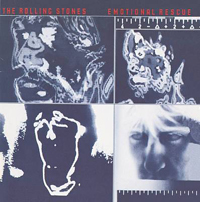
The Rolling Stones: Emotional Rescue

The Rolling Stones Emotional Rescue

In 1978, Some Girls proved that the Rolling Stones were still a major creative force and a rock and roll band to be reckoned with. In the age of punk, the Stones had proven themselves as fierce as any of the young upstarts who were dismissing them as dinosaurs. By ramping up the guitars, speeding up the tempos, and still being open to the current music scene, the Stones had planted a flag for all the remaining bands of the 1960s.

In 1980, they dug up the flag and buried it under a landfill.

Emotional Rescue is not the worst officially released Rolling Stones album, but it’s certainly near the bottom of the barrel. At least Their Satanic Majesties’ Request was an interesting failure and contained two classic Stones songs. By comparison, Emotional Rescue is a tired slog through the music scene of the day, populated by songs that were recorded but deemed not good enough for the previous album and a handful of new tracks. But even in 1980, the songs here sounded out of date. Disco was still king in 1980, but it was being absorbed by New Wave and post-punk and starting to manifest itself in some interesting ways. Some Girls showed that the Stones were paying close attention to disco and punk; Emotional Rescue indicates that they’d stopped listening to anything new in 1978. It is not the sound of a vital band; it is the sound of old war horses trying to emulate the sounds that the kids are listening to these days.

The opening track, “Dance, Pt. 1”, is as imaginative as its title. It’s a disco/funk track that is better than “Hot Stuff” but nowhere near as good as “Miss You”. It’s actually a pretty good groove, and Mick Jagger is convincing even as the rest of the band is coasting. “Get up/get out/Into something new” Jagger snarls. The nights he was spending at Studio 54 are clearly his muse here, but the lyrics are mostly nonsensical; he seems to have put almost no effort into writing them.

The Stones follow this with a rocker, opening the album with a disco/rock salvo that mirrors Some Girls. But “Summer Romance” is no “When The Whip Comes Down”. While “Romance” is one of the few genuine winners on the album, it’s also an archetypal post-Exile on Main Street rock track. It pales in comparison to the vastly superior rockers on Some Girls, but it’s a good album track here, and probably would have fit on Goats Head Soup or It’s Only Rock ‘n’ Roll. “Summer Romance” does, at least, have an excellent guitar solo, and Charlie Watts swings like a demon. There’s also an excellent bass line from Bill Wyman. In fact, Wyman is the unsung star of the album. For years his bass had been largely buried in the mix, but as the Stones paid homage to dance music, the rhythm section rose in importance and Wyman’s bass once again came forward. This album is actually a potent reminder of what a great bass player Bill Wyman was, and a sad reminder that the bass that was so prominent in the 1960s had become muted in the 1970s.

“Send It To Me” served notice that the Stones were checking off boxes on this album. “Dance” was the disco track, “Romance” the rocker, and “Send It To Me” is the obligatory reggae filler. It’s a lazy shuffle that Charlie Watts sounds half asleep on. The entire band plays it as if they simply don’t care. Jagger tries to put some life into it, but his delivery is once again undercut by half-baked lyrics about a mail-order bride. The Stones were never particularly convincing when it came to reggae, and this is readily apparent here. There’s no inspiration at all, just lazy playing.

The band returns to rock with “Let Me Go”, but the song simply sits there. Keith Richards and Ron Wood chug along nicely on guitar, but the song sounds like it’s going somewhere only when Jagger and Richards start harmonizing on the bridge. That moment passes in the blink of an eye and it’s back to the chug. There’s a decent guitar solo and once again Wyman plays like an old pro, but Watts now sounds like he’s completely asleep. The drums aren’t bad, especially in the breakdown about two and half minutes into the song, when Watts wakes up and reminds the world that he’s Charlie Watts and he doesn’t play bad drum parts, but nothing could save the song from its mediocrity. In the context of the album, “Let Me Go” sounds better than it actually is because it’s at the very least a rock number, and it’s the Stones playing the music they were born to play. It’s all the more disappointing because the song segues into “Indian Girl”, a too-long acoustic ballad that features some nice, tinkling piano parts and some genuinely lovely pedal steel from Ron Wood. But despite some interesting Mexican mariachi-style horns that add a nice touch “Indian Girl” is boring. The acoustic guitar is so laid back it might as well not even be there. Jagger talk-sings over the fade as the song disappears into nothingness. It’s too bad because on an album where the lyrics can best be described as weak, “Indian Girl” is a political rumination about the indigenous population of Central American countries at a time when that section of the world was being torn apart by conflict. It’s a serious subject and a heartfelt lyric, married to a tune that never happens.

The second side of the album kicks off with another rocker. “Where The Boys Go” was picked up by rock radio at the time because it was one of the few songs on the album where the Stones rocked unapologetically. But that doesn’t mean it’s a good song. There’s a fine guitar solo, but Jagger sings much of the song in a faux-Cockney accent that is, at best, distracting and, at worst, silly. There are also prominent female backing singers that add nothing but stridency to an already half-assed vocal. Yes, it rocks. Yes, Charlie Watts is now fully awake and pounding. But “Where The Boys Go” is tuneless and pointless. Like “Let Me Go” it sounds better in context but this is the weaker song.

The Stones had cut their teeth on blues music. Jagger famously said, in his first newspaper quote, “I hope they don’t think we’re a rock and roll outfit”. But while the blues always underpinned the Stones, the traditional form had largely been eschewed by the band. “Down In The Hole” was the first traditional 12-bar blues the Stones had done in many years. There’s a great harmonica and for the first time on this album the band sounds like they’re fully invested in the music. It’s not a great blues song by any stretch, but it was good enough that the Stones should have taken a cue from it and started doing more straight blues numbers. It’s a style the Stones always excelled at, and “Down In The Hole” provides a highlight on an album drowning in indifferent writing and playing.

The Stones were smart enough to put only one real disco song on Some Girls, and “Miss You” had a bridge that came out of the rock world. While you could dance to “Beast Of Burden” it was disguised enough to pass for a rock ballad on first listen. But the title track for this album is the single purest expression of Jagger’s love of disco that the Stones ever did. It bears almost no trace of rock. There are good things here: as required by the Gods of Disco, the rhythm section is spot-on (Wyman’s bass is outstanding) and the song is an earworm, making it somewhat listenable even when you’re not on the dance floor. There’s also a great saxophone in the fadeout. But there’s plenty of bad here, too. Jagger sings the entire song in a tortured falsetto, and does a proto-rap that is nothing short of excruciating; Richards and Wood are almost invisible; there’s no warmth at all and nary a trace of emotion in the performance. “Emotional Rescue” is a time piece. It’s forever locked into 1980 and it must be admitted that it evokes a time and a place for those of us who were around at that time. As was true of most disco, however, the songs that worked when you were dancing do nothing when you’re sitting at home or driving in your car. That goes double for this song because its style was based on heavily electronic Euro-disco, and not the more organic American dance music. “Emotional Rescue” was shocking enough as a Stones song that many fans started reaching for the torches and pitchforks, but it’s not as terrible as it seemed when it first was released. It’s also not good.

As if sensing that “Emotional Rescue” was a bridge too far, the Stones followed it with the one legit Stones classic on the album. “She’s So Cold” is the only track on this album that could have fit on Some Girls…probably because it was written and first recorded for that earlier album. Wyman again provides the support; his is the car the band rides in. Jagger’s vocal delivery is excellent and the lyrics contain the trademark misogyny and humor that marked so many of the band’s best songs. As they are throughout the album, the guitars are fairly muted but they are at least solid and Richards and Wood blend seamlessly.

Unfortunately, the Stones couldn’t sustain this level even for one more song. “All About You” has some wonderful harmonies on the chorus, but this is the first of many of Keith’s sleepy, album-closing ballads. Keith hasn’t written and sung a great ballad with the Stones since “You Got The Silver” on Let It Bleed, and “All About You” is never more than pleasant and boring.

Taken as a whole, Emotional Rescue is saved from being the Stones worst album by the fact that it sounds like the Stones at least had songs that they were performing (as opposed to the riff-based jams of Black And Blue). But there’s no question that the album is occasionally painful to listen to, and only once truly engages the listener. Satanic Majesties was a druggy experiment that went awry; Black and Blue was an audition turned into a contractual obligation album. Emotional Rescue was a different animal completely. Emotional Rescue was the Stones doing what the Stones are supposed to do…and failing.

Grade: D+