The Beatles: Magical Mystery Tour

TheBeatlesMagicalMysteryTouralbumcover

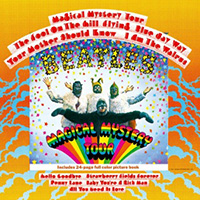
Released less than six months after the glory of Sgt. Pepper, Magical Mystery Tour is not really an album. At least, it wasn’t at the time. It was never released in England until the compact disc era. In truth, it was another money-grabbing effort from Capitol Records to milk a little more cash out of the audience. Ah, but what an effort…

In England, Magical Mystery Tour was released as an EP consisting of six songs on two slabs of vinyl. The songs were the soundtrack to a new movie made by, and starring, the Beatles. Since the EP market didn’t exist in America, Capitol Records took the six songs and added three recent singles, including the pre-Pepper “Strawberry Fields Forever/Penny Lane” single, the post-Pepper “All You Need Is Love/Baby You’re A Rich Man” single, and “Hello Goodbye” the A-side of the current single. But in this case, the desire for more sales accidentally created a masterpiece. There’s really no comparison: the American version of the Magical Mystery Tour soundtrack is so much better than the officially released EP that even the Beatles were forced to acknowledge it by making the American version the official version in 1987.

U.S. Edition U.K. Edition
1. Magical Mystery Tour
2. The Fool on the Hill
3. Flying
4. Blue Jay Way
5. Your Mother Should Know
6. I Am The Walrus
7. Hello Goodbye
8. Strawberry Fields Forever
9. Penny Lane
10. Baby You’re A Rich Man
11. All You Need Is Love
1. Magical Mystery Tour
2. Your Mother Should Know
3. I Am The Walrus
4. The Fool On The Hill
5. Flying
6. Blue Jay Way

Everything about the American version works better. Even the sequencing of the six soundtrack songs has a far better flow and pace than the double EP version. The packaging of the album, a gatefold with a 24-page booklet featuring a bizarre Beatles cartoon story and a series of extremely odd photographs, also benefits from being the larger LP size. It should be remembered how strange this must have seemed to the American audience. The Magical Mystery Tour movie was made specifically for the BBC and was never shown in America (lucky us), which means that the photographs and cartoon story had no real context outside of the album art. Why is there a photo of John Lennon dressed as a waiter shoveling mounds of spaghetti and what look like rags onto the plate of a large woman? Why is Paul McCartney in a military uniform? Why are there cartoons of the Beatles dressed as wizards? Who the hell is Little Nicola and why is she so adamant that I am not, in fact, the Walrus? Why are the Beatles, if it’s really them, dressed up like animals on the front cover?

The answer, of course, is that it was all part of a trippy mess of a movie, but the Americans didn’t know any of that, aside from a brief mention in the gatefold. What they knew was the music, most of which was sublime.

The title track serves much the same purpose as the title track of Sgt. Pepper. It’s a grand fanfare and an introduction. Separated from the movie, the song still works as an album intro, promising a journey to lands unknown in the songs that follow. It’s a loud, brassy song with simple lyrics that can be read two ways: the literal interpretation of a magical tour, and the metaphorical reading that reveals the drug references. “Magical Mystery Tour” is a drug song, starting with John Lennon’s carnival barker shout of “Roll up for the Magical Mystery Tour!”, a line that uses a common English phrase as code for the act of rolling a joint. The entire concept of the song, written by Paul McCartney, is based on the notion of tripping, taking the common British bus tour and using it as a metaphor for a journey to magical lands. But it is, in the end, still just a fanfare. The lyrics are simple and repetitive, saved from banality by the McCartney’s lead vocal and by the driving, propulsive music. Lyrically it’s even simpler than Sgt. Pepper‘s opening salvo, though the song itself is longer. Removed from its context it’s not a great song, but it’s a world-class album opener. It’s short enough that it doesn’t wear on the listener, punchy enough to force you to pay attention, and catchy enough to leave it stuck in your head. “Magical Mystery Tour” is less a song and more a mission statement. As such, it’s the perfect introduction to the songs that follow.

“The Fool On The Hill” is the first Beatles song to reflect their newfound admiration for the Maharishi Mahesh Yogi, a short, bearded guru with a girlish giggle who turned the Beatles on to Transcendental Meditation. At this point, the band was still enthralled with the diminutive Indian and McCartney’s “The Fool On The Hill” is a loving tribute, portraying the Maharishi as a misunderstood wise man while playing with the imagery of the man with the answers to life’s questions being seated at the top of a mountain. It hearkens back to the literary convention, used most famously by William Shakespeare, of having the Fool be the only person who can speak the truth that others don’t want to hear. The powerful brass of the preceding song is here replaced with flutes and woodwind instruments that float throughout the song, lending an airiness and a baroque sense of sophistication to the music that perfectly complements the naïve lyrics.

This is followed by a song that is one-of-a-kind in Beatles history. “Flying” is the only song credited to all four Beatles, and is the only instrumental they ever officially released. In the film, “Flying” is the soundtrack to a collection of unused footage that had been filmed for the trippy “stargate” sequence of 2001: A Space Odyssey, and it’s one of the few parts of the movie that genuinely works well. On record, distanced from the visuals, “Flying” still manages to achieve its desired effect. The title clues the listener in to what to expect, and the music doesn’t disappoint. The music glides and swirls. Keep the title in mind and close your eyes and you will see landscapes below you and clouds ahead. It’s very brief, just a bit over two minutes and the last thirty seconds or so is some Mellotron  squealing and backwards tapes that provides a perfect segue into George Harrison’s “Blue Jay Way”.

One of the key elements to Beatles music has always been humor. All four of the them were very, very funny. “Blue Jay Way” sounds mysterious and dark, psychedelic and moody. But the lyrics are actually typical Harrison humor. The song was composed when Harrison was waiting for Derek Taylor to arrive at a house he had rented in Los Angeles. Taylor was late, and had gotten lost. Harrison, at the point of exhaustion, passed the time by playing a Hammond organ and making up lyrics about his friends. The mysterious, atonal, psychedelia of the music is paired with lyrics that could have come from a Monty Python song:

There’s a fog upon L.A.
And my friends have lost their way
They’ll be over soon, they said
Now they’ve lost themselves instead
Please don’t be long

It’s the “they’ve lost themselves” that makes it, a wonderfully eccentric turn of phrase. The music on “Blue Jay Way” is probably the most psychedelic the Beatles ever got, which makes the next song on the album all the more jarring. “Your Mother Should Know” is a McCartney soft-shoe shuffle that harkens back to English music hall. It’s a thoroughly enjoyable trifle, as good as or better than most of McCartney’s similar excursions (“When I’m 64”, “Honey Pie”). It’s the kind of track that would never be approved by a record company today because it doesn’t sound like the other songs on the album, but the Beatles never felt constrained by the need to stick to a formula. They were restless in their creativity and went wherever the song happened to take them. In the case of “Your Mother Should Know” that creativity took them to a time before Elvis shook their worlds, a sound that may have opened the ears of some of their fans.

It was the last song on side one, the final song that appeared in the Magical Mystery Tour movie that really opened ears. John Lennon had heard that there was a course that analyzed Beatles lyrics being offered at his old high school in Liverpool, something he considered absolutely absurd. “I Am The Walrus” was his response, a series of images and lyrics that seemed to make sense in a Jabberwocky kind of way but were, in the end, meaningless. This was Lennon playing with words and having a grand time doing it. The images were sometimes shocking (“pornographic priestess”, “yellow-matter custard dripping from a dead dog’s eye”), sometimes funny (“crabalocker fishwife”, “I am the eggman”), and sometimes coded (“elementary penguins” were Hare Krishnas, “semolina pilchard” was a reference to Norman Pilcher, a British police officer who was notorious for busting rock stars for drugs and even more notorious for bringing his own just to be sure the charges stuck). “Lucy in the sky” gets a shoutout, and the opening couplet came to Lennon on separate acid trips, and it was all punctuated with the refrain “Goo goo g’joob!” The ending includes dialogue taken from a radio production of King Lear and a chanting chorus that repeats the phrase “everybody’s got one” and “oompah oompah stick it up your jumper”. Musically, the song stands with “A Day in the Life” and “Strawberry Fields Forever” as one of the band’s crowning achievements, largely due to producer George Martin’s ability to interpret the desires of his unschooled musicians. There is a rock band of guitar, bass, drums, and piano at the heart of “I Am The Walrus” but it’s the churning orchestration led by violins and cellos, with brass punctuation marks, that make the song stand out. The orchestration adds a veneer of sophistication and respectability. The song seems to be an important statement because the music is so serious. Ironically, a song written to mock the people who took Lennon’s lyrics too seriously sent people into a tizzy as they tried to figure out the meaning of this word jumble. Absent the orchestration, it’s likely that Lennon’s words would have been taken for what they were: a joke. But by adding the hallmarks of so-called “serious” music the Beatles made the joke all that much funnier. “I Am the Walrus” is the greatest musical practical joke ever played.

And it was a B-side of a single. Not even deemed worthy of being the A-side, much to Lennon’s annoyance.

The song that was the A-side of that single led off the second side of the album. “Hello Goodbye” is certainly a better single than “I Am the Walrus” even if it falls far short as a musical innovation. “Hello Goodbye” is insanely catchy, perhaps the catchiest thing Paul McCartney ever wrote (and that’s saying something). One listen and it’s hooked into your brain forever. The simple yin/yang lyrics are easily remembered and the melody is unforgettable. It may not be the achievement that “Walrus” was, but it was unquestionably a more marketable single. “I Am the Walrus” was a brilliantly disorienting slice of surrealism and wordplay. “Hello Goodbye” was a markedly less brilliant solid gold radio-ready hit.

What’s ironic about this is that the two songs that follow “Hello Goodbye” were the two sides of a double A-side single that had been released in February of 1967, months before Sgt. Pepper changed the musical landscape. That single, considered one of the greatest singles ever released, was also the first Beatles single to fail to make the top of the charts. “Strawberry Fields Forever” and “Penny Lane” were a huge leap forward when they were released as the first Beatles single after Revolver. Perhaps it was too far a leap, because the single stalled at number two in the charts, held back by Engelbert Humperdinck’s “Release Me”. That doesn’t change that both sides of the single were masterpieces. The songs had been recorded for Sgt. Pepper but rush released as a single when that album was delayed. They became the centerpiece of the second side of Magical Mystery Tour instead, and their inclusion elevates the entire album. There is a slight difference in tone between these songs and the rest of the tracks on the album…they’re not a perfect fit as they would have been on Pepper, but one would have to be a long-faced, humorless scold to care. When an LP is blessed to have both sides of what may be the greatest single in rock history (all votes for “Paperback Writer”/”Rain” will be counted), the idea that the songs sound like they were recorded at a different time and mindset is the lowest form of nitpicking.

If there is a fly in the ointment of the LP it’s “Baby You’re A Rich Man”. Comprised of two songs blended together (Lennon’s “One of the Beautiful People” and McCartney’s “Baby You’re A Rich Man”), the music features a discordant and harsh clavioline, not entirely pleasing to the ear. Lennon’s vocal melody is excellent though the vocal itself isn’t his strongest, and McCartney’s chorus is loud and brash, but both are somewhat undercut by the willfully defiant music. Rolling Stone Brian Jones pops up tooting on an oboe throughout the song, and Mick Jagger is rumored to be a backing voice in the finale. The song was thought to be about Beatles manager Brian Epstein (allegedly Lennon sings “baby you’re a rich fag Jew” at one point, but I’ve never heard it), but Lennon insisted that the song was a message to people to quit whining about their status in life, that we were all “rich”. Unfortunately, the lyrics are something of a mess (“You keep all your money in a big brown bag/Inside a zoo/What a thing to do”, contributed by McCartney, may be one of the dumbest lyrics ever written), so Lennon’s theme never becomes clear.

The lyrics of Magical Mystery Tour‘s final track are also something of a mess. The chorus made the song the anthem of the so-called “Summer of Love” when it was released as a single a month after Sgt. Pepper, but the verses are a circular mash of word soup. How do you parse “There’s nothing you can do that can’t be done” or “Nothing you can sing that can’t be sung”? At first glance, the lyrics seem like a “You can do it!” affirmation but what Lennon is really saying throughout the song is that you can’t do it. If it can’t be done, you can do nothing; if it can’t be sung, you can sing nothing; if it can’t be known, you can know nothing; if it isn’t shown, you can see nothing. This is reinforced by the one exception: “There nothing you can say/But you can learn how to play the game”. The chorus seems like a non-sequitur: “All you need is love/Love is all you need”. Lyrically, “All You Need is Love” takes a somewhat darker and more cynical tone than it is ever given credit for. “Love is all you need,” Lennon sings in the chorus, while the verses hammer home the message “because you don’t/can’t have anything else.” You  can learn how to play the game, but if it’s not already being done you can’t do it. “All You Need Is Love” is Lennon’s message to the voiceless, powerless masses that they don’t need the trappings of modern life as long as they have love. It’s a childlike message but, as he did later with the even more naïve “Imagine”,  he uses the music to sell the message. “All You Need Is Love” is a beautiful song, from the opening bars of “Le Marseillaise” to the winding close that incorporates musical themes from “Greensleeves” and “In The Mood” and lyrical shoutouts to “Yesterday” and “She Loves You”. The chorus is simple, making it perfect for singalongs and sloganeering (much like the vastly inferior song “Give Peace A Chance”), and the verses are melodic and sung beautifully by Lennon.

Magical Mystery Tour is not an album, but it is a magnificent LP record. Some of the best songs the Beatles ever did grace its grooves and even the songs that don’t rise to that level are excellent. The Beatles canon is improved by its inclusion.

Grade: A+

Ash, by James Herbert

8713500

It received scant notice on this side of the pond when James Herbert died at the age of 69 in March, 2013. I wasn’t even aware he had died until late in 2014. This demonstrates a considerable cultural difference between the States and England, where Herbert was the most successful and influential horror novelist of all time. His books have sold nearly 60 million copies and he was the leading stylist of what became known in Britain as “nasties”: horror novels that piled up gore, explicit sex, and far out plots, written in a breathless, fast-paced style. The sometimes extreme levels of gore and violence made the books difficult to read at times; the writing style made them impossible to put down. Once begun, you had to finish the book just to see what could happen next. In the 1980s, this movement reached America (by way of the English writer Clive Barker), in a more literary style that became known as “splatterpunk”.

James Herbert, whose first book came out the same time as Stephen King’s Carrie, was a talented writer who was responsible for some of the great horror novels of the past four decades. He started with real pulp, the go-for-the-throat, no-holds-barred horror of The Rats, but by his second novel he was creating believable characters and situations that took horror to new levels. The Fog, no relation to the John Carpenter film, is about a mist of chemicals traveling through the English countryside, turning everyone who comes into contact with it into homicidal or suicidal maniacs. In the most notorious section, a young woman attempts to commit suicide by drowning herself in the ocean, only to have second thoughts and begin to fight the powerful undertow and make her way back to shore. Blocking her way are thousands of people, the entire population of the beach town, walking into the sea like lemmings in a giant mass suicide shortly after the titular fog has passed through. The young woman never makes it back. It’s a genuinely chilling moment, and reveals a dark imagination at work. Herbert never really matched that scene, and his books swung wildly in quality from excellent (The Fog, Shrine, Domain, The Magic Cottage) to mediocre (Moon, The Dark, The Secret of Crickley Hall) to bad (Once, The Jonah, Portent, The Spear). Herbert’s books hurtle along at rocket speed, piling one horror on another, until the reader becomes exhausted. There’s nothing in any of his novels that qualifies as “literary”, but that’s fine. Herbert never made any claims to being literary. As a writer he’s far below the level of his American counterpart Stephen King, though even in his worst books nobody had ever accused Herbert of being boring (as some King books can be). If King is, as he described himself, the “literary equivalent of a Big Mac and fries”, then Herbert is the literary equivalent of a White Castle slider. If you like it, you love it, but nobody will ever make the mistake of calling it gourmet cuisine.

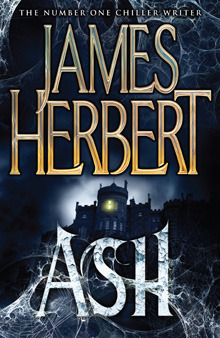
Ash is Herbert’s last book, barring any future posthumous releases. It is the continuing saga of ghost hunter David Ash, the protagonist of the earlier, excellent, novels Haunted and The Ghosts of Sleath. Unfortunately, David Ash’s saga and James Herbert’s career close not with the thunderous boom of a sarcophagus lid but rather the dull thud of a pine box.

In this novel, David Ash investigates the paranormal goings-on at a castle in Scotland. A man has been found crucified against a wall, held firmly in place by nothing. There is far more going on at Comraich Castle than a malevolent spirit, however. The castle has been used for over a hundred years by a cabal of extremely powerful people who go by the name the Inner Court and who specialize in making problems disappear. The castle is home to criminals, dictators, and those who could prove harmful or otherwise detrimental to those in power. Adolf Hitler’s aged daughter is kept in a cell in the basement, as are a high-ranking Church of England bishop who is also a notorious pedophile, Moammar Ghadafi who was secretly escorted out of Libya after his body double was assassinated, and Princess Diana’s first-born son (and heir to the throne), Louis, who suffered a severe birth defect that left him with nearly transparent skin. There is also a paid assassin who works for the Inner Court but who is determined to destroy the castle and everyone inside of it before the cancer in his body kills him.

The problem with Ash is that the title character is a ghost hunter and, while there are some supernatural events happening at the Castle, being channeled through the aforementioned unknown daughter of Hitler, those events are few and far between and then largely forgotten as the book winds down.

And this is the biggest issue with the book: as bombs are going off and castle walls are collapsing, as the main characters are desperately looking for a way out of the inferno, the supernatural elements of the book all but disappear and never threaten the heroes. There is a very creepy scene where Ash and his fellow protagonists need to make their way through a spider-infested cave, but that’s it. And even this scene may only be creepy to arachnophobes. A few of the less savory characters, the all-too-human villains, meet their ends at the hands of malevolent spirits but this seems to be almost an afterthought, as if at the last moment Herbert remembered that he was writing a ghost story and backfilled a few chapters with token appearances of the supernatural.

It’s a satisfying end to the story of David Ash, a likeable character whose experiences in earlier books would put Job to shame. It’s not a satisfying end to Herbert’s career, a book from the bad section of his lengthy bibliography. That’s unfortunate because, at his best, James Herbert crafted some of the most intense, horrifying scenes in the entire genre of horror fiction. None of those scenes appear in this book, a too-long, flat, novel that wants to go somewhere but never gets off the ground. James Herbert’s career has sadly ended with his first truly boring book.

The Rolling Stones: Undercover

undercover

In 1983, the Rolling Stones released yet another album that polarized fans. Undercover was their last blending of dance music and rock, and it was buried in “contemporary” production techniques that sound almost impossibly dated today. The music of the 1980s was blighted by these production standards: drums that sounded like machines (even when they weren’t), a clean, bright sound that smoothed over any and all rough edges, an over-reliance on synthesizers and sound effects, a shrill keyboard sound. Much of the music on Undercover, and even the album cover, was garish and brightly lit: like the decade itself. It’s hard to describe a sound of production techniques but the sound of the 1980s is all right there on side one, track one of Undercover.

“Undercover of the Night” is an almost perfect example of a song from the 1980s: the lyrics are about revolution in Central America, it was a rock song that had a dance groove, the drums sound like they were played on a computer, the bass is very prominent, the guitars slash but don’t really sound like guitars until the terrific solo, there is a wash of synthesizers over everything. But “Undercover” works, as so many other songs from this era failed to do. The production techniques of the time wrapped songs in a gauzy haze. The sound was pristine, but indistinct at the same time. There was no hint of musical interplay. For too many songs, there was no sense of real musicians playing instruments. Everything sounded processed by machines. Many great songs from this era are still difficult to listen to because they sound so bad. The quality of the writing, playing, and singing needed to be extraordinarily good to rise above the production values. Some albums succeeded despite their production (e.g., XTC’s Skylarking is a perfect example of an album where the songs were so good they rose above the neon shininess of the production), but most mainstream albums were suffocated before they had a chance to breathe.

“Undercover of the Night” is an exception. Perhaps it’s because the Stones embraced the new production values that they sound refreshed throughout most of the album. They were no longer even attempting to sound like the band that recorded Exile on Main Street. Instead, they sounded like the most vicious New Wave band on the planet. They brought their trademark aggression and encased it in a sound better suited for Duran Duran or Spandau Ballet. The final results were admittedly spotty, but that had more to do with the material than the production. “Undercover of the Night” is a great song, full of tension and violence. The video, featuring Keith Richards as a skull-masked assassin looking to kill Mick Jagger’s stuffed shirt diplomat, solidifies the impact. Taking a cue from dance music, Bill Wyman’s thick, rubbery bass is the lead instrument, swapping lines with the guitar over Charlie’s mechanized, effects-enhanced drums. Over the backing Jagger barks his lyrics about Communist insurgency in Central America, wisely avoiding choosing sides (there were no good guys in those conflicts). This being the Stones, Jagger makes even revolution sexual as he sings about the prostitutes “done up in lace, done up in rubber” servicing “jerky little GI Joes/On R&R from Cuba and Russia”. It’s a kitchen sink production, with the backwards loops, dub-influenced echo, and phased drums, but still leaves space for a ferocious guitar solo from Ron Wood. “Undercover of the Night” was the first single released from the album and was shocking in a way that the Stones hadn’t achieved since “Miss You”, and for the same reason. The song was the Stones wading into the production values of New Wave and dance music, and emerging with a tough rocker that you could dance to, and a video violent enough to be banned from MTV until it was edited. You can change the sound, but the Stones were still the Stones.

This was proven by “She Was Hot”, a comic sex-romp about groupies who are so steamy they leave even Mick Jagger burnt out. The effects of the previous song are gone here, leaving the band to sound natural again. Charlie Watts and Keith Richards benefit the most from this. Charlie lays down a steady beat and Keith plays a distorted, thick solo. Jagger shouts the funny lyrics, a vocal style that he would use more often as he got older. Undercover has a lot of great singing from Jagger, but also marks the point where his voice started to change into what you hear today: over-enunciated, shouting. The man who sang “Wild Horses” is still there, but time and life were conspiring to change the timbre of his voice.

This vocal style is even more pronounced on “Tie You Up (The Pain of Love)”, Jagger’s nod-and-a-wink song about S&M. In a way it’s a companion piece to “She Was Hot”, just another experience pulled from Jagger’s bottomless well of libertine decadence, but you never get the feeling that Jagger actually means it. When it came to sex, the Stones were always a little cartoonish, and this song fits right in to the milieu. Indeed, Keith has said that the song was something of a joke meant to annoy “mouthy little feminists” who had given the band a difficult time over their perceived misogyny since the days of “Under My Thumb”. Bill Wyman is again the real star of the song, which is a straight rocker with one foot in dance rhythms. There’s also a completely unnecessary conga break that adds nothing but a distraction.

Those dance rhythms are gone in “Wanna Hold You”, another winner in Keith’s string of rockers that dated back to Some Girls‘s “Before They Make Me Run”. From a technical perspective, “Wanna Hold You” is a mess. The backing vocals are all over the place, the lyrics are a throwaway, and Keith slurs the lead vocal. But Charlie Watts once again rides the beat like the old pro he is, and Ron Wood plays a solid bass line. It’s sloppy, but effective, a throwback to a time when the band was more concerned with the feeling of a song and not the perfection of a recording. Four songs in, and Undercover is firing on almost all cylinders. It won’t make anyone forget Sticky Fingers, but it’s clearly their best album since Some Girls.

All of which makes “Feel On Baby” even more disappointing. To call it a half-hearted stab at reggae would be overestimating it. Musically it’s a dull, phony dub/reggae tune mired in awful production values, electronic drums, shrill harmonica, and a go-through-the-motions lyric about hooking up with a girl while on the road. It’s one of the worst songs in the Stones canon.

The nadir of “Feel On Baby” is all the more unfortunate because it’s the one song on the album that’s truly bad. “Tie You Up” isn’t great, but otherwise Undercover is a strong album, more interesting and inspired than the overly praised Tattoo You. The second half picks up with “Too Much Blood”, another love-it-or-hate-it song that comes from the dance world. Once again the drums are processed beyond recognition, leaving the listener baffled as to why the Stones would put the great Charlie Watts in an electronic box. The guitars are barely noticeable, but offer a constant plucking and picking that drives the song. Once again, it’s Bill Wyman’s show, though he’s assisted by a punchy horn part. Over it all is a superficial lyric about just wanting to dance in a world that’s gone crazy. What makes the song different, however, is Jagger’s two extended raps. The first is a straight telling of a true murder story from Paris, about a Japanese man who murdered and ate his girlfriend. The second is, to me at least, an hilarious rap about the then-current trend of slasher movies. “You ever see the Texas Chainsaw Massacre? ‘Orrible, wasn’t it?” Jagger asks. “Oh no, don’t saw off me leg…don’t saw off me arm…When I go to the movies I like to see something more romantic. You know, like Officer and A Gentleman‘”. Both of the raps were off-the-cuff vocals, and they make the song. “Too Much Blood” succeeds because it has a great bass line, and because it’s funny. The video, with a campy, scared Jagger running away from chainsaw-wielding Keith and Woody, is even more amusing (in an admittedly dark way).

In a way, it’s easy to see why many fans dismissed Undercover. The middle of the album is a three song sequence that starts with the awful “Feel On Baby”, continues to the dance/rap hybrid of “Too Much Blood”, and culminates in the funk of “Pretty Beat Up”. If the Black and Blue album is what funky dance music sounded like in 1976, then “Pretty Beat Up” is what it sounded like in 1983. It’s a junk lyric, but it’s got a solid groove and a good sax solo from David Sanborn. Still, it’s the third song in a row that can’t really be classified as rock and roll or blues, so it’s the Stones playing outside of their strengths. “Pretty Beat Up” is good. It’s closer in spirit to Tattoo You‘s “Black Limousine” than Black and Blue‘s “Hot Stuff”, which makes it one of the band’s better excursions into funk.

The fans who stuck with the album through these three songs were paid off with “Too Tough”, “All The Way Down”, and “It Must Be Hell”. Jagger plays the strutting macho man of “Too Tough”, a riposte to an aggressive, possibly psychotic, woman who tried (and failed) to put the singer under her thumb. It’s the flip to “She Was Hot” with Jagger boasting of his victory over his female adversary. It’s a thoroughly convincing rocker, with Charlie once again on target and Ron Wood tearing into a quasi-heavy metal guitar solo.

Even better is “All The Way Down”, a sleazy rocker about a youthful affair. Jagger has commented that the song was based on an old relationship and the opening lyric, “I was 21, naïve/Not cynical, I tried to please” would seem to indicate that the girl in question may be Marianne Faithfull who, in 1983 when Undercover was released, was deep in the throes of drug addiction. “Still I play the fool and strut,” Jagger sings in a proto-rap style before shouting “Still you’re a slut!” It’s a harsh, angry song but there’s an undercurrent of lost affection in the bridge as Jagger croons “She’s there when I close my eyes” and also a real sense of lost time, innocence, and youth. “Still the years rush on by/Birthdays, kids, and suicides…Was every minute just a waste? Was every hour a foolish chase?” With Keith and Woody lending strong support, the chorus line of “She went all the way/All the way down” can serve as the obvious sexual reference it is but, assuming the song is about Faithfull, also a judgement about her life, now that the beautiful songbird of Swingin’ London had become a croaking, haggard junkie (she has, fortunately, cleaned up her act).

“It Must Be Hell” ends the album as it began, with another foray into politics. In this case, Jagger compares his life in the West with the one lived by those on the other side of the Iron Curtain. Lyrically, it’s a little sloppy. Jagger has admitted that the words weren’t as clear as he would have liked, especially in the first two verses. The closing summation makes his point, though, that as troubled as the West may have been, things were far worse under Communist rule:

Keep in a straight line, stay in tune

No need to worry, only fools

End up in prison or conscience cells

Or in asylums they help to build

We’re free to worship, free to speak

We’re free to kill, it’s guaranteed

We’ve got our problems, that’s for sure

Clean up the backyard, don’t lock the door

Musically, “It Must Be Hell” draws on a more unlikely source: the Stones themselves. The main guitar riff is a slightly altered variation of the chorus riff on Exile on Main Street‘s “Soul Survivor”. (Hey, it’s a great riff…Slash ripped it off for Michael Jackson’s “Black or White”, too.) At just over five minutes, “It Must Be Hell” overstays its welcome a little, but it’s a fine, propulsive rocker with scorched earth guitar work from Ron Wood.

Undercover was an experiment, an attempt to sound very contemporary. It was the last time the Stones would be this daring on an album. Experiments would be few over the rest of their career, which is unfortunate. Soon after this album the band would settle into workmanlike songwriting and playing that provided lots of good material, almost none of which were as memorable as their best music. In 1983 the Stones were fracturing. Keith and Mick were at each other’s throats, which is clearly evident in the lyrics on Undercover. It’s an album where the songs are steeped in violent metaphors and allusions. Even sex, Jagger’s leitmotif, has become violent. Nearly every song carries this theme: “Pretty Beat Up”, “Tie You Up”, “Too Tough”, “It Must Be Hell”, and that doesn’t even include the themes as shown in songs with more innocent titles: revolution, recrimination, bitterness, anger. What you’ve got with Undercover is an album where the band was working as a unit, but where the two songwriters and leaders were filled with passion. The anger would be even more pronounced later, but by then the unity was gone. By the time the unity returned, the passion was lost to an uneasy détente. That makes Undercover the last album made by the Rolling Stones as a vibrant, intense rock group. From here on they would be a working band, driven by habit, finance, and professionalism. Undercover has its flaws, but is a largely underrated album in the Stones discography. It’s the last album where the Stones sound like they were really trying, and that has to count for something.

Grade: B

Two Of The Greats Are Gone

They were never as widely known as the people they played with, but the recent loss of Bobby Keys and Ian McLagan marks a sad week for rock and roll fans.

Bobby Keys was a saxophone player out of Texas who had played with everyone from Little Eva to Little Anthony and the Imperials. He met the Rolling Stones while they were on their first tour of America and became friends with the band, especially Mick Jagger and Keith Richards. He was primarily a session player, but in 1969 he became an unofficial Rolling Stone when he played the sax solo on Let It Bleed‘s “Live With Me”. He was Keith’s sax player of choice afterwards, adding an extra dimension of musicality to the band’s extraordinary string of albums in the early Seventies. When people think of the classic Rolling Stones sound, Bobby Keys is an integral part of that mix.

He toured with the band throughout the rest of his life while also playing sessions for rock’s royalty. The sax on John Lennon’s “Whatever Gets You Through The Night”? The Faces’s “Had Me A Real Good Time”? George Harrison’s epic All Things Must Pass? Joe Cocker’s raucous Mad Dogs and Englishmen? These, and countless others, were improved by Bobby Keys. He played the sax with the soul of a jazz musician but the heart of a bluesman and the muscle of a rock star. I wouldn’t be surprised to find that most Stones fans have never even heard of the man, though it was the Stones with whom he was most closely associated. But any fans of rock music, and Stones fans in particular, have grooved to the music he made.

And if losing Bobby Keys wasn’t enough of a hit to the Rolling Stones camp, news yesterday announced the death of the great Ian McLagan. Mac was probably better-known than Keys because in addition to his session and tour work with the Rolling Stones, Mac was also an essential ingredient in two legendary bands that shared a name and personnel. Ian McLagan was the keyboard player for the Small Faces in the 1960s, and provided exemplary work on their classic albums (he also wrote and sang one of my favorites, “Up the Wooden Hills to Bedfordshire”). After singer Steve Marriott left, McLagan stayed when the Small Faces recruited Rod Stewart and Ron Wood and changed their name to Faces, and their sound from dreamy psych pop to raw blues rock. Mac’s piano playing was always a highlight of the band. He played broad boogie woogie, swirling psychedelia, and even the prominent electric keyboards on the Stones’s first excursion into disco, “Miss You”. He played sessions for everyone from Bob Dylan to Paul Westerberg, as well as releasing several solo albums. He also wrote one of the great rock autobiographies: All the Rage: A Riotous Romp Through Rock and Roll History. The rock and roll universe is a little dimmer now.

Jack Bruce, RIP

In my Junior year of high school, way back in 1980, my Spanish class had a Secret Santa for Christmas. We were all supposed to write our names on a slip of paper, put them in a box, and then draw names out of the box. Fortunately, my best friend and partner in all things music, Joe, sat next to me in that class. We had the slips of paper with our names but, rather than put them in the hopper, simply handed them to each other and then pretended to draw from the box. Neither of us wanted the obligatory bottle of cologne that would be presented by a girl, or whatever token gift one high school boy would give another. So when the time came, we exchanged presents. I gave him the LP Rainbow Bridge, by Jimi Hendrix. Joe gave me Cream’s Disraeli Gears. I can still vividly remember another of my friends complaining about the gift he’d gotten (of course, a bottle of cheap cologne). I’m sure he forgot about that gift long ago, but those two LPs Joe and I exchanged served us well for decades. I listened to Disraeli Gears until the grooves on the record were gone, and the album had to be replaced. I taped it and listened to it on a boombox whenever I had to do yard work the following summer. It became part of my DNA. I knew every note, every nuance. In May of 1982, Joe threw a beer bash at his house while his parents were away. We discovered that the day of the party also happened to be Cream bassist Jack Bruce’s birthday, so we posted up signs saying “Happy birthday Jack Bruce” and made sure that both Disraeli Gears and Wheels of Fire made it on to the turntable that night.

The soundtrack of my life during those years was huge, and varied, but Cream was one of the major players. I had all the albums, and went so far as to buy the huge poster that came with the first edition of the Goodbye album from my local record store, where it was stapled to the ceiling. Many years later, in 2005, Joe called me at work. He was talking to me in a very distracted way, mumbling and repeating, “Hold on…” before finally bursting out with “Got it! We’re going to see Cream at the Garden!” He’d been sitting at home, with two computers going, trying to get tickets. The concert was one of the best we’d ever been to, somewhat to our surprise. The band didn’t sound like three guys playing the music of Cream. They sounded like Cream. The three of them stretched out, with songs routinely crossing the eight-, nine-, or ten-minute mark. They played with the fluidity of the best jazz musicians and the fury of the best rock musicians. They were as locked in as any band I’ve ever seen, and they were louder than bombs. Nobody in the band had done anything as good as Cream in the 30+ years since the band’s breakup, but on this night it was like no time had passed. Eric Clapton was being forced to break a sweat for the first time in decades. Ginger Baker was a revelation, as good as he’d ever been, if not better.

The night, however, belonged to Jack Bruce. Two years earlier Bruce had a liver transplant, which meant that there were moments in the show where he sat down to rest. But his voice was as elegant as ever, a resonant tenor that added pathos to “We’re Going Wrong” and a withering intensity to “White Room.” His bass playing was equally remarkable. He played lightning fast runs on the bass, going toe-to-toe with one of rock’s greatest drummers and one of rock’s greatest guitarists.

Cream was a band of equals. Equal in skill, equal in ego, equal in ambition. It was a band that was never going to last because it was far too combustible. Bruce and Baker hated each other, though they were in awe of each other’s musicianship. All three members were also far too mercurial. Much like Jeff Beck or Neil Young, they were journeymen, too restless to ever be tied down for a long time. In many ways it’s a miracle Cream lasted as long as it did.

After the band split, Jack Bruce began an erratic solo career. He played free jazz with John McLaughlin on Things We Like and joined Tony Williams’s jazz fusion-oriented Lifetime. He released solo albums, and played with everyone from Frank Zappa and Lou Reed to Robin Trower and Leslie West. His jazz-influenced rock album I’ve Always Wanted To Do This paired him with the great jazz drummer Billy Cobham. It was released around the time I first got Disraeli Gears, and I bought it almost immediately.

Jack Bruce and Ginger Baker were jazz musicians. They played blues and rock, as well, but at the end of the day it was all about jazz for both of them. The intensity they brought to their extended musical improvisations when Cream performed live were revolutionary. They brought a level of musicianship to rock that demanded attention and respect.

Jack Bruce never matched what he did with Cream. He didn’t have to. He, along with the Who’s John Entwistle, changed the way bass players handled their instruments. Every jazz or rock bass player since Jack Bruce reflects his influence, consciously or unconsciously. He wrote some of the classic songs of the rock era: “Sunshine Of Your Love”, “White Room”, “Theme From An Imaginary Western”, among others. He was one of the greatest musicians in jazz, blues, or rock, a true virtuoso on his chosen instrument (and others he played equally well, like cello and piano), known for the complexity and speed he brought to his bass lines. He was an extraordinary singer, a difficult personality to deal with, too obstinate for his own good, too restless for his own career. He was a titan of the era of rock music. RIP.