Hot Wired Guitar: The Life of Jeff Beck, by Martin Power

Hot Wired Guitar Life Jeff BeckThere’s an old joke in music circles: If you want to drive a Jeff Beck fan crazy, ask him to name a good Jeff Beck album. There’s a soupçon of truth in that joke but, in fact, it’s easy to name a good Jeff Beck album. Or even a great one. It’s just as easy to name an album that is loaded with unbelievably great guitar playing but that still falls far short of the mark. Beck is nothing if not maddening.

Martin Power’s 2014 biography of the now late guitarist borders on hagiography at times, though it never quite succumbs. What is crystal clear is that Power considers Beck the greatest guitar player who ever lived, with the possible exception of Jimi Hendrix. And who’s to say that he’s wrong? Far more inventive than Clapton, Page, Allman, Vaughan and so many others, Beck has been lighting up the ears of guitar freaks and, maybe more importantly, other guitar players since he first burst onto the scene with the Yardbirds in 1965. His early experiments with feedback pre-dated Hendrix’s mastery over it while his lightning runs and otherworldly tremolo use set him up as a breed apart from his predecessor in the Yardbirds (Clapton) and his friend/successor (Page). The Yardbirds are known as the band that served as the minor leagues for Cream and Led Zeppelin, but the band’s best material, by far, was when Beck shook the strings. It’s really not even close. With Clapton the band was a fairly standard white blues band out of London, albeit one with a fiery guitar player. With Page the band was a spent force creatively until they broke up and the guitarist recruited three new players to fill the void. With Beck the band was frenetic and wild, incorporating sounds (like feedback) and tone (like Beck’s imitation of a sitar on “Heart Full of Soul”) that existed outside of the main music scene of the day.

Hot Wired Guitar focuses strongly on Beck’s career from his teenage years with The Tridents through the Yardbirds, the Jeff Beck Group, his brief dalliance with Vanilla Fudge’s Tim Bogert and Carmine Appice, and his solo career. It’s a well-written, excellent resource for the guitar player’s work, including the million and one guest spots he’s done with everyone from Stevie Wonder to Kelly Clarkson. A discography in the back of the book is a nice summary of Beck’s travels over a fifty-year career, and very handy if you want to stream his many guest appearances (who knew it was Jeff Beck providing the lead guitar work on Tina Turner’s “Private Dancer”? Not me).

Martin Power has clear favorites from the Beck discography, as his album by album reviews attest, and they’re the usual suspects: the Yardbirds’ Roger the Engineer, the Jeff Beck Group’s masterpiece Truth, the all-instrumental jazz fusion of Blow By Blow. The only album that Power criticizes as an album is 1985’s Flash, an attempt to get a hit record by pairing Beck up with a singer for the first time since 1972. Glossy, overproduced, and light on songs, Flash was a definite misfire despite a few good songs (an an excellent pairing, and near hit single, with his former lead singer Rod Stewart on “People Get Ready”). But other than Flash, Power focuses on Beck’s playing rather than the albums as a whole. So while Wired and There And Back, two more jazz fusion albums that are far less interesting than Blow By Blow, get criticized as being somewhat lacking, Power focuses on riffs and solos within the songs and in this area Beck could do no wrong. It is actually true that those albums, and most of his post-Blow By Blow efforts, do not measure up to what came before but the guitar playing is never less than brilliant. Long after Eric Clapton started playing it safe and Jimmy Page had all but retired, Beck was as playful, inventive, and incendiary as he ever was. Unique among musicians from that generation, Beck never rested on his laurels or settled into complacency. There is no sense of “heard it before” when discussing Jeff Beck.

Where Power fails in the book is the scant treatment he gives to the man himself. There is some talk about Beck’s prowess among the groupies in his time with the Yardbirds, but otherwise there’s no exploration of the man’s actual existence outside of his playing (and, later, his love of working on vintage cars). There’s no mention of drug use for example, and I don’t know whether that’s because Beck didn’t partake or because the author chose not to present him in a bad light. There’s a little bit of drinking, but not much and it seems never to have been a problem for the guitarist. One can write a book about a straight arrow, but there needs to be something in his life that’s of interest other than being a musician and a mechanic. Power discusses how mercurial Beck could be, dropping out of tours a few days into them, changing his mind about albums, recording, shows, and band members, but never really gets into what that meant for the people who surrounded him. The book is more about the life of a musician than that of a flesh-and-blood human being, and that’s a missed opportunity. Jeff Beck has always been an enigma. After reading Hot Wired Guitar, he’s still an enigma.
Cinema Speculation, by Quentin Tarantino

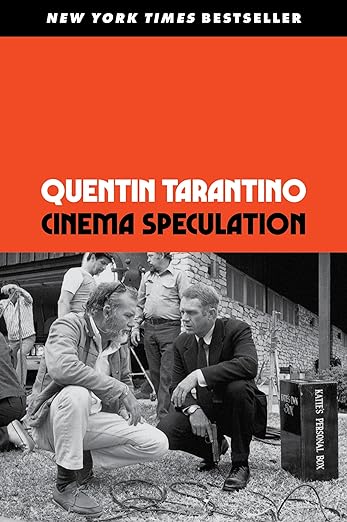
Cinema Speculation by Quentin Tarantino

Back in 1993, I rented the movie Reservoir Dogs from my local Blockbuster based on nothing more than the fact that it had a really good cast and I was going through something of a Harvey Keitel phase at the time. In my head now I can see Quentin Tarantino, the director of Reservoir Dogs, nodding his head briskly and winding himself up to tell me about all the movies he discovered the exact same way, by taking a chance on an unknown film with a favorite actor. I’d never heard of the director.

I also was struck by the title. What were “reservoir dogs”? It was an evocative title, but I couldn’t fathom what it was evoking. Now, having read Tarantino’s ode to genre movies, I understand. It means absolutely nothing. It was just a title that he thought sounded cool.

And that’s the thing with Tarantino. The movies he’s made all have one thing in common: the director thought they were cool. Cool plots, cool stars, cool camera tricks. Cool like Fonzie. Cool like Steve McQueen in Bullitt, the first film that Tarantino discusses in Cinema Speculation. This book is not any kind of history of cinema in the 1970s…that would be handled definitively by Peter Biskind in his massive tome Easy Riders, Raging Bulls. This book is the equivalent of one of Tarantino’s movies. The movies written about in its pages are ones that Tarantino would describe as “cool”.

Anyone who’s seen an interview with Tarantino knows what he’s like. He’s a hyped-up motormouth who can go on for hours, or maybe days, when it comes to discussing movies. With the possible exception of Martin Scorcese, he likely knows more about movies than anybody alive. But unlike so many of his fellow cinephiles, Tarantino doesn’t put on any airs. He likes what he likes, and doesn’t like the rest. He’s more in his element watching a movie like Humanoids From the Deep than he would be watching The 400 Blows or La Dolce Vita. He’s refreshingly unpretentious for a Hollywood doyen.

And that’s how the book reads. It reads at times more like a transcript of a monologue than something he’s carefully considered and written down. He fills the book with personal anecdotes about the movies he’s discussing, and goes off on tangents about other movies that are directly or indirectly related to the main topic of the chapter. It’s as if somebody turned on a tape recorder and asked, “So what are your impressions of Deliverance?” and then just let Tarantino joyfully and effortlessly spiel.

Tarantino has kept notes about every movie he’s ever seen, going back to when he was a child and his mother took him to some very adult films (e.g., M*A*S*H). He can thus recall not only when he saw the movies, but where, and with whom. In the book he writes about the “Movie Brats” like Scorcese, Spielberg, and DePalma…directors who grew up obsessed with the movies, and how they differed from their forerunners who looked at the movies as a job to be done on time and on budget. The earlier directors tried everything they could think of to get rid of solar lens flare in their outdoor scenes, and now J.J. Abrams, one of the more recent movie brats and something of a hack at it, is known for inserting lens flare into his movies. Why? Because he grew up watching the older movies and accepted it as an effect he thought was marvelous.

Tarantino largely ignores the tent pole movies of the 1970s. He skips The Sting, The Exorcist, Jaws, and Star Wars, although each of those movies gets a mention or two. He skips Viet Nam-centered movies like The Deer Hunter and Apocalypse Now in favor of Rolling Thunder. He makes the case, convincingly, that the violence and mayhem of Rolling Thunder makes for a better movie about veterans coming home from the war than the maudlin and overly dramatic “serious” film, Coming Home. He writes glowingly about movies termed “Revengeamatics” like Taxi Driver, Rolling Thunder, and Hardcore (which he tears to pieces for the second half of the movie). He doesn’t mention it, but I’ll go out on a limb and say he hated Best Picture Oscar winner Ordinary People…with good reason.

Rather than belabor the much-discussed and analyzed Rocky, he focuses on Sylvester Stallone’s long-forgotten directorial debut, Paradise Alley. It’s an odd choice, and Tarantino writes about the experience of seeing Rocky in the theater and the reaction of the audience, an experience that mirrors my own almost exactly. Instead of Brian DePalma’s masterworks Carrie or Dressed to Kill, he writes about the early effort Sisters, a pretty pedestrian thriller. Clint Eastwood gets the royal treatment with a chapter about Dirty Harry and another about Escape from Alcatraz.

Even The Funhouse, a pretty standard slasher movie from 1981, gets a chapter.

Mixed in with these film discussions are personal anecdotes of a lifetime spent watching movies, and one chapter that gives the book its title, wondering what Taxi Driver would have been like if Brian DePalma had directed it instead of Martin Scorcese. There’s also a somewhat out of place chapter about Peter Bogdanovich’s Daisy Miller that, I suspect, was included because he wanted to write a chapter about that particular movie brat without falling back on The Last Picture Show, Paper Moon, or What’s Up, Doc?

Throughout the book, Tarantino’s love for movies shines through on every page. It’s almost impossible not to ride the wave of his sheer enthusiasm. I read the ebook version and there are some formatting issues that may or may not be in the print edition. Names of characters, and anything between quotation marks are all italicized for some bizarre reason. Tarantino also has a tendency to be all over the place in his storytelling as talking about one movie will remind him of others that he feels the need to discuss, sometimes at length. This is where that feeling that the book is a transcript comes in. It’s fun, it’s interesting and at times fascinating, it’s opinionated, and you can get dizzy trying to keep up.

Quentin Tarantino, along with Christopher Nolan, is one of the most interesting writer/directors working today. He has said repeatedly that his next movie will be his last so he can focus on writing about the movies. As a fan of his work from Reservoir Dogs to Once Upon a Time…in Hollywood and including everything in between, I would wish for both. Hanging up his director shoes is the equivalent of Daniel Day-Lewis retiring from acting. It seems like a crime against cinema. But if the downside is more books like Cinema Speculation, that will at least be something to tide his fans over and keep his gonzo spirit alive.