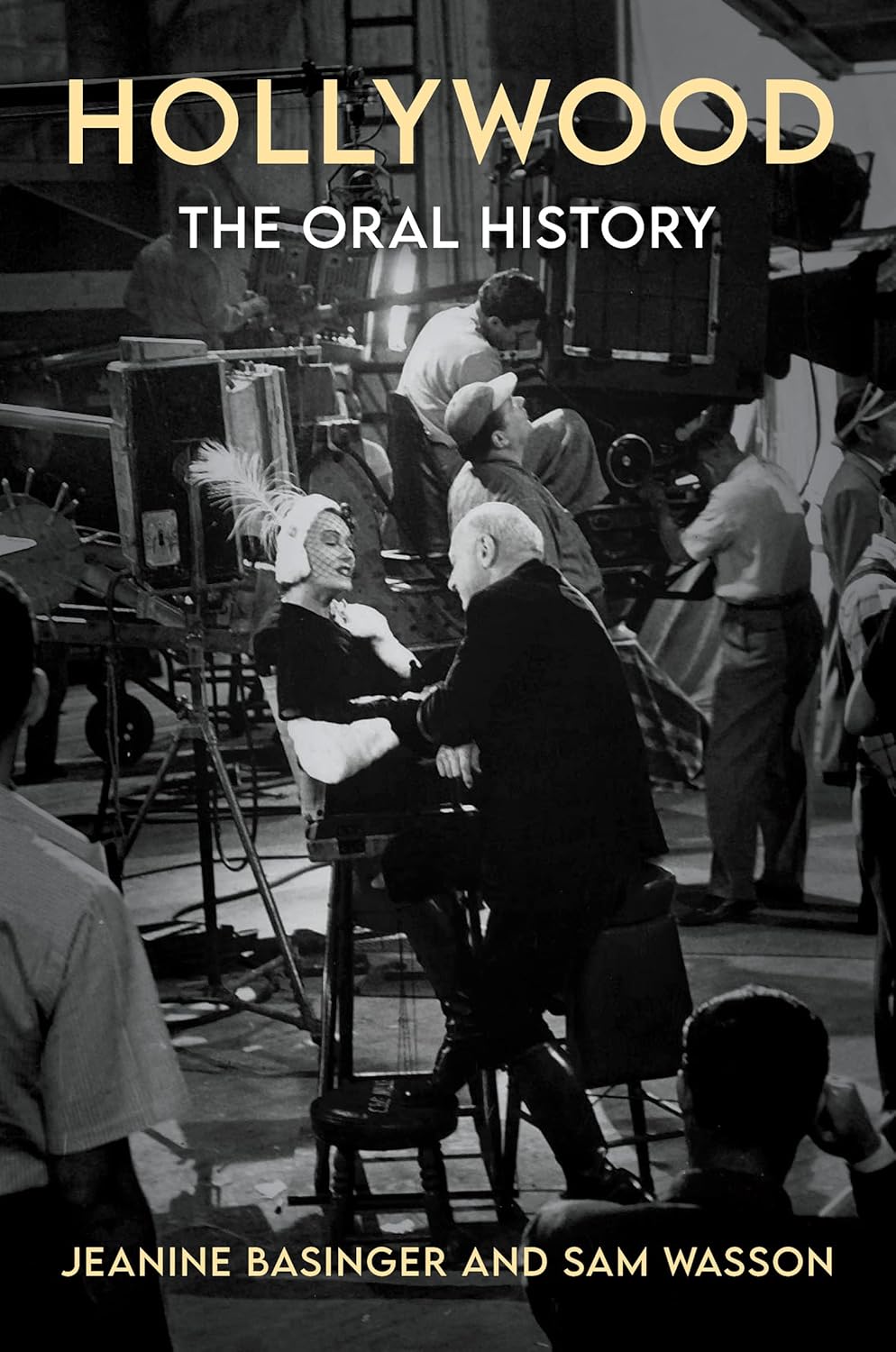
 I’ve been looking for a good history of the movie industry for a long time now, which makes Jeanine Basinger’s and Sam Wasson’s 2023 release Hollywood: The Oral History all that much more frustrating.
The book is excellent for what it is. Oral histories are as difficult to compile as they are easy to read, and the effort that Basinger and Wasson put in is Herculean. They scoured primarily the American Film Institute’s series of interviews with the movers and shakers of Hollywood. Everyone is accounted for here from studio heads to writers to producers to directors to stars to crew. As they tell their stories, a rough history of the movies takes shape. Unfortunately almost 800 pages later that’s what you’re left with…a rough history of the movies told from specific, and sometimes contradictory, points of view. Over 400 people are represented in the book so the story can get a little scattershot at times.
What this book is extraordinarily good at is providing a detailed look at how movies are made. From concept to script to screen, the journey of a film is explained in detail. Mysteries are solved, such as “What does a producer actually do?” The moguls, people like Irving Thalberg, Jack Warner and Sam Goldwyn, are also discussed at some length by people who knew and worked with them. This oral history approach brings the famous names of Hollywood to life in a way that a more conventional history might not have.
The evolution and dissolution of the studio system takes up the first half of the book, before giving way to the “New Hollywood” when the Hays Code was abandoned and filmmakers approached their jobs with newfound freedom. That freedom ushered in a lot of gratuitous nudity and violence but also enabled the moviemakers with the ability to make personal artistic statements in a way not seen since Orson Welles made Citizen Kane. The ending of Bonnie and Clyde, one of the first films from the New Hollywood, could never have been made during the studio system (one of the reasons it was so shocking in 1967) but it still has the power to shake the viewer almost 60 years later. From the studio system only the shower scene in Psycho compares, and that contained no shots of the knife piercing Janet Leigh’s skin.
The New Hollywood is deservedly discussed at some length, including the rise of the blockbuster films, led by Jaws. The tentpoles of the era are The Godfather, The Exorcist, Jaws, and Star Wars and all receive their due respect. Most other films are glossed over or mentioned in passing despite their influence on the cinema. While directors like Peter Bogdanovich are quoted extensively, there’s virtually nothing in the book about The Last Picture Show, Paper Moon, or What’s Up, Doc? and less to connect him to those movies. Stanley Kubrick gets a bit more respect, but not much. Even Martin Scorsese string of influential 70’s movies get a superficial treatment.
The book is basically the point of view of the studios. There is a great deal of talk about how Jaws opened in a record number of theaters, how it became the first summer blockbuster film, and how much money it made. There is very little, if any, discussion about the content of the film. If you were to read the book without being familiar with the movie, there would be no context whatsoever with the words on the page.
And this is the most frustrating part of the book. In the beginning there is a list of all of the designated narrators of the story, along with their role. So you get names like “Steven Spielberg, director” but there is nothing at all to tell the reader what films Spielberg actually directed. There is no filmography in the book so there is no way to connect the narrators with the final work that they did. More than once I had to go to IMDB to find out just who the narrators actually were. The director Allan Dwan is quoted at some length in the book but it wasn’t until I went to IMDB before I realized that he’d directed Brewster’s Millions and The Sands of Iwo Jima. Similarly, there is no sense of when the interviews were given. Some of them are decades old. Directors will wax poetic about the good old days and the problems with movies in the current age, but there is no clue whatsoever about when the good old days were or when the current age is. When discussing movies in the present tense, it’s helpful to know when the present is.
A similar frustration is the lack of an index. It is historical malpractice to write an extensive, 800 page survey history of a time and place without including an index. So if you want to know the opinion of the Hollywood movers and shakers about Monroe, Marilyn (not a good opinion at all), you just need to remember in which chapter and pages those observations reside. It makes going back to fact check some of my opinions here impossible.
On the negative side, there is also the lack of pictures. How does one compile an oral history of moving pictures without including any pictures? It’s another missed opportunity for Basinger and Wasson. Perhaps they were worried that the inclusion of pictures, filmographies, and an index would pad an already overstuffed book, but it would be better to have a 900 page book with context than an 800 page without.
Finally, this is something of a whitewashed history. Hollywood’s notorious reputation of being a place where decadence and debauchery are not just accepted but expected, is nowhere to be found. There is no cocaine blizzard in the studios during the 1970s. There’s no casting couch or #MeToo movement. There are not even any closeted homosexuals married to beautiful starlets. No affairs, no divorce, no alcoholism, no mental breakdowns. Hollywood earned this reputation and not just recently. Nathanael West’s The Day of the Locust was written in 1940 and the hedonistic reputation of the city as both the maker and breaker of dreams was already set in stone.
Hollywood: The Oral History is a compelling and at times fascinating book. Unfortunately it is not the whole story and what is there is presented without much context. As such it is Hollywood 101. Deep dives into the history of the movies exist, but they are more likely to be focused on specific eras or filmmakers (e.g., Peter Biskind’s authoritative history of the New Hollywood in Easy Riders, Raging Bulls). An oral history may be the right approach for a history of such an unwieldy subject, but Basinger and Wasson fall several feet short of the mark.
 shabby-road.com