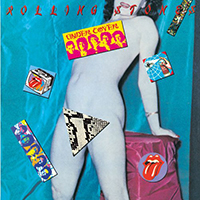
The Rolling Stones: Undercover

undercover

In 1983, the Rolling Stones released yet another album that polarized fans. Undercover was their last blending of dance music and rock, and it was buried in “contemporary” production techniques that sound almost impossibly dated today. The music of the 1980s was blighted by these production standards: drums that sounded like machines (even when they weren’t), a clean, bright sound that smoothed over any and all rough edges, an over-reliance on synthesizers and sound effects, a shrill keyboard sound. Much of the music on Undercover, and even the album cover, was garish and brightly lit: like the decade itself. It’s hard to describe a sound of production techniques but the sound of the 1980s is all right there on side one, track one of Undercover.

“Undercover of the Night” is an almost perfect example of a song from the 1980s: the lyrics are about revolution in Central America, it was a rock song that had a dance groove, the drums sound like they were played on a computer, the bass is very prominent, the guitars slash but don’t really sound like guitars until the terrific solo, there is a wash of synthesizers over everything. But “Undercover” works, as so many other songs from this era failed to do. The production techniques of the time wrapped songs in a gauzy haze. The sound was pristine, but indistinct at the same time. There was no hint of musical interplay. For too many songs, there was no sense of real musicians playing instruments. Everything sounded processed by machines. Many great songs from this era are still difficult to listen to because they sound so bad. The quality of the writing, playing, and singing needed to be extraordinarily good to rise above the production values. Some albums succeeded despite their production (e.g., XTC’s Skylarking is a perfect example of an album where the songs were so good they rose above the neon shininess of the production), but most mainstream albums were suffocated before they had a chance to breathe.

“Undercover of the Night” is an exception. Perhaps it’s because the Stones embraced the new production values that they sound refreshed throughout most of the album. They were no longer even attempting to sound like the band that recorded Exile on Main Street. Instead, they sounded like the most vicious New Wave band on the planet. They brought their trademark aggression and encased it in a sound better suited for Duran Duran or Spandau Ballet. The final results were admittedly spotty, but that had more to do with the material than the production. “Undercover of the Night” is a great song, full of tension and violence. The video, featuring Keith Richards as a skull-masked assassin looking to kill Mick Jagger’s stuffed shirt diplomat, solidifies the impact. Taking a cue from dance music, Bill Wyman’s thick, rubbery bass is the lead instrument, swapping lines with the guitar over Charlie’s mechanized, effects-enhanced drums. Over the backing Jagger barks his lyrics about Communist insurgency in Central America, wisely avoiding choosing sides (there were no good guys in those conflicts). This being the Stones, Jagger makes even revolution sexual as he sings about the prostitutes “done up in lace, done up in rubber” servicing “jerky little GI Joes/On R&R from Cuba and Russia”. It’s a kitchen sink production, with the backwards loops, dub-influenced echo, and phased drums, but still leaves space for a ferocious guitar solo from Ron Wood. “Undercover of the Night” was the first single released from the album and was shocking in a way that the Stones hadn’t achieved since “Miss You”, and for the same reason. The song was the Stones wading into the production values of New Wave and dance music, and emerging with a tough rocker that you could dance to, and a video violent enough to be banned from MTV until it was edited. You can change the sound, but the Stones were still the Stones.

This was proven by “She Was Hot”, a comic sex-romp about groupies who are so steamy they leave even Mick Jagger burnt out. The effects of the previous song are gone here, leaving the band to sound natural again. Charlie Watts and Keith Richards benefit the most from this. Charlie lays down a steady beat and Keith plays a distorted, thick solo. Jagger shouts the funny lyrics, a vocal style that he would use more often as he got older. Undercover has a lot of great singing from Jagger, but also marks the point where his voice started to change into what you hear today: over-enunciated, shouting. The man who sang “Wild Horses” is still there, but time and life were conspiring to change the timbre of his voice.

This vocal style is even more pronounced on “Tie You Up (The Pain of Love)”, Jagger’s nod-and-a-wink song about S&M. In a way it’s a companion piece to “She Was Hot”, just another experience pulled from Jagger’s bottomless well of libertine decadence, but you never get the feeling that Jagger actually means it. When it came to sex, the Stones were always a little cartoonish, and this song fits right in to the milieu. Indeed, Keith has said that the song was something of a joke meant to annoy “mouthy little feminists” who had given the band a difficult time over their perceived misogyny since the days of “Under My Thumb”. Bill Wyman is again the real star of the song, which is a straight rocker with one foot in dance rhythms. There’s also a completely unnecessary conga break that adds nothing but a distraction.

Those dance rhythms are gone in “Wanna Hold You”, another winner in Keith’s string of rockers that dated back to Some Girls‘s “Before They Make Me Run”. From a technical perspective, “Wanna Hold You” is a mess. The backing vocals are all over the place, the lyrics are a throwaway, and Keith slurs the lead vocal. But Charlie Watts once again rides the beat like the old pro he is, and Ron Wood plays a solid bass line. It’s sloppy, but effective, a throwback to a time when the band was more concerned with the feeling of a song and not the perfection of a recording. Four songs in, and Undercover is firing on almost all cylinders. It won’t make anyone forget Sticky Fingers, but it’s clearly their best album since Some Girls.

All of which makes “Feel On Baby” even more disappointing. To call it a half-hearted stab at reggae would be overestimating it. Musically it’s a dull, phony dub/reggae tune mired in awful production values, electronic drums, shrill harmonica, and a go-through-the-motions lyric about hooking up with a girl while on the road. It’s one of the worst songs in the Stones canon.

The nadir of “Feel On Baby” is all the more unfortunate because it’s the one song on the album that’s truly bad. “Tie You Up” isn’t great, but otherwise Undercover is a strong album, more interesting and inspired than the overly praised Tattoo You. The second half picks up with “Too Much Blood”, another love-it-or-hate-it song that comes from the dance world. Once again the drums are processed beyond recognition, leaving the listener baffled as to why the Stones would put the great Charlie Watts in an electronic box. The guitars are barely noticeable, but offer a constant plucking and picking that drives the song. Once again, it’s Bill Wyman’s show, though he’s assisted by a punchy horn part. Over it all is a superficial lyric about just wanting to dance in a world that’s gone crazy. What makes the song different, however, is Jagger’s two extended raps. The first is a straight telling of a true murder story from Paris, about a Japanese man who murdered and ate his girlfriend. The second is, to me at least, an hilarious rap about the then-current trend of slasher movies. “You ever see the Texas Chainsaw Massacre? ‘Orrible, wasn’t it?” Jagger asks. “Oh no, don’t saw off me leg…don’t saw off me arm…When I go to the movies I like to see something more romantic. You know, like Officer and A Gentleman‘”. Both of the raps were off-the-cuff vocals, and they make the song. “Too Much Blood” succeeds because it has a great bass line, and because it’s funny. The video, with a campy, scared Jagger running away from chainsaw-wielding Keith and Woody, is even more amusing (in an admittedly dark way).

In a way, it’s easy to see why many fans dismissed Undercover. The middle of the album is a three song sequence that starts with the awful “Feel On Baby”, continues to the dance/rap hybrid of “Too Much Blood”, and culminates in the funk of “Pretty Beat Up”. If the Black and Blue album is what funky dance music sounded like in 1976, then “Pretty Beat Up” is what it sounded like in 1983. It’s a junk lyric, but it’s got a solid groove and a good sax solo from David Sanborn. Still, it’s the third song in a row that can’t really be classified as rock and roll or blues, so it’s the Stones playing outside of their strengths. “Pretty Beat Up” is good. It’s closer in spirit to Tattoo You‘s “Black Limousine” than Black and Blue‘s “Hot Stuff”, which makes it one of the band’s better excursions into funk.

The fans who stuck with the album through these three songs were paid off with “Too Tough”, “All The Way Down”, and “It Must Be Hell”. Jagger plays the strutting macho man of “Too Tough”, a riposte to an aggressive, possibly psychotic, woman who tried (and failed) to put the singer under her thumb. It’s the flip to “She Was Hot” with Jagger boasting of his victory over his female adversary. It’s a thoroughly convincing rocker, with Charlie once again on target and Ron Wood tearing into a quasi-heavy metal guitar solo.

Even better is “All The Way Down”, a sleazy rocker about a youthful affair. Jagger has commented that the song was based on an old relationship and the opening lyric, “I was 21, naïve/Not cynical, I tried to please” would seem to indicate that the girl in question may be Marianne Faithfull who, in 1983 when Undercover was released, was deep in the throes of drug addiction. “Still I play the fool and strut,” Jagger sings in a proto-rap style before shouting “Still you’re a slut!” It’s a harsh, angry song but there’s an undercurrent of lost affection in the bridge as Jagger croons “She’s there when I close my eyes” and also a real sense of lost time, innocence, and youth. “Still the years rush on by/Birthdays, kids, and suicides…Was every minute just a waste? Was every hour a foolish chase?” With Keith and Woody lending strong support, the chorus line of “She went all the way/All the way down” can serve as the obvious sexual reference it is but, assuming the song is about Faithfull, also a judgement about her life, now that the beautiful songbird of Swingin’ London had become a croaking, haggard junkie (she has, fortunately, cleaned up her act).

“It Must Be Hell” ends the album as it began, with another foray into politics. In this case, Jagger compares his life in the West with the one lived by those on the other side of the Iron Curtain. Lyrically, it’s a little sloppy. Jagger has admitted that the words weren’t as clear as he would have liked, especially in the first two verses. The closing summation makes his point, though, that as troubled as the West may have been, things were far worse under Communist rule:

Keep in a straight line, stay in tune

No need to worry, only fools

End up in prison or conscience cells

Or in asylums they help to build

We’re free to worship, free to speak

We’re free to kill, it’s guaranteed

We’ve got our problems, that’s for sure

Clean up the backyard, don’t lock the door

Musically, “It Must Be Hell” draws on a more unlikely source: the Stones themselves. The main guitar riff is a slightly altered variation of the chorus riff on Exile on Main Street‘s “Soul Survivor”. (Hey, it’s a great riff…Slash ripped it off for Michael Jackson’s “Black or White”, too.) At just over five minutes, “It Must Be Hell” overstays its welcome a little, but it’s a fine, propulsive rocker with scorched earth guitar work from Ron Wood.

Undercover was an experiment, an attempt to sound very contemporary. It was the last time the Stones would be this daring on an album. Experiments would be few over the rest of their career, which is unfortunate. Soon after this album the band would settle into workmanlike songwriting and playing that provided lots of good material, almost none of which were as memorable as their best music. In 1983 the Stones were fracturing. Keith and Mick were at each other’s throats, which is clearly evident in the lyrics on Undercover. It’s an album where the songs are steeped in violent metaphors and allusions. Even sex, Jagger’s leitmotif, has become violent. Nearly every song carries this theme: “Pretty Beat Up”, “Tie You Up”, “Too Tough”, “It Must Be Hell”, and that doesn’t even include the themes as shown in songs with more innocent titles: revolution, recrimination, bitterness, anger. What you’ve got with Undercover is an album where the band was working as a unit, but where the two songwriters and leaders were filled with passion. The anger would be even more pronounced later, but by then the unity was gone. By the time the unity returned, the passion was lost to an uneasy détente. That makes Undercover the last album made by the Rolling Stones as a vibrant, intense rock group. From here on they would be a working band, driven by habit, finance, and professionalism. Undercover has its flaws, but is a largely underrated album in the Stones discography. It’s the last album where the Stones sound like they were really trying, and that has to count for something.

Grade: B
Two Of The Greats Are Gone

They were never as widely known as the people they played with, but the recent loss of Bobby Keys and Ian McLagan marks a sad week for rock and roll fans.

Bobby Keys was a saxophone player out of Texas who had played with everyone from Little Eva to Little Anthony and the Imperials. He met the Rolling Stones while they were on their first tour of America and became friends with the band, especially Mick Jagger and Keith Richards. He was primarily a session player, but in 1969 he became an unofficial Rolling Stone when he played the sax solo on Let It Bleed‘s “Live With Me”. He was Keith’s sax player of choice afterwards, adding an extra dimension of musicality to the band’s extraordinary string of albums in the early Seventies. When people think of the classic Rolling Stones sound, Bobby Keys is an integral part of that mix.

He toured with the band throughout the rest of his life while also playing sessions for rock’s royalty. The sax on John Lennon’s “Whatever Gets You Through The Night”? The Faces’s “Had Me A Real Good Time”? George Harrison’s epic All Things Must Pass? Joe Cocker’s raucous Mad Dogs and Englishmen? These, and countless others, were improved by Bobby Keys. He played the sax with the soul of a jazz musician but the heart of a bluesman and the muscle of a rock star. I wouldn’t be surprised to find that most Stones fans have never even heard of the man, though it was the Stones with whom he was most closely associated. But any fans of rock music, and Stones fans in particular, have grooved to the music he made.

And if losing Bobby Keys wasn’t enough of a hit to the Rolling Stones camp, news yesterday announced the death of the great Ian McLagan. Mac was probably better-known than Keys because in addition to his session and tour work with the Rolling Stones, Mac was also an essential ingredient in two legendary bands that shared a name and personnel. Ian McLagan was the keyboard player for the Small Faces in the 1960s, and provided exemplary work on their classic albums (he also wrote and sang one of my favorites, “Up the Wooden Hills to Bedfordshire”). After singer Steve Marriott left, McLagan stayed when the Small Faces recruited Rod Stewart and Ron Wood and changed their name to Faces, and their sound from dreamy psych pop to raw blues rock. Mac’s piano playing was always a highlight of the band. He played broad boogie woogie, swirling psychedelia, and even the prominent electric keyboards on the Stones’s first excursion into disco, “Miss You”. He played sessions for everyone from Bob Dylan to Paul Westerberg, as well as releasing several solo albums. He also wrote one of the great rock autobiographies: All the Rage: A Riotous Romp Through Rock and Roll History. The rock and roll universe is a little dimmer now.

Jack Bruce, RIP

In my Junior year of high school, way back in 1980, my Spanish class had a Secret Santa for Christmas. We were all supposed to write our names on a slip of paper, put them in a box, and then draw names out of the box. Fortunately, my best friend and partner in all things music, Joe, sat next to me in that class. We had the slips of paper with our names but, rather than put them in the hopper, simply handed them to each other and then pretended to draw from the box. Neither of us wanted the obligatory bottle of cologne that would be presented by a girl, or whatever token gift one high school boy would give another. So when the time came, we exchanged presents. I gave him the LP Rainbow Bridge, by Jimi Hendrix. Joe gave me Cream’s Disraeli Gears. I can still vividly remember another of my friends complaining about the gift he’d gotten (of course, a bottle of cheap cologne). I’m sure he forgot about that gift long ago, but those two LPs Joe and I exchanged served us well for decades. I listened to Disraeli Gears until the grooves on the record were gone, and the album had to be replaced. I taped it and listened to it on a boombox whenever I had to do yard work the following summer. It became part of my DNA. I knew every note, every nuance. In May of 1982, Joe threw a beer bash at his house while his parents were away. We discovered that the day of the party also happened to be Cream bassist Jack Bruce’s birthday, so we posted up signs saying “Happy birthday Jack Bruce” and made sure that both Disraeli Gears and Wheels of Fire made it on to the turntable that night.

The soundtrack of my life during those years was huge, and varied, but Cream was one of the major players. I had all the albums, and went so far as to buy the huge poster that came with the first edition of the Goodbye album from my local record store, where it was stapled to the ceiling. Many years later, in 2005, Joe called me at work. He was talking to me in a very distracted way, mumbling and repeating, “Hold on…” before finally bursting out with “Got it! We’re going to see Cream at the Garden!” He’d been sitting at home, with two computers going, trying to get tickets. The concert was one of the best we’d ever been to, somewhat to our surprise. The band didn’t sound like three guys playing the music of Cream. They sounded like Cream. The three of them stretched out, with songs routinely crossing the eight-, nine-, or ten-minute mark. They played with the fluidity of the best jazz musicians and the fury of the best rock musicians. They were as locked in as any band I’ve ever seen, and they were louder than bombs. Nobody in the band had done anything as good as Cream in the 30+ years since the band’s breakup, but on this night it was like no time had passed. Eric Clapton was being forced to break a sweat for the first time in decades. Ginger Baker was a revelation, as good as he’d ever been, if not better.

The night, however, belonged to Jack Bruce. Two years earlier Bruce had a liver transplant, which meant that there were moments in the show where he sat down to rest. But his voice was as elegant as ever, a resonant tenor that added pathos to “We’re Going Wrong” and a withering intensity to “White Room.” His bass playing was equally remarkable. He played lightning fast runs on the bass, going toe-to-toe with one of rock’s greatest drummers and one of rock’s greatest guitarists.

Cream was a band of equals. Equal in skill, equal in ego, equal in ambition. It was a band that was never going to last because it was far too combustible. Bruce and Baker hated each other, though they were in awe of each other’s musicianship. All three members were also far too mercurial. Much like Jeff Beck or Neil Young, they were journeymen, too restless to ever be tied down for a long time. In many ways it’s a miracle Cream lasted as long as it did.

After the band split, Jack Bruce began an erratic solo career. He played free jazz with John McLaughlin on Things We Like and joined Tony Williams’s jazz fusion-oriented Lifetime. He released solo albums, and played with everyone from Frank Zappa and Lou Reed to Robin Trower and Leslie West. His jazz-influenced rock album I’ve Always Wanted To Do This paired him with the great jazz drummer Billy Cobham. It was released around the time I first got Disraeli Gears, and I bought it almost immediately.

Jack Bruce and Ginger Baker were jazz musicians. They played blues and rock, as well, but at the end of the day it was all about jazz for both of them. The intensity they brought to their extended musical improvisations when Cream performed live were revolutionary. They brought a level of musicianship to rock that demanded attention and respect.

Jack Bruce never matched what he did with Cream. He didn’t have to. He, along with the Who’s John Entwistle, changed the way bass players handled their instruments. Every jazz or rock bass player since Jack Bruce reflects his influence, consciously or unconsciously. He wrote some of the classic songs of the rock era: “Sunshine Of Your Love”, “White Room”, “Theme From An Imaginary Western”, among others. He was one of the greatest musicians in jazz, blues, or rock, a true virtuoso on his chosen instrument (and others he played equally well, like cello and piano), known for the complexity and speed he brought to his bass lines. He was an extraordinary singer, a difficult personality to deal with, too obstinate for his own good, too restless for his own career. He was a titan of the era of rock music. RIP.

The Exorcist: Finding Faith And Hope In The Fires Of Hell

the-exorcist-poster1

The opening scenes of The Exorcist take place in a pre-Saddam Hussein Iraq, far from the townhouse in Georgetown where the bulk of the movie is set. It’s a curious introduction; all the dialogue is in Arabic, and nothing really happens. A boy runs across an archeological dig and summons an elderly man. The man follows the boy back and unearths a medallion of St. Joseph, the patron saint and protector of the Catholic Church, bearing a Latin inscription that translates as “pray for us” (not the usual thing one finds in ancient archeological digs). Digging further, the old man pulls out a dirt encrusted figurine of a grotesque head. As he clears the dirt from the figure, his expression subtly changes from one of curiosity about the relic to one of dread. It is evident in his eyes that he recognizes what has been uncovered. The rest of this prologue follows the old man through the streets of Iraq. He takes a nitroglycerin pill for his heart, his hands shaking violently, as he makes his way. A one-eyed man hammers at an anvil. An elderly woman, dressed in black mourning clothes, nearly runs him over in her horse-drawn carriage. Finally, he arrives at an archeological site where two men with guns rush out and are dismissed by a wave of the man’s hand. A third man stands to the side, watching him with interest, but does nothing. Two dogs, one white with black spots and the other black with white spots, start to fight, snarling, growling, and snapping at each other in a brutal dance, while a third dog, also white, circles. The camera pulls back to a wide shot of the man standing on a promontory, face to face with a statue of a winged figure that shares the same grotesque visage as the figurine. The winds howls as the old man and the statue face each other like the last two pieces of a chess game. End scene.

It’s a master class in filmmaking, powerful, evocative, and disturbing. It says little (there isn’t a lot of dialogue in these first few minutes), but foreshadows much. These characters will all turn up later in different guises. Father Damien Karras is half-blind to his faith but still relentlessly hammering away as he seeks the truth. Chris McNeil is a helpless passenger in a life that’s careening out of control, mourning the living death of her daughter Regan. Regan’s physician and psychiatrist, and all they represent, rush to the scene but are summarily dismissed because their science is of no use here. Lieutenant William Kinderman, the policeman who is ever watchful, stands apart from the action, separated by his distance from the truth of what is happening in that Georgetown townhouse. Father Merrin, the old man in Iraq, the good man who is stained by sin, fights to the death with the demon Pazuzu, while Father Karras assists.

One of the things that makes The Exorcist so remarkable is this attention to imagery and symbolism. The sound of the demon leaving Regan is manipulated audio of pigs squealing, tying the scene to the Bible, where Christ exorcised a man by sending the demons into a herd of swine. Father Karras is considering leaving the priesthood as he and his bishop sit in a Georgetown bar, while the background music is “Ramblin’ Man” from the Allman Brothers. “I think I’ve lost my faith…I want out of this job,” says Karras as the song of a life on the road is turned into a prayer for understanding: “Lord, I was born a rambling man…/When it’s time for leaving/I hope you’ll understand.” Unsure of his faith and unsure of his role in the Church, Father Karras is literally running in circles, around a track, when he is first pulled into the orbit of the McNeils by Lieutenant Kinderman, the circumstances that will renew his faith and provide his ultimate redemption. But what really sets the film apart is that The Exorcist is a profound meditation on the battle of good vs. evil gussied up with gross out special effects, obscene language, and the most shocking visuals anyone had ever seen in a movie at that time (some of these visuals are still shocking over 40 years later).

Even more unusual for a horror film, or any film made after the 1950s, is that the good is represented unambiguously by the Catholic Church. There’s no ironic detachment, no Christian bashing. The heroes are not non-denominational ministers waving Bibles in the air and reading out-of-context quotes from the New Testament, or New Age clerics combining religions into a “spiritual” soup to defeat a non-specific agent of evil; the heroes are two Catholic priests, reading verbatim from the Catholic rite of exorcism and supported fully by the Church hierarchy. It’s a script that only a devout Catholic like William Peter Blatty could have written. There’s an ancient evil unleashed in the world, the ne plus ultra of evil, and the only thing standing in its way is the Catholic Church, armed with nothing more than an ancient ritual, holy water, communion wafers, and the compelling power of Christ. The parade of demonic horrors that is The Exorcist may be the most pro-Catholic movie ever made. Indeed, in her typically snooty review, the dyspeptic critic Pauline Kael called The Exorcist “the biggest recruiting poster the Catholic Church has had since the sunnier days of Going My Way….”

At the center of the movie is Jason Miller’s portrayal of Father Damien Karras, a Jesuit priest and psychologist. He’s burned out from listening to the confessions and troubles of his fellow priests. He’s racked by guilt because he’s living in Washington D.C. while his elderly mother is alone in New York. Miller, a Pulitzer Prize-winning playwright and stage actor in his first film role, plays Karras perfectly. It’s remarkable how tired he appears through the film, as if the weight of the world is on his shoulders. He doubts the idea of possession, at one point telling Chris that to get an exorcism you’d first need to get a time machine. Even when the Church hierarchy asks if he’s “convinced” the possession is genuine Karras responds, “No, not really” before explaining that his conclusion is based on a rational judgement of the criteria as indicated by the Church.

Karras is given the okay to aid in the exorcism, but the main role will be filled by Father Lancaster Merrin, last seen in the archeological ruins of Iraq. Max Von Sydow’s Merrin is quiet and gentle, but spiritually strong. He’s confronted this situation before, in an exorcism that “lasted for months” and “damn near killed him” according to the bishop, and knows what he will be facing. In his first meeting with Karras, Merrin gently but firmly rebukes the younger priest. Karras uses the language of psychology, explaining “the case”, and that the girl “is convinced” there are three entities inside of her. Merrin cuts him off: “There is only one,” he says. When Karras opines that he thinks he should explain the specifics of what he’s seen, Merrin is even more curt: “Why?” Psychology as an aid for the girl is useless. But psychology as a weapon for the demon is not. “The demon is a liar…but he will mix lies with the truth to attack us. The attack is psychological, and powerful.” That is certainly what the demon does to Karras, appearing to him in the guise of his recently departed mother, speaking in her voice, asking sadly why he left her. The appeal is to Karras’s guilt, and it shakes up the priest to the point where he can’t continue.

The battle at the heart of the movie is timeless. The modern gods of science and psychology are useless. The outcome of the fight is never really in doubt. The only question is whether or not the demon can stand long enough to achieve its purpose.

The film also differs from the rest of the genre in the reasons for the possession of young Regan McNeil. Horror films are filled to bursting with ghosts seeking vengeance, demons unleashed to kill as many people as possible and create as much havoc as they can, monsters avenging the destruction of their habitat, self-aware robots looking to overthrow their creators, and mad scientists out to rule the world. The demon’s motivation in The Exorcist is far more subtle, and far more profound. The demon is not seeking world domination. Its purpose is not to kill the possessed girl, though her death is a perfectly acceptable part of the desired outcome. The purpose of the demon is the eternal purpose of the Devil in Judeo-Christian theology: to tempt man away from God. When asked by Karras why this innocent child would be victimized this way, Merrin responds “I think the point is to make us despair. To see ourselves as animal and ugly. To make us reject the possibility that God could love us.” The target of the demon is not the girl; the target is God. The demon’s purpose is not carnage or dominion or, in fact, any earthly desire; it is to plant a voice in your head that makes you believe you are unworthy of God’s love and, thus, to sever the bond between God and His greatest creation. The demon does not seek to gain; it seeks to destroy humanity’s relationship with God. Once the break from God is accomplished, the demon succeeds. By casting people into the sin of despair and the rejection of God, the demon damns souls and undermines the meaning of the Crucifixion and Resurrection. The battle is between God and the Devil here: the little girl and the priests are merely pawns.

Part of the genius of The Exorcist is that it is a genuinely philosophical work about the nature of man and God, yet never fails to deliver all the shocks of a traditional horror movie. Whether it’s the swiveling head, the projectile vomiting, the poignant but still creepy words “help me” that appears on Regan’s torso, the sexualized desecrations in the church, or the demonic visage that intermittently pops into the frame for less than a second, The Exorcist‘s visual language is horrific and terrifying. The infamous scene of Regan masturbating with a crucifix (though a better description would be “stabbing herself repeatedly and brutally”) is one of the most disturbing scenes ever filmed. But even as the horrors escalate and grow closer together the film never strays from the humanity of the characters. Even Regan, devolved from a pretty pre-teen into a barely recognizable nightmare strapped to a bed, remains a little girl who is trapped inside of herself.

The Exorcist ends with hope, also an anomaly among the biggest horror films of the last fifty years, many of which end with evil triumphant (Rosemary’s Baby, The Omen) or with evil merely set back but still threatening (Halloween, The Ring, the endless string of Jason, Freddy, Pinhead, and Jigsaw movies). Too much recent horror fiction, in both books and movies, is nihilistic. Filmmakers and writers come up with ever more elaborate ways of killing off impossibly good-looking twentysomethings. There are three deaths in The Exorcist: one gruesome murder that is discussed but never seen, one natural death (also off-camera, but shown after the fact), and one Christ-like sacrifice that saves a girl and redeems a sinner. Compare this to over 40 lovingly detailed on-screen deaths in the five Final Destination movies, or the nearly 40 on-screen deaths in four Scream movies. In The Exorcist, the deaths advance the plot. In too many other horror movies, the deaths are the plot. It is the firm belief that good will triumph over evil, the unashamed celebration of Catholicism, the philosophical undertones, and the striking attention to imagery and symbolism that make The Exorcist a film of the first rank. Add in the relentless pacing, Oscar-worthy acting (Linda Blair, Jason Miller, and Ellen Burstyn were nominated…the film itself got ten nominations, winning one for Blatty’s script), a director at the peak of his ability, and the idea that even the worst horror can have meaning in the world, and you’ve got a classic.

Paul Revere, RIP

In the summer of 2013, my closest friend and partner in all things music-related gave me a parting gift. It was a bag full of music magazines from the 1960s and early 1970s. It included everything from an issue of Time with The Band on the cover to issues of Teenset and Hit Parade. Those magazines were directly aimed at the teenybopper crowds. The issues were full of articles with titles like “What Kind of Girl Does Davy Jones Like?” and “Will Mickey Dolenz Ever Find the Girl of His Dreams?” (The implication, of course, was maybe it was you.) Clearly the Monkees were the band. The Beatles figured prominently as well, but they were written about almost as if they existed on another plane.

The second most popular band in those magazines, with enormous amounts of ink spilled in slavish devotion, was the now largely forgotten Paul Revere and the Raiders. It’s kind of a shame that few people know them or remember them now. Sure, they looked ridiculous in their tri-corner hats and Revolutionary War-era garb. Paul Revere (yes, that was his real name), like Manfred Mann and Dave Clark, was not the focus of attention in his own band. Revere stayed in the back, playing keyboards while singer Mark Lindsay was the public face in all those teenybopper magazines. There was nothing hip about them at all, and hip was an important consideration in the music industry then, just as it is today.

But hip or not, the band released a handful of great singles. “Just Like Me” is a flat out mid-60s classic, as is “Kicks”, a song that took a strong anti-drug stance in an era where drugs were being celebrated in music. “Him Or Me, What’s It Gonna Be?” and “Good Thing” were all tough rockers whose energy and attitude belied the gimmick of the band’s dress code.

The band scored one hit in the 1970s, the cheeseball AM-radio standard “Indian Reservation (The Lament of the Cherokee Reservation Indian)” and then sank into obscurity before hitting the Oldies tour circuit.

Now Paul Revere has died at the age of 76. Like his namesake, he represented America when the British were invading. He played a small part in rock history, but that handful of singles still shine as brightly now as they did almost fifty years ago, long after songs by more well-known bands have become dated relics of a bygone era. RIP.