When You’re Strange: A (Bad) Film About The Doors

For over 30 years, I’ve been a fan of The Doors. I was knee-deep into the band when the book No One Here Gets Out Alive was released and by the time I’d turned the last page I was well over my head. For a teenager, the wild tales of Jim Morrison’s excesses were like nectar. Morrison wasn’t simply a drug addicted drunk like Janis Joplin, he was a poet, a shaman. Or as the beginning of that first bio put it, “Jim Morrison was a god. At least a lord.”

The book, by Jerry Hopkins and Danny Sugarman, became the boilerplate for all future Doors releases. And that’s too bad because now that my teenage years are behind me, I think the book is junk.

The problem is not that the book has errors, but that No One Here Gets Out Alive encased Jim Morrison in a mythology that is, at best, half-true.

From every page of the book, you can hear the authors screaming “Look at the tormented genius!” One doesn’t get the impression that Morrison had a really serious drinking problem; instead Morrison is portrayed as a Dionysian shaman who tests the boundaries of existence through a derangement of the senses. Well, no. He was a drunk and a drug addict, but mainly a drunk. He wasn’t testing boundaries any more than the guy I see on Park Avenue in the morning, staggering down the street with his pants around his knees.

But the book was a moneymaker, and it brought a renewed interest in the band…an interest that greatly profited Ray Manzarek, Robbie Krieger, and John Densmore.

Since the publication of Alive, there have been a score of books about the Doors, a boxed-set of rarities, remixed reissues, officially released bootlegs, a full-length feature film, concert films, a VH1 Storytellers episode featuring the surviving members and a rotating gaggle of lead singers, and even a tour featuring Ray, Robbie, and Ian Astbury doing his best, most shameless, Morrison impersonation. Most recently there is a 90-minute documentary narrated by none other than Captain Jack Sparrow himself, Johnny Depp.

Some of this material has been great. I’m very partial to the “Doors Collection” DVD that compiles their videos, Hollywood Bowl performance, and their interview/performance at PBS, along with backstage film footage. I also thought Ray Manzarek’s book Light My Fire and John Densmore’s book Riders On The Storm were both excellent. Stephen Davis’s biography of Morrison, Life, Death, Legend is one of his better books.

But for the most part, the Doors remain trapped in the amber that is No One Here Gets Out Alive, and that’s a pity. Somewhere out there, right at this moment, Ray Manzarek is telling the story of meeting Jim on Venice Beach. He is using the words “Dionysos” and “shaman” without the slightest trace of irony. Rather than the story being a celebration of the Lizard King’s lyrics, vocals, humor, and life it is the story of one man’s descent into alcoholic hell. In recent years, Manzarek has been more forthrightly stating that Morrison had a real problem and that drunken Jim was not a pleasant guy to be around. But all too often he couches his criticism in that No One Here Gets Out Alive myth that Morrison was a dark god testing the boundaries of human experience in his endless quest to break on through to the other side.

Which brings me to When You’re Strange: A Film About The Doors. Among Doors fans, there was a lot of hype around the Tom DiCillo-directed documentary since it promised lots of unseen footage and the cooperation of the surviving band members. It was all a sham.

The only remotely interesting thing about the documentary is the inclusion of clips from HWY, a short film made by (and starring) Jim Morrison. The footage from this film is pristine and oddly fascinating, but it in no way compensates for the fact that this is an otherwise dreadful documentary.

Clocking in at a paltry 86 minutes, the entire history of the band from formation to inglorious end is given less screen time than their incendiary first album gets in the Classic Albums: The Doors DVD (now, that’s worth watching). There are no interviews with anybody in the band or their extended entourage. Almost all the footage has appeared on other Doors-related DVDs and videos. Events are told out of sequence (the story of July 1969’s Soft Parade album is told before the story of the 1968 New Haven on-stage arrest and the March 1969 Miami incident). The narration by Johnny Depp is breathless and overheated, and the script he’s reading sounds like a first draft that was written in one weekend by someone whose only knowledge of the band came from a cursory reading of No One Here Gets Out Alive. Any Doors fan with a working knowledge of the band will be more than familiar with the story as it is presented here. Like their disappointing coffee table book The Doors By The Doors, this is Doors 101, an introductory class for a band that merits so much more. On the plus side, the footage of a hapless flight attendant asking the Doors if they’re a band “like the Monkees” is priceless.

One of these days, somebody will sit down with the surviving members of the Doors and force them to stop regurgitating the mythology. Yes, Jim Morrison was a drunk and a drug addict, but while he may have gone on stage three sheets to the wind, he wasn’t writing that way. Nobody writes good songs while inebriated. This is the Morrison I want to hear about: the poet, the songwriter, the music fan. I want to hear about the man, his sense of humor, his sober relationship with the other Doors. The Doors came out of an explosive era in rock music, but aside from their infatuation with Arthur Lee’s Love, the Doors seem to exist outside of the music scene. It’s almost impossible to get musicians to stop talking about music, but the Doors seem to talk about everything except music.

There’s a real human story behind this great band. It is not a tale of gods and lords, of shaman or Dionysian ecstasy. The story of the Doors is the story of four friends who were exceptionally good musicians, who wrote great songs, who rehearsed, who laughed together, who toured the world. Yes, the tales of drink and drugs, of arrests and outbursts of violence, are there, but these episodes of excess are not the whole tale, just part of the larger, human story. Hopefully there will be a documentary someday that will tell the whole story, not just the salacious parts.
The Listening Post: September 2010

Autumn brings earth tones.

  • MojoTom Petty And The Heartbreakers. After a lot of time wandering in the wilderness in search of real inspiration, Tom Petty has come back with his strongest set of tunes since 1994’s Wildflowers. That’s not really saying much since this is only his fourth album in 16 years, but that doesn’t underestimate the strength of these albums. What’s interesting on Mojo is how Petty has reclaimed his muse by going back to his roots. There’s a strong bluesy feel to a lot of this, but the best tracks on the album are the ones that are the strangest in terms of Petty’s repertoire. “First Flash of Freedom” features an extended psychedelic instrumental section that sounds like the Doors jamming on an alternate take of “Light My Fire,” with Mike Campbell channeling Robbie Krieger. “The Trip To Pirate Cove” uses a ghostly backing vocal to augment a haunted tale. “No Reason To Cry” is a countrified ballad, and a beautiful one. “I Should Have Known It” is a bruising rocker. On the other hand, “Don’t Pull Me Over” simply proves that Petty should steer far away from reggae, “U.S. 41” and “Lover’s Touch” are strictly compose-by-numbers, and “Something Good Coming” is a decent ballad that never goes anywhere. Clocking in at over an hour, Mojo is about 15 minutes too long, but is still a worthy listen, thanks mainly to Mike Campbell’s excellent guitar throughout and the bar-band spirit that the Heartbreakers manage to inject into the songs.
    Grade: B+
  • Tons Of SobsFree. It is immediately apparent upon listening to Tons of Sobs that the début album by Free was logging a lot of time on Jimmy Page’s turntable in 1968. While most knowledgeable music fans know that Page borrowed an enormous amount of sound from Jeff Beck’s Truth, the debt that the mighty Zeppelin owe to Free is a less well-known story. After the Moody Blues-ish opener “Over the Green Hills, Part 1” Tons of Sobs explodes into a molten meltdown of British blooze, led by Paul Kossoff’s ferocious guitar playing and Paul Rodgers’s impassioned and soulful vocals. “Worry” features jagged, circular guitar lines that will shred your eardrums, and there’s a terrific version of Albert King’s “The Hunter.” While most of the songs suffer from the sameness of sound and performance that dogs a lot of the Brit blues albums of the late Sixties, there’s no denying that each track represents this mutant strain of heavy blues at a peak, and the album as a whole doesn’t have time to get boring since it begins and ends in less than 40 minutes. What this album represents is a template for what heavy rock would sound like in the 1970s. While other bands may have taken the sound further and done more with it, the debt that bands as diverse as Zeppelin, Black Sabbath, Deep Purple, and Foghat owe to Free is enormous. And Free had a better lead singer than any of those bands, and a guitarist who could hold his own with any of his more famous peers.
    Grade: A-
  • Taj MahalTaj Mahal. L.A.’s Rising Sons were considered one of the can’t miss bands of the club circuit, gifted with the extraordinary guitarist Ry Cooder and, in band leader Taj Mahal, a vocalist with more grit and soul than any of his peers. Despite some fine recordings, however, The Rising Sons never hit. Ry Cooder went on to a semi-legendary career playing with nearly everyone under the sun, and Taj Mahal became the oddest of birds: a blues cult artist. Despite a great reputation with the critics, Taj never had mainstream success as a blues player because his music included everything from folk to world music. But in 1967, the début album was a straightforward collection of great blues tunes featuring sublime slide guitar from Taj, extraordinary lead guitar from Jesse Ed Davis, and the virtuoso Ry Cooder playing rhythm. Add in a rhythm section that practically defines the term “in the pocket,” cover it with the magnificently gruff vocals by Taj, and you’ve got one of the single best blues albums you’re ever likely to hear. There’s only one original song, “E Z Rider” but the covers are smartly chosen to highlight the band. Taj sets up Blind Willie McTell’s “Statesboro Blues” and delivers a hit to the Allman Brothers who stole his arrangement. Robert Johnson’s “Dust My Broom” gets a passionate reading with stinging slide guitar worthy of Elmore James. “Leaving Trunk,” “Everybody Got To Change Sometime” and “Diving Duck Blues” are electrified translations of the acoustic country blues of Sleepy John Estes, and Sonny Boy Williamson’s “Checking Up On My Baby” gets sped up and swings like a Louisville Slugger. At nearly nine minutes, “The Celebrated Walkin’ Blues” drags a bit, but only a bit, and that drag is a smallest of nits to pick on an otherwise extraordinary album.
    Grade: A

The Listening Post: August 2010

The long, hot summer continues and I am escaping the swelter into the past of Mod/freakbeat-type stuff from a bygone era.

  • Friday On My MindThe Easybeats. It’s hard to tell with a lot of the records from this era whether the album is a genuine artistic statement from the band, or if it’s just a cobbled together collection of singles. That’s especially true with non-American bands since the American record labels frequently released bastardized collections of songs as albums. Either way, Friday On My Mind from Australia’s Easybeats is a winner. For starters, it has the classic title track which remains the single best waiting-for-the-weekend song in rock music, a song of such effervescent joy that it would make even the sternest curmudgeon sing along. But then when you add “Do You Have A Soul?” “Saturday Night,” “You Me We Love,” “Pretty Girl,” “Happy Is The Man,” “Who’ll Be The One,” “Made My Bed, Gonna Lie In It” and “Remember Sam” you start talking about an album that stands alongside the best albums of its type. If the caliber of the songwriting isn’t quite up to Lennon/McCartney or Jagger/Richards levels, there’s still no question that the team of Harry Vanda and George Young (older brother of AC/DC’s Malcolm and Angus) are still first-rate tunesmiths. There’s also a punky cover of the perennial ’60s standard, “River Deep, Mountain High,” a by-the-numbers Mod raveup called “Women (Make You Feel Alright)” and a throwaway tip of the hat to nascent psychedelia (“See Line Woman”). Whether Friday On My Mind is an artistic statement from the band, or a make-a-buck package from an American record company is, in the end, irrelevant. It’s a fine album, and much of it brushes the edges of brilliance.
    Grade: A
  • Rolled GoldThe Action. The Action was a middling R&B band out of North London that had the distinction of being signed to EMI by George Martin, the producer for, and man who signed, the Beatles. They played around for a few years doing the usual Sixties covers like “Land of 1000 Dances” and songs by Goffin and King. In 1967 they went into the studio and recorded a series of demos that showed the influences of bands like the the Small Faces and the Who, as well as the growing psychedelic scene. The record company hated the demos and refused to release the album, and the band broke up. In 2002, Rolled Gold was released and it’s a gem. The obvious touchstone for the album is The Small Faces, but it would be unfair to imply that The Action is strictly a second-rate copy of that great band. These are startlingly good songs, beautifully played and sung. Only the slow, acoustic-based “Things You Cannot See” is of a less than extremely high quality, and it’s not bad at all. Of the rest, “Come Around,” “Something To Say,” “Brain,” “Look At The View,” “I’m A Stranger,” “Little Boy,” “Follow Me” and “In My Dream” are as good as anything that came out of the London Mod scene in 1967 (and yes, that includes the Small Faces and the Who). The remaining songs are nearly as good. How this album never saw the light of day in 1967 is a mystery. Had it been released it would today be considered a cult classic along the lines of S.F. Sorrow or Something Else By The Kinks.
    Grade: A
  • No Way Out…PlusThe Chocolate Watchband. Things really were different in the 1960s, and some bands just couldn’t get any respect. The Chocolate Watchband was a rough and tumble garage rock band who scored with the brutal “Are You Gonna Be There (At The Love-In)?” a musical question that sounded like it was being posed by the Manson family, and not the Earth mothers who wore flowers in their hair. Once they went to the studio to record an album, however, the record label and their management started swapping out members and replacing them with session musicians. Even the lead singer was replaced for some songs. The end result of that is that this a band with no real identity since it’s nearly impossible to know who is playing what. Given that, this first album (in this expanded edition) is surprisingly good. The replacement players did their parts well, playing in the garage/punk style of the original band. There’s a fine, raw version of Buffalo Springfield’s “Hot Dusty Roads” and a somewhat psychedelicized take on Dylan’s “It’s All Over Now, Baby Blue,” but the album is at its best on the punishing, fuzz-drenched rockers like “Love-In,” “Let’s Talk About Girls,” “Milk Cow Blues,” and “Sweet Young Thing.” The ballads “Misty Lane” and “She Weaves A Tender Trap” are also excellent and there’s a decent, but loose run-through of “Don’t Let The Sun Catch You Crying.” Where the album falls apart are the faceless psychedelic instrumentals “Dark Side of the Mushroom,” and “Expo 2000,” and the dreadfully dull “Gossamer Wings.” No Way Out…Plus is a good collection with a few songs that should be pictured in the rock ‘n’ roll dictionary next to “garage rock.”
    Grade: B
  • Take A Vacation!The Young Veins. The two main songwriters from emo-weenies Panic At The Disco apparently ran out of mascara, so they split up that band in order to go all the way back in time to the mid-sixties. Everything from the Beach Boys-style cover art to the mid-Sixties production of the music mark Take A Vacation as an album strangely out of time. That said, this is a good collection of catchy songs. It’s far from a grand artistic statement and as an album it doesn’t stand up to the best albums of the decade for which they pine. This is not even close to being a Beatles or Stones album, and it’s a several steps below the second tier of mid-Sixties bands like the Hollies. The Young Veins have to settle for releasing a uniformly pleasant batch of very catchy, finger-snapping, toe-tapping songs that are in one ear and out the other. Yes, it’s a good way to listen to tunes for 29 minutes, but why would I want to go back and listen to this when I can listen to The Hollies’ Greatest Hits?
    Grade: C+
  • Love & DesperationSweet Apple. For those about to rock, Sweet Apple salutes you. Sweet Apple is apparently an indie rock supergroup, though the only name I’m familiar with is Dinosaur Jr.’s guitar genius J Mascis, who plays the drums on this collection. The album was the result of a gathering of friends in an attempt to help one of them, band leader John Petkovic deal with his grief after the death of his mother. The end result is twelve tunes that rock in a style unheard in decades. It’s not that this is the heaviest or fastest thing you’ve ever heard, it’s that it echoes 1975 in a more seamless manner than the Young Veins’ mimicry of 1965. Forget the cover art that shamelessly steals from Roxy Music’s Country Life. There are no pretensions to Roxy-style art rock. This is also not the arena rock of Queen or Bad Company. Sweet Apple is the unrepentant outdoor summer festival rock of Grand Funk Railroad, minus the shirtless poetry of Mark Farner, the bong-rattling bass of Mel Schacher, and the competent drumming of Don Brewer. “Do You Remember” and “Somebody Else’s Problem” are great heavy rock, and “Blindfold” rides an asteroid-sized riff into your skull and climaxes with a corrosive guitar solo that will turn your brain to goo. Nothing else on the album rises quite to the level of these three songs, but all of the rest is pretty darn close. If you like your rock music heavy in that stadium boogie style, but played with an alt-rock edge, Sweet Apple hits the bulls-eye.
    Grade: B+

The Rolling Stones: Exile On Main St. (Deluxe Edition)

When news broke in late 2009 that Exile On Main St. would be rereleased in a deluxe package as a 2-CD set with ten previously unreleased bonus tracks, there was a great deal of anticipation among hardcore Stones fans. Possibly the best album of their career would now have ten additional songs that had been left on the cutting room floor. Then the news came out that many of the tracks were left unfinished. Some had no lyrics, some were missing crucial elements (like lead guitar). The decision the Stones made to go in and write new lyrics, add new vocals, and new overdubs was greeted with a great deal of skepticism.

Turns out, there was no need for skepticism.

I’m not going to parse what’s “authentic” and what’s not on the bonus tracks. As a whole, they’re excellent whether the vocal was done in 1972 or 2009. To my ears, they all sound like they’ve been mastered using modern technology, and Jagger’s vocals on the unheard material sounds suspiciously like it’s a more recent vintage…but they’re still the best vocals he’s laid down in ages. From a sonic perspective, the unreleased songs sound brighter and cleaner than Exile‘s famous murkiness, but that’s not really a drawback.

“Pass The Wine (Sophia Loren)” has a killer harmonica solo and the soul sister backing vocals that highlighted many of the Exile tracks, but in some ways it sounds to me more like a Goat’s Head Soup outtake overdubbed to sound like Exile. All the same, while it’s not of the same quality as songs like “Tumbling Dice” or “Loving Cup,” it blends in nicely with those songs, carrying a similar groove and vibe.

The second track, and single release, is “Plundered My Soul,” which features newly overdubbed guitar from Mick Taylor, who was invited back to put his special touch on the song. It was a wise choice. Taylor was the best guitarist the Stones ever had, and his distinctive blues picking is a pleasure to hear after so many years of the Keith Richards/Ronnie Wood rhythmic “art of weaving.” The vocal sounds suspiciously recent, but it’s excellent. It’s a fantastic track that gets better with each listen and the best single the Stones have released since God knows when. Maybe since “Tumbling Dice.” It’s the kind of song that’s easy to imagine blasting out of a portable transistor radio in a 1970s summer and if there were any justice in the world it would be a lot more successful than the latest single by the chart toppers of 2010.

“I’m Not Signifying” slows it down with a great boogie piano worthy of Johnnie Johnson. Jagger’s vocal is slurred and thick, and Charlie Watts rides the beat like a demon. The drums on these tracks are apparently the only instrument that didn’t need any touch up…they were perfect as is. Just more proof that Charlie Watts is a human drum machine. This track is the one that sounds most like a finished song from 1972, and it’s easy to picture it on the album in place of a similar song like “Hip Shake” or “Casino Boogie.” It’s probably why the song was left off the album, because there were other, better, songs of the same style.

Jagger did record brand new vocals and lyrics for “Following The River,” a gospel-infused piano ballad in the style of “Shine A Light.” Recent vocal or not, this is a gem with a sweet and simple backing vocal that sounds like a church choir, and a rousing chorus. If it’s not Nicky Hopkins on the piano it should be. If it is, isn’t it about time someone inducted him into the Rock and Roll Hall of Fame as a sideman? The guy was brilliant.

“Dancing In The Light” is another diamond in this rough patch. The elegant country-style guitar picking suggests Mick Taylor and Jagger’s vocal sounds young and strong. Once again, there’s great piano (truly the underrated star of Exile) and the vibe of the song is that of a band that is loose-limbed and having the time of their lives.

A lightly picked guitar that sounds like it’s trying to play the sitar part of “Paint It Black” kicks off “So Divine (Aladdin Story).” It’s another song that sounds like it was mostly figured out in 1972, and features one of the catchiest choruses the Stones have ever done. The ghostly vibes that underpin the melody add a depth to the sound and elevate the song into the realm of the other great tracks from the album.

The next three tracks are alternate versions of Exile tracks. “Loving Cup” is a very different version, slowed down to a crawl. It’s a great curiosity, but inferior to the version used on the album. In his Rolling Stone review of the album, the normally pretty sensible David Fricke wrote:

The highlight of the bonuses is a striking variation on the closer, “Soul Survivor,” sung by Richards instead of Jagger in an enraged bray, as if the guitarist just got up from a vicious beating. I would gladly pay extra to hear a tape of the two debating which version to use.

Frankly this just proves that Fricke was either wasted when he wrote the review or he’s listening to something that I’m not. The Keith Richards vocal on “Soul Survivor” is simply an extemporaneous guide vocal with made up lyrics that are slurred or mumbled deep in the mix. This is not the highlight, David. This is just a rough run through of the song with junk words that were made up on the spot (“I may be a fool/You have my tool…My big blind eye/My swollen nose/Every time she walks by”). Absolutely nothing special here, and I’m sure the “debate over which version to use” lasted approximately one second.

“Good Time Women” dates back to 1969 but is included here because it’s an early version of “Tumbling Dice.” The song’s not there yet, so there’s no surprise it wasn’t used on either Let It Bleed or Sticky Fingers. Most of the lyrics are entirely different and the song sounds like a rehearsal and not a finished track (probably for a pretty good reason). There’s a similarity in the melody to the Exile track, but the track necessarily suffers in comparison to the classic Stones song. It’s very good, and probably better if you’ve never heard “Tumbling Dice,” but it also comes under that heading of “interesting curiosity.”

The last track is a throwaway, a brief instrumental that sounds like nothing more than a loose jam. The song is so unfinished it doesn’t have a real title other than “Title 5.” Still, it’s a good little jam and not a bad way to end the disc of bonus tracks.

As ten songs left over from Exile, the second disc is an excellent addition. As ten Stones songs you’re probably not familiar with, it’s the best album they’ve released in years.

Grade: A

The review of the album Exile On Main St. is here.

The Rolling Stones: Exile On Main St.

Exile On Main StreetAfter the triumph of the career- and era-defining Sticky Fingers, there was only one way to go. Simply put, you don’t put out a better album than Sticky Fingers. Unless, of course, you’re the Rolling Stones at their peak, in which case you put out a double album that transcends pretty much every album you’ve ever made and almost every rock album made by anyone else, as well. Exile On Main St. is that album.

There’s an enormous amount of mythology wrapped up in the making of Exile. The bare bones of the myth is that the Stones left England to escape onerous taxation, and they set up shop in a mansion in France. Drunk, high, and decadent, they recorded Exile in the basement of the mansion. That’s partially true. They did leave England for tax reasons, and much of Exile was recorded in the basement of Keith Richards’ villa at Nellcôte. There was also an enormous amount of drugs and decadence going around. But the Stones were not sharing a house, and an enormous amount of the final record was recorded, overdubbed, mixed, and mastered in the decidedly less glamorous world of Los Angeles.

With Exile, the mythology of the making of the album is inextricably linked to the final product. The myth of the Stones endlessly working out these songs as a tight five-piece unit in the basement of a French villa, swigging whiskey straight from the bottle, is so evocative because that’s exactly how the album sounds like it should have been recorded. Los Angeles or not, there’s a lot of “basement” vibe on the album. It’s murky, sludgy, dark, and dank. As a recording, it leaves a lot to be desired. As a rock album, it’s one of the best ever made, a collection that isn’t flawless but whose greatness towers above almost every other album of the rock era. There are some artists that have put out albums as good or better, but those albums are few and far between and the artists are the titans of the music business: The Beatles, The Who, Bob Dylan. And even their best only shares the rarefied air of Exile On Main St.

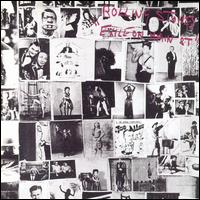
In order to get to the music, one must first get past the artwork that adorns the sleeve. Outside, a collection of photographs of freaks, geeks, and sideshow attractions with the name of the band and the album titled scrawled in what looks like lipstick adorn the front cover while similar photos of the band are on the back. Inside, pictures of the band and scrawled slogans that would turn up, sometimes modified, as lyrics: “I gave you diamonds. You gave me disease.” “Got to scrape the shit right off your shoes.” Mick Jagger stands coyly in front of a movie poster for an X-rated film, a poster that contains a small and very explicit photograph if you look closely enough. The inner sleeves of the album contain more photos, many of them duplicated like a negative of a film roll (the still photos were taken from a film shot by the photographer). The song titles are scrawled with partial information about who plays what instruments. The original version of the album contained 12 inscrutable postcards. All photos in black and white or with a slight color tint. The Stones clearly had gone all out on the packaging, and the cover and sleeves were a perfect manifestation of the music: there is so much going on in the cover it’s hard to know where to look (although almost everyone seems fascinated with the one photo of the man with three oranges in his mouth).

The cover was dark and strange, and the music offered no comfort. Over the course of 18 songs, the Stones take the listener on a tour of the dark underbelly of American music, from Delta blues (a ripping cover of Robert Johnson’s “Stop Breaking Down”) to a Southern Gothic gospel (“Shine A Light,” “Just Wanna See His Face”) to true country music (“Sweet Virginia,” “Torn and Frayed”) to barn-busting rock (“Rip This Joint,” “Rocks Off,” “Happy”). Exile, in essence, is a roots album. Unlike, say, Stephen Stills’s similar Manassas album that explored the different types of American music over its four sides, everything on Exile comes out sounding like the work of a band that had so completely absorbed their influences that they have become second nature. “Sweet Virginia” is both 100% American country music and 100% English bad-boy blues rock. It’s a pretty neat trick when you get right down to it, one that few bands have ever replicated and one which the Stones themselves were never able to do again.

There are several hard-charging rock and roll songs on the album. Side one boasts “Rocks Off,” the fearsome ode to the sex and drugs lifestyle being lived on the French Riviera, as well as the souped-up Little Richard blast of “Rip This Joint,” the fastest song in the band’s repertoire to this day. Side three begins with the greatest Keith Richards-led moment in the band’s career, the driving “Happy,” which Richards sings as if his heart was going to explode. In the long, storied life of Keith Richards, “Happy” remains his defining moment: three minutes of sheer exuberance, conceited boasting, and wistful loneliness. The verses of braggadocio and jaded living (“Always took candy from strangers…Never wanna be like papa/Workin’ for the boss…Never got a lift out of Lear jets…”) end in the desperate chorus of “I need a love to keep me happy/Baby, won’t you keep me happy?” This is Keith’s moment to shine on Exile, and shine brightly he does.

Then there is one of Exile‘s most overlooked tracks, “Turd On The Run.” The song will never be played on the radio because of the title alone and it is one of the Stones songs that’s known only to purists and hardcore fans. Musically, it’s essentially a rewrite of “Rip This Joint,” but the lyrics are some of the nastiest that ever came from Jagger’s pen. A tale of obsession and lost love that turns into a wicked revenge story, the lyrics are Jagger at his most sinister. The sex-crazed predator of underage girls from “Stray Cat Blues” and the demonic narrator of “Sympathy For The Devil” merge together as Jagger recounts the time and energy and love he “lost,” becoming increasingly bitter (“Diamond rings, vaseline/You give me disease”) before concluding with a bold threat (“Tie your hands/Tie your feet/Throw you to the sharks/Make you sweat/Make you scream/Make you wish you’d never been.”)

But Exile would probably not have the grand reputation it enjoys today if it were nothing but hard-driving rock tunes. Side two, boasting “Sweet Virginia,” “Torn and Frayed,” “Sweet Black Angel,” and the epic “Loving Cup” is dripping with country elements, from the drunken sing along of “Virginia” to the magisterial pedal steel of “Frayed,” to the acoustic jam of “Angel.” “Loving Cup” is a perfect synthesis of rock ballad, grand piano, and country drinking song. “Gimme little drink! From your loving cup,” drawls Jagger, but the jokey nature of the chorus is undermined by the beauty of the verses and, especially, the bridge where Jagger claims to be “humbled with you tonight/Just sitting by the fire…what a beautiful buzz.” The verses are sweetness and romanticism; the chorus, a good time drinking tune. On paper, it shouldn’t work. On record, it works beautifully. “Loving Cup” is one of the greatest of all Stones songs, mired in the obscurity of being an album track on a densely packed record that most fans of the band in this day and age have probably never heard.

The blues gets its due on Exile, of course. “Stop Breaking Down” has a loose, jammy feel of a well-rehearsed band breaking out a song they all know and love. There’s also a cover of Slim Harpo’s “Hip Shake,” retitled “Shake Your Hips” and an ode to the overheated, stuffy basement at Nellcôte entitled “Ventilator Blues,” the only song in the Stones canon that carries an official co-writing credit for guitar ace Mick Taylor. There’s really nothing all that special about these latter two songs, nor is “Casino Boogie,” the other blues-oriented song from side one, anything to write home about. None of these songs are bad, but they also don’t stand up outside of the context of this messy, sprawling album.

The same is true, in spades, of “I Just Wanna See His Face.” It’s an odd quasi-instrumental jam with extemporaneous lyrics from Jagger about Jesus. Overdubbed backing vocals from Clydie King, Vanetta Fields, Jerry Kirkland add a hint of gospel music, but the song sounds like it belongs on Harry Smith’s Anthology of American Folk Music. As a song, it’s really nothing, yet to my ears it’s crucial to the fabric of Exile. Without it, Exile would be lessened in much the same way that the White Album would suffer if it were to lose throwaways like “Wild Honey Pie” and “Why Don’t We Do It In The Road”. More serious attempts at a gospel vibe are made in “Let It Loose” and “Shine A Light” which both rank in the top-tier of Stones recordings. The songs rock with a steady assurance and a confidence that borders on obscene, but the instrumentation and vocals, particularly the backing vocals, are lifted straight from the churches of the American South.

The remaining tracks also represent the cream of the crop from the Stones. “All Down The Line” and “Soul Survivor” are blistering rockers that bookend side four of the record. “All Down The Line” still gets performed today by the band, despite the fact that it was never a hit and the Stones are nothing if not a traveling greatest hits show when they tour. “Soul Survivor” has a riff so good that it was stolen by Slash for his work on Michael Jackson’s hit single, “Black Or White.” It was also stolen by the Stones themselves, when they reused it in 1983 for “It Must Be Hell.”

Which leaves “Tumbling Dice.” Many critics claim that this is the best song the Stones have ever done. Along with “Happy” it’s the only song from Exile that has managed to achieve “classic” status. It was a Top 10 single in the States, peaking at #7, but it has managed to seep into the consciousness of Stones fans everywhere. It’s a slow, languid groove featuring some incredible guitar from Keith Richards, a seamless merge of Charlie Watts and Jim Miller on drums, and a slow, almost lazy vocal from Jagger that nonetheless manages to perfectly match up with the lyrics. “Tumbling Dice” is the sound of the Rolling Stones and the American blues becoming one and the same.

Exile on Main St. is the Grand Finale of the Rolling Stones. They would release many more albums, some of which were very good, but they would never again climb to these heights. It’s probably not even possible to do. As such, much of their later work suffers for the sole reason that it is compared to Exile, which is unfair. For this reason, Exile stands at the peak of 1970s rock music, yet is also an albatross over the career of the band that made it. It’s no surprise that Mick Jagger is ambivalent about the quality of the album, complaining that it doesn’t sound good and that the mix is terrible. It’s a natural reaction to being told that everything you’ve done for the past 38 years doesn’t match up to what you did back then. But the fact is simply this: Mick Jagger’s denunciations of the album and his confusion about its popularity are just plain wrong.

Grade: A+

Exile has recently been re-released in a deluxe edition with ten extra tracks. These are reviewed separately.