The Rolling Stones: Exile On Main St.

Exile On Main StreetAfter the triumph of the career- and era-defining Sticky Fingers, there was only one way to go. Simply put, you don’t put out a better album than Sticky Fingers. Unless, of course, you’re the Rolling Stones at their peak, in which case you put out a double album that transcends pretty much every album you’ve ever made and almost every rock album made by anyone else, as well. Exile On Main St. is that album.

There’s an enormous amount of mythology wrapped up in the making of Exile. The bare bones of the myth is that the Stones left England to escape onerous taxation, and they set up shop in a mansion in France. Drunk, high, and decadent, they recorded Exile in the basement of the mansion. That’s partially true. They did leave England for tax reasons, and much of Exile was recorded in the basement of Keith Richards’ villa at Nellcôte. There was also an enormous amount of drugs and decadence going around. But the Stones were not sharing a house, and an enormous amount of the final record was recorded, overdubbed, mixed, and mastered in the decidedly less glamorous world of Los Angeles.

With Exile, the mythology of the making of the album is inextricably linked to the final product. The myth of the Stones endlessly working out these songs as a tight five-piece unit in the basement of a French villa, swigging whiskey straight from the bottle, is so evocative because that’s exactly how the album sounds like it should have been recorded. Los Angeles or not, there’s a lot of “basement” vibe on the album. It’s murky, sludgy, dark, and dank. As a recording, it leaves a lot to be desired. As a rock album, it’s one of the best ever made, a collection that isn’t flawless but whose greatness towers above almost every other album of the rock era. There are some artists that have put out albums as good or better, but those albums are few and far between and the artists are the titans of the music business: The Beatles, The Who, Bob Dylan. And even their best only shares the rarefied air of Exile On Main St.

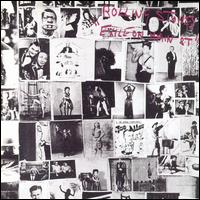
In order to get to the music, one must first get past the artwork that adorns the sleeve. Outside, a collection of photographs of freaks, geeks, and sideshow attractions with the name of the band and the album titled scrawled in what looks like lipstick adorn the front cover while similar photos of the band are on the back. Inside, pictures of the band and scrawled slogans that would turn up, sometimes modified, as lyrics: “I gave you diamonds. You gave me disease.” “Got to scrape the shit right off your shoes.” Mick Jagger stands coyly in front of a movie poster for an X-rated film, a poster that contains a small and very explicit photograph if you look closely enough. The inner sleeves of the album contain more photos, many of them duplicated like a negative of a film roll (the still photos were taken from a film shot by the photographer). The song titles are scrawled with partial information about who plays what instruments. The original version of the album contained 12 inscrutable postcards. All photos in black and white or with a slight color tint. The Stones clearly had gone all out on the packaging, and the cover and sleeves were a perfect manifestation of the music: there is so much going on in the cover it’s hard to know where to look (although almost everyone seems fascinated with the one photo of the man with three oranges in his mouth).

The cover was dark and strange, and the music offered no comfort. Over the course of 18 songs, the Stones take the listener on a tour of the dark underbelly of American music, from Delta blues (a ripping cover of Robert Johnson’s “Stop Breaking Down”) to a Southern Gothic gospel (“Shine A Light,” “Just Wanna See His Face”) to true country music (“Sweet Virginia,” “Torn and Frayed”) to barn-busting rock (“Rip This Joint,” “Rocks Off,” “Happy”). Exile, in essence, is a roots album. Unlike, say, Stephen Stills’s similar Manassas album that explored the different types of American music over its four sides, everything on Exile comes out sounding like the work of a band that had so completely absorbed their influences that they have become second nature. “Sweet Virginia” is both 100% American country music and 100% English bad-boy blues rock. It’s a pretty neat trick when you get right down to it, one that few bands have ever replicated and one which the Stones themselves were never able to do again.

There are several hard-charging rock and roll songs on the album. Side one boasts “Rocks Off,” the fearsome ode to the sex and drugs lifestyle being lived on the French Riviera, as well as the souped-up Little Richard blast of “Rip This Joint,” the fastest song in the band’s repertoire to this day. Side three begins with the greatest Keith Richards-led moment in the band’s career, the driving “Happy,” which Richards sings as if his heart was going to explode. In the long, storied life of Keith Richards, “Happy” remains his defining moment: three minutes of sheer exuberance, conceited boasting, and wistful loneliness. The verses of braggadocio and jaded living (“Always took candy from strangers…Never wanna be like papa/Workin’ for the boss…Never got a lift out of Lear jets…”) end in the desperate chorus of “I need a love to keep me happy/Baby, won’t you keep me happy?” This is Keith’s moment to shine on Exile, and shine brightly he does.

Then there is one of Exile‘s most overlooked tracks, “Turd On The Run.” The song will never be played on the radio because of the title alone and it is one of the Stones songs that’s known only to purists and hardcore fans. Musically, it’s essentially a rewrite of “Rip This Joint,” but the lyrics are some of the nastiest that ever came from Jagger’s pen. A tale of obsession and lost love that turns into a wicked revenge story, the lyrics are Jagger at his most sinister. The sex-crazed predator of underage girls from “Stray Cat Blues” and the demonic narrator of “Sympathy For The Devil” merge together as Jagger recounts the time and energy and love he “lost,” becoming increasingly bitter (“Diamond rings, vaseline/You give me disease”) before concluding with a bold threat (“Tie your hands/Tie your feet/Throw you to the sharks/Make you sweat/Make you scream/Make you wish you’d never been.”)

But Exile would probably not have the grand reputation it enjoys today if it were nothing but hard-driving rock tunes. Side two, boasting “Sweet Virginia,” “Torn and Frayed,” “Sweet Black Angel,” and the epic “Loving Cup” is dripping with country elements, from the drunken sing along of “Virginia” to the magisterial pedal steel of “Frayed,” to the acoustic jam of “Angel.” “Loving Cup” is a perfect synthesis of rock ballad, grand piano, and country drinking song. “Gimme little drink! From your loving cup,” drawls Jagger, but the jokey nature of the chorus is undermined by the beauty of the verses and, especially, the bridge where Jagger claims to be “humbled with you tonight/Just sitting by the fire…what a beautiful buzz.” The verses are sweetness and romanticism; the chorus, a good time drinking tune. On paper, it shouldn’t work. On record, it works beautifully. “Loving Cup” is one of the greatest of all Stones songs, mired in the obscurity of being an album track on a densely packed record that most fans of the band in this day and age have probably never heard.

The blues gets its due on Exile, of course. “Stop Breaking Down” has a loose, jammy feel of a well-rehearsed band breaking out a song they all know and love. There’s also a cover of Slim Harpo’s “Hip Shake,” retitled “Shake Your Hips” and an ode to the overheated, stuffy basement at Nellcôte entitled “Ventilator Blues,” the only song in the Stones canon that carries an official co-writing credit for guitar ace Mick Taylor. There’s really nothing all that special about these latter two songs, nor is “Casino Boogie,” the other blues-oriented song from side one, anything to write home about. None of these songs are bad, but they also don’t stand up outside of the context of this messy, sprawling album.

The same is true, in spades, of “I Just Wanna See His Face.” It’s an odd quasi-instrumental jam with extemporaneous lyrics from Jagger about Jesus. Overdubbed backing vocals from Clydie King, Vanetta Fields, Jerry Kirkland add a hint of gospel music, but the song sounds like it belongs on Harry Smith’s Anthology of American Folk Music. As a song, it’s really nothing, yet to my ears it’s crucial to the fabric of Exile. Without it, Exile would be lessened in much the same way that the White Album would suffer if it were to lose throwaways like “Wild Honey Pie” and “Why Don’t We Do It In The Road”. More serious attempts at a gospel vibe are made in “Let It Loose” and “Shine A Light” which both rank in the top-tier of Stones recordings. The songs rock with a steady assurance and a confidence that borders on obscene, but the instrumentation and vocals, particularly the backing vocals, are lifted straight from the churches of the American South.

The remaining tracks also represent the cream of the crop from the Stones. “All Down The Line” and “Soul Survivor” are blistering rockers that bookend side four of the record. “All Down The Line” still gets performed today by the band, despite the fact that it was never a hit and the Stones are nothing if not a traveling greatest hits show when they tour. “Soul Survivor” has a riff so good that it was stolen by Slash for his work on Michael Jackson’s hit single, “Black Or White.” It was also stolen by the Stones themselves, when they reused it in 1983 for “It Must Be Hell.”

Which leaves “Tumbling Dice.” Many critics claim that this is the best song the Stones have ever done. Along with “Happy” it’s the only song from Exile that has managed to achieve “classic” status. It was a Top 10 single in the States, peaking at #7, but it has managed to seep into the consciousness of Stones fans everywhere. It’s a slow, languid groove featuring some incredible guitar from Keith Richards, a seamless merge of Charlie Watts and Jim Miller on drums, and a slow, almost lazy vocal from Jagger that nonetheless manages to perfectly match up with the lyrics. “Tumbling Dice” is the sound of the Rolling Stones and the American blues becoming one and the same.

Exile on Main St. is the Grand Finale of the Rolling Stones. They would release many more albums, some of which were very good, but they would never again climb to these heights. It’s probably not even possible to do. As such, much of their later work suffers for the sole reason that it is compared to Exile, which is unfair. For this reason, Exile stands at the peak of 1970s rock music, yet is also an albatross over the career of the band that made it. It’s no surprise that Mick Jagger is ambivalent about the quality of the album, complaining that it doesn’t sound good and that the mix is terrible. It’s a natural reaction to being told that everything you’ve done for the past 38 years doesn’t match up to what you did back then. But the fact is simply this: Mick Jagger’s denunciations of the album and his confusion about its popularity are just plain wrong.

Grade: A+

Exile has recently been re-released in a deluxe edition with ten extra tracks. These are reviewed separately.

The Listening Post: July 2010

Hot town, summer in the city. The broiling New York July was a time of vacation, and not a lot of listening time.

  • Strange Change MachineThe Grip Weeds. The brand new album by New Jersey’s finest is a 2 CD set with over 80 minutes of music. There is a lot of really good stuff here, but the album suffers from the same problem that plagues most double sets: it should have been pared down. There’s nothing bad on the album. Even the worst songs (the Doors-y instrumental “Sun Ra Ga (Pt. One),” the brief “Green Room Interlude,” the silly “The Law,” the Seventies soft-rock of “Nothing’s Ever Gonna Be The Same” and the fruity “Love In Transition”) are pretty good, but without them the album would have been a 60+ minute powerhouse instead of a meandering 82 minutes. As is typical with the Grip Weeds there’s nothing here that you haven’t heard before. They wear their influences on their sleeves and their tributes to the Sixties and Seventies rock music they love is practically defiant in its brazenness. Continuing their habit of selecting a really choice cover song, they do an excellent reading of “Hello, It’s Me” finding a perfect spot in between the glacier-paced Nazz original and the sped-up kitchen sink production of Todd Rundgren’s hit single. “Hold Out For Tomorrow” manages to geekily tip a hat to the Beatles and the Stones in the same line: “Rubber soles/Worn shoe leather/Pocket full of holes/Kicking over stones/In a moonlight mile.” The aforementioned “Sun Ra Ga (Pt. One)” sounds a lot like the Doors jamming on the Middle Eastern vibe of “The End.” The Byrds-y harmonies appear all over the place, with Kurt Reil’s Keith Moon-influenced drums providing an extra hard rock edge. “Be Here Now,” “Thing Of Beauty,” “Strange Change Machine,” “Coming And Going,” “Hello, It’s Me” and “Long Way (To Come Around)” are the definite peaks, and the majority of the rest provides a lot of great rock ‘n’ roll kicks. The Grip Weeds aren’t particularly original, but their influences are in all the right places and they’re so good you don’t care about originality. There’s a place in the world (the older I get, the bigger that place seems to become) for bands that are more concerned with rocking out with good solid songs than they are with being on the cutting edge of the music scene. Strange Change Machine is about 65 minutes of high-energy, butt-kickin’ rock and roll in a solid classic rock style, and about 15 minutes of reasonably good filler.
    Grade: B+

Andy Hummel, RIP

Andy Hummel, bass player for the legendary cult band Big Star, is dead at the age of 59 after battling cancer for the past couple of years. Jody Stephens is now the sole remaining member of this great band. Hummel didn’t get the name recognition or icon status of Alex Chilton or Chris Bell, but he wrote some great songs like “Way Out West,” and “The India Song,” and co-wrote the amazing “Back Of A Car” and “Life Is White.” RIP.

Dean Koontz’s Muddled Message

Sometime in the Fall of 1984, I took a chance on an author I’d never heard of and was richly rewarded. The book I chose was Phantoms, and the author was Dean R. Koontz. I devoured the 400+ pages in a weekend and was completely caught up in the story. At that time, the only other Koontz novels that were available were Whispers, Darkfall, and Night Chills. I was so impressed by Phantoms that I soon bought the others and read them in the same white heat. He may not have become my favorite author overnight, but Dean R. Koontz was a name I now felt sure would provide a good story and a quick read.

A lot has changed in the past 26 years, but two things remain: I still buy Dean Koontz books as soon as they’re released in paperback, and they are still quick and easy reads. But somewhere along the line, Koontz has changed.

For starters, he dropped the “R.” in his name. Then the distinguished, balding author with the thick moustache pictured on the back of the books was replaced by a clean-shaven guy with a really bad hair weave. But that’s all superficial. The truly significant change was that Koontz became more explicit in his embrace of both Catholicism and political conservatism.

I have no problems with Koontz’s Catholicism or his conservatism. The problems I’ve been having with Koontz for a decade or more now has been how these beliefs end up getting in the way of his stories.

The novels are rarely explicitly Catholic though many of them are explicit in their belief in God, and they’re not overtly conservative, either. But just as you can always tell that Stephen King’s characters are good liberals who always vote for the Democrat ticket, you can also tell that Koontz’s characters are good conservatives who vote for the Republican.

What his religious beliefs have done for Koontz is inspire in him the belief that his books should be hopeful and optimistic, even though they deal in murder, sociopathy, psychopathy, horror, and evil. I have no doubt that this makes the writer a wonderful husband and friend, but it also makes for some schizophrenic reading.

To be clear, I think it’s great that Koontz wants to use his novels to express a worldview that is based on optimism and a great hope for mankind. One of the things you can count on in a Koontz book is that love will find a way and goodness will emerge triumphant, perhaps battered and bruised, but still walking proudly into the sunset. His chosen method for imparting this message are his good characters, invariably tossed by chance into some type of confrontation with the forces of evil.

The bad guy or guys in a Koontz novel are ruthless, amoral, human monsters who take a savage delight in murder and mayhem. They are frequently aided by a cabal of associates who may be part of the government, or corporation, or some secret society who believes that mankind is worthless and fit only to be killed or to serve their intellectual and political betters. Many of these bad guys are interchangeable from one novel to the next. One may be motivated by power lust, one may be motivated by blood lust, but their methods and their relentless pursuit of the good guys is a common trait. Despite this interchangeability, Koontz is at his best with his bad guys.

The problem with his most recent books comes from his good guys. If the bad guys are all pretty much the same except for their motivation, then the good guys are all nearly identical in every way. They have the same likes and dislikes, they share beliefs, they share attitudes, they share their politics, and, most annoyingly, they all share the same manner of speaking.

The good guys in a Koontz novel are mirrors of the author. If they are not religious they probably will be by the end of the book. They espouse politically conservative ideals. They are indefatigable optimists who, even in the darkest times, bet their bottom dollar that the sun’ll come out tomorrow. In order to express these traits, the characters don’t so much speak as they banter. The rhythm of their speech is taken nearly whole from any number of screwball comedies from the 1930s. For instance:

“Well who are you?”
“I don’t know. I’m not quite myself today.”
“Well, you look perfectly idiotic in those clothes.”
“These aren’t my clothes.”
“Well, where are your clothes?”
“I’ve lost my clothes!”
“But why are you wearing these clothes?”
“Because I just went gay all of a sudden!”
“Now see here young man, stop this nonsense. What are you doing?”
“I’m sitting in the middle of 42nd Street waiting for a bus.”

Or:

“How do you think Deucalion does that Houdini stuff?”
“Don’t ask me. I’m a prestidigitation disaster. You know that trick with the little kids where you pretend to take their nose off, and you show it poking out of your fist, but it’s really just your thumb?”
“Yeah?”
“They always look at me like I’m a moron, and say ‘That’s just your stupid thumb.'”
“I’ve never seen you goofing around with kids.”
“I’ve got a couple of friends. They did the kid thing. I’ve played babysitter in a pinch.”
“I’ll bet you’re good with kids.”
“I’m no Barney the Dinosaur, but I can hold my own.”
“He must sweat like a pig in that suit.”
“You couldn’t pay me enough to be Barney.”
“I used to hate Big Bird when I was a kid.”
“Why?”
“He was such a self-righteous bore.”

Notice the similarity in rhythm. The first excerpt above is from the classic Cary Grant/Katherine Hepburn comedy Bringing Up Baby and the dialogue follows a lengthy chain of screwups and pranks that ends with Grant in a woman’s bathrobe confronting Hepburn’s mother.

The second excerpt is from Dean Koontz’s Frankenstein, Part Two: City Of Night. The conversation takes place in a car as the good guys (a male and female cop who are, of course, in love with each other) are speeding through New Orleans after killing an inhuman creation that was about to murder the female cop’s autistic brother. The cops then very narrowly avoided being murdered by two inhuman assassins, their lives saved only by the appearance of the original creation made by Victor Frankenstein two hundred years earlier. There’s an enormous set up for this, taking place near the end of the second book of a trilogy, but the fact remains that after killing one monster, engaging in a fierce gun battle with two other monsters, and being saved by a third monster, the good guys then launch into a dialogue that is light, breezy, humorous, and wholly inappropriate to the experiences they are undergoing.

Unfortunately, Koontz seems to be unable to break out of this style. The situations in which his characters find themselves are tense to the point of being nearly unbearable. They are being hunted, shot at, tormented, sometimes seeing family and friends die…and yet Koontz can’t seem to help the fact that he keeps writing dialogue more suitable for His Girl Friday or The Lady Eve than for The Night Of The Hunter or Se7en.

There is a place for the type of banter that Koontz loves, but that place is not when the situation is fraught with tension and threat hangs heavy in the air. In those situations, this style of dialogue sounds contrived and forced. It’s not a “whistling past a graveyard” type of tension relief, though perhaps the author thinks of it as such. Rather, I would be worried about the psychological health of anyone who can be subjected to the assaults, car chases, gun battles, murder attempts, and general torment that these heroes endure and who could then slip so easily into the sort of light rapport that one finds at a picnic.

Dean Koontz is a good writer, and the storylines in which his characters reside are inventive and move at the speed of a runaway locomotive. There is much good to be found in a book by Dean Koontz, and his message of hope and love is a good one. That doesn’t change the fact that the lightweight badinage in which his heroes engage is frequently off-putting for the sole reason that no sane people in such insane circumstances could possibly talk this way, a trait that subverts the serious nature of the evil at work in the books. In the long run, how the good guys respond to the evil being done to them is where Koontz’s message can be imparted but the reaction of the protagonists, as demonstrated by their dialogue, ends up sending the message that evil is something that should not be taken seriously. I’m all for injecting a little comic relief into a tense or horrific situation, but there’s a fine line between a subtle joke that breaks the tension and having the heroes respond to calamity by slipping into a Marx Brothers routine.

The Listening Post: June 2010

Summer begins with new music.

  • Stone Temple PilotsStone Temple Pilots. It’s been many years since the Pilots were last heard from on Shangri-La-Dee-Da, but they haven’t missed a beat. The band members stayed active, with Scott Weiland joining the dysfunctional crew of Velvet Revolver and the rest of the Pilots forming Army of Anyone with former Filter singer Richard Patrick. The Army of Anyone album sounded close enough to STP that it was clear the former Pilots were keeping their chops up, and Weiland brought the same melodic skill that elevates the Pilots to Slash, Duff, and Company. The result of keeping their hands in and playing to their strengths is that the new, eponymous STP album sounds a lot like the same band you’ve always known. If you like STP (and I do), you’ll like the album. If you think they’re a pack of posers, the new album won’t change your mind. The time off wasn’t all beneficial. This is their least impressive album since their overrated début, Core. Only “Between The Lines,” “Dare If You Dare,” “Fast As I Can,” and “Maver” are really top-flight material, worthy of being included with the songs from Purple or Tiny Music. Tracks like “Huckleberry Crumble,” “Hickory Dichotomy,” “Hazy Daze,” and “Bagman” are strictly filler material, and “Cinnamon” sounds amazingly like an outtake from Rooney’s second album. The rest of the tracks fall somewhere between the filler and the fantastic. They’re better than most of what you hear on the radio today, but still a far cry from the best work of the band. Hopefully, now that the band is ironing out the kinks on the road and in the studio, the next album will be a return to their best form.
    Grade: B
  • Sea Of CowardsThe Dead Weather. Jack White’s workaholism has generated yet another Dead Weather album, their second within a year. The first album was a triumph of feel and sound, with a fascinating vocal and lyrical interplay between Alison Mosshart and Jack White. (The world’s longest review of Horehound is here.) It was startling in how different it sounded. The second album loses that advantage of surprise. It sounds like the first album and while it has some songs that are as good or better than anything on the début, it also has several tracks that don’t measure up. There’s nothing as good as “Treat Me Like Your Mother” on Sea of Cowards, but “Die By The Drop,” “Gasoline,” “No Horse,” and “Jawbreaker” outshine almost everything else off Horehound. Unfortunately, that’s where it ends. “Blue Blood Blues” and “The Difference Between Us” are very good, but much of the rest sinks into mediocrity. “I’m Mad” suffers from the worst phony laugh since Phil Collins tried to sound menacing on Genesis’s “Mama,” and “Old Mary” is a bizarre (and dreadful) spoken word rip of the Hail Mary prayer. The big problem with the Dead Weather is that the distorted heavy industrial/noise sound of the band doesn’t lend itself to repeated listens. It’s impressive when you are listening to it and digesting it, but it’s not something you go back to. I genuinely like the Dead Weather, but I’m really starting to miss The Raconteurs and The White Stripes.
    Grade: B
  • Third Man Records Single Releases 2009Various Artists. This 2-LP (that’s vinyl, kids) from Jack White’s record label, Third Man Records, collects all the singles they released in 2009 as well as singles that were recorded in 2009 but released early this year. It’s a mixed-bag, but there’s a lot in it that’s very good. There are several Dead Weather singles, including a very good cover of Gary Numan’s “Are Friends Electric?” and a great cover of “A Child Of A Few Hours Is Burning To Death,” by the very obscure ’60s garage rock/psychedelic band the West Coast Pop Art Experimental Band. There’s also a spontaneous blues track White wrote and recorded for the It Might Get Loud documentary, that sounds like it was made up on the spot (it was). Jack White is all over these songs, playing drums on some, piano on others, and singing with the Dex Romweber Duo on their songs. Jack Lawrence and Patrick Keeler, the Greenhornes/Raconteurs rhythm section, also appear on several tracks. There’s some junk on the record. Mildred And The Mice (rumor has it that it’s Jack White’s wife, Karen Elson) has two completely unlistenable songs about dead vermin that I assume are meant to be a joke, but they’re not funny. There’s a track where the astronomer Carl Sagan has his voice Auto-Tuned into a sing-song monologue about the cosmos. More problematic, Rachelle Garniez’s sole song, “My House of Peace” has great music behind a voice that alternates between a sweet, breathy soprano and a slurred, drunken mumble, sometimes in the same line. The Black Belles make an interesting attempt at the garage rock classic “Lies,” but the song lacks power, Transit’s ’70s soul-style “C’mon and Ride” is pretty much a put-on. But then there’s the good: Dan Sartain’s Tom Waits-ish jazz blues, Dex Romweber’s howling guitar stomp, Wanda Jackson’s shredding Amy Winehouse’s “You Know I’m No Good” and Johnny Kidd’s “Shaking All Over,” the Smoke Fairies’ haunting folk blues, Transit’s “Afterparty” which begins as smooth soul and ends as a raveup, the Black Belles’ Dead Weather meets the Shangri-Las “What Can I Do?” And for those so inclined, there are two spoken word pieces from music scenester BP Fallon, who offers a solemn meditation called “Fame #9” about the pitfalls of being famous and a Jack White-conducted interview where he reminisces about everything from seeing Chuck Berry in New York to the nature of blues. He also “sings” a really interesting track called “I Believe In Elvis Presley.” It’s a fascinating collection, and a good glimpse into the mind of Jack White. This is truly alternative rock.
    Grade: B+
  • A Little Madness To Be FreeThe Saints. This 1984 album finds Australia’s The Saints leaving in the dust any trace of the punk band that released three classic albums in the late 1970s. That’s not necessarily a problem since other bands with punk roots (The Replacements, for example) managed to leave punk behind and still do high-quality work. That’s not really the case here, though. While the album starts strongly with three very good tunes (“Ghost Ships,” “Someone To Tell Me” and “Down the Drain”) the rest of the album sinks into a midtempo malaise that makes for a listless listening experience. Some of these songs, like “It’s Only Time,” “Imagination,” and “Walk Away,” aren’t bad but they’re far from compelling. The rest of the album never rises above the blandly mediocre with the worst offender being “Photograph,” which is burdened with the type of maudlin string arrangement that’s supposed to indicate depth of feeling but only sounds like Muzak. The Saints would rebound from this with the classic All Fools Day, but while there’s not much on this album that’s genuinely awful, there’s even less that’s genuinely fresh and exciting.
    Grade: C
  • Time Fades AwayNeil Young. This album was called “the worst I ever made” by Neil Young. And this was after he released Re-Ac-Tor, Trans, and Everybody’s Rockin’. Young holds this album in such low regard that he included none of the songs on his Decade compilation and still has not released the album on compact disc. All of this just goes to show that Neil Young is not necessarily the best judge of his own material. Yes, Times Fades Away is so loose and rough it brings new meaning to the word “ramshackle,” but it is this ragged weariness that gives the album so much strength. Recorded during the tour for Harvest, the album that put Young all over AM radio, this is about as far away from “Heart Of Gold” as you can get. The sweet singer/songwriter country leanings of Harvest are replaced here with a bone-shaking, toxic stew of distorted guitar and vocals that don’t crack so much as they shatter. This album is really more like a live version of Young’s harrowing junkie tales from Tonight’s The Night than they are anything Young had released up to this point. The vocals are all over the place, the music is dense and distorted, the subject matter is dark, and the album is a powerhouse. It’s ugly, but it’s art.
    Grade: A-