The Listening Post: June 2010

Summer begins with new music.

  • Stone Temple PilotsStone Temple Pilots. It’s been many years since the Pilots were last heard from on Shangri-La-Dee-Da, but they haven’t missed a beat. The band members stayed active, with Scott Weiland joining the dysfunctional crew of Velvet Revolver and the rest of the Pilots forming Army of Anyone with former Filter singer Richard Patrick. The Army of Anyone album sounded close enough to STP that it was clear the former Pilots were keeping their chops up, and Weiland brought the same melodic skill that elevates the Pilots to Slash, Duff, and Company. The result of keeping their hands in and playing to their strengths is that the new, eponymous STP album sounds a lot like the same band you’ve always known. If you like STP (and I do), you’ll like the album. If you think they’re a pack of posers, the new album won’t change your mind. The time off wasn’t all beneficial. This is their least impressive album since their overrated début, Core. Only “Between The Lines,” “Dare If You Dare,” “Fast As I Can,” and “Maver” are really top-flight material, worthy of being included with the songs from Purple or Tiny Music. Tracks like “Huckleberry Crumble,” “Hickory Dichotomy,” “Hazy Daze,” and “Bagman” are strictly filler material, and “Cinnamon” sounds amazingly like an outtake from Rooney’s second album. The rest of the tracks fall somewhere between the filler and the fantastic. They’re better than most of what you hear on the radio today, but still a far cry from the best work of the band. Hopefully, now that the band is ironing out the kinks on the road and in the studio, the next album will be a return to their best form.
    Grade: B
  • Sea Of CowardsThe Dead Weather. Jack White’s workaholism has generated yet another Dead Weather album, their second within a year. The first album was a triumph of feel and sound, with a fascinating vocal and lyrical interplay between Alison Mosshart and Jack White. (The world’s longest review of Horehound is here.) It was startling in how different it sounded. The second album loses that advantage of surprise. It sounds like the first album and while it has some songs that are as good or better than anything on the début, it also has several tracks that don’t measure up. There’s nothing as good as “Treat Me Like Your Mother” on Sea of Cowards, but “Die By The Drop,” “Gasoline,” “No Horse,” and “Jawbreaker” outshine almost everything else off Horehound. Unfortunately, that’s where it ends. “Blue Blood Blues” and “The Difference Between Us” are very good, but much of the rest sinks into mediocrity. “I’m Mad” suffers from the worst phony laugh since Phil Collins tried to sound menacing on Genesis’s “Mama,” and “Old Mary” is a bizarre (and dreadful) spoken word rip of the Hail Mary prayer. The big problem with the Dead Weather is that the distorted heavy industrial/noise sound of the band doesn’t lend itself to repeated listens. It’s impressive when you are listening to it and digesting it, but it’s not something you go back to. I genuinely like the Dead Weather, but I’m really starting to miss The Raconteurs and The White Stripes.
    Grade: B
  • Third Man Records Single Releases 2009Various Artists. This 2-LP (that’s vinyl, kids) from Jack White’s record label, Third Man Records, collects all the singles they released in 2009 as well as singles that were recorded in 2009 but released early this year. It’s a mixed-bag, but there’s a lot in it that’s very good. There are several Dead Weather singles, including a very good cover of Gary Numan’s “Are Friends Electric?” and a great cover of “A Child Of A Few Hours Is Burning To Death,” by the very obscure ’60s garage rock/psychedelic band the West Coast Pop Art Experimental Band. There’s also a spontaneous blues track White wrote and recorded for the It Might Get Loud documentary, that sounds like it was made up on the spot (it was). Jack White is all over these songs, playing drums on some, piano on others, and singing with the Dex Romweber Duo on their songs. Jack Lawrence and Patrick Keeler, the Greenhornes/Raconteurs rhythm section, also appear on several tracks. There’s some junk on the record. Mildred And The Mice (rumor has it that it’s Jack White’s wife, Karen Elson) has two completely unlistenable songs about dead vermin that I assume are meant to be a joke, but they’re not funny. There’s a track where the astronomer Carl Sagan has his voice Auto-Tuned into a sing-song monologue about the cosmos. More problematic, Rachelle Garniez’s sole song, “My House of Peace” has great music behind a voice that alternates between a sweet, breathy soprano and a slurred, drunken mumble, sometimes in the same line. The Black Belles make an interesting attempt at the garage rock classic “Lies,” but the song lacks power, Transit’s ’70s soul-style “C’mon and Ride” is pretty much a put-on. But then there’s the good: Dan Sartain’s Tom Waits-ish jazz blues, Dex Romweber’s howling guitar stomp, Wanda Jackson’s shredding Amy Winehouse’s “You Know I’m No Good” and Johnny Kidd’s “Shaking All Over,” the Smoke Fairies’ haunting folk blues, Transit’s “Afterparty” which begins as smooth soul and ends as a raveup, the Black Belles’ Dead Weather meets the Shangri-Las “What Can I Do?” And for those so inclined, there are two spoken word pieces from music scenester BP Fallon, who offers a solemn meditation called “Fame #9” about the pitfalls of being famous and a Jack White-conducted interview where he reminisces about everything from seeing Chuck Berry in New York to the nature of blues. He also “sings” a really interesting track called “I Believe In Elvis Presley.” It’s a fascinating collection, and a good glimpse into the mind of Jack White. This is truly alternative rock.
    Grade: B+
  • A Little Madness To Be FreeThe Saints. This 1984 album finds Australia’s The Saints leaving in the dust any trace of the punk band that released three classic albums in the late 1970s. That’s not necessarily a problem since other bands with punk roots (The Replacements, for example) managed to leave punk behind and still do high-quality work. That’s not really the case here, though. While the album starts strongly with three very good tunes (“Ghost Ships,” “Someone To Tell Me” and “Down the Drain”) the rest of the album sinks into a midtempo malaise that makes for a listless listening experience. Some of these songs, like “It’s Only Time,” “Imagination,” and “Walk Away,” aren’t bad but they’re far from compelling. The rest of the album never rises above the blandly mediocre with the worst offender being “Photograph,” which is burdened with the type of maudlin string arrangement that’s supposed to indicate depth of feeling but only sounds like Muzak. The Saints would rebound from this with the classic All Fools Day, but while there’s not much on this album that’s genuinely awful, there’s even less that’s genuinely fresh and exciting.
    Grade: C
  • Time Fades AwayNeil Young. This album was called “the worst I ever made” by Neil Young. And this was after he released Re-Ac-Tor, Trans, and Everybody’s Rockin’. Young holds this album in such low regard that he included none of the songs on his Decade compilation and still has not released the album on compact disc. All of this just goes to show that Neil Young is not necessarily the best judge of his own material. Yes, Times Fades Away is so loose and rough it brings new meaning to the word “ramshackle,” but it is this ragged weariness that gives the album so much strength. Recorded during the tour for Harvest, the album that put Young all over AM radio, this is about as far away from “Heart Of Gold” as you can get. The sweet singer/songwriter country leanings of Harvest are replaced here with a bone-shaking, toxic stew of distorted guitar and vocals that don’t crack so much as they shatter. This album is really more like a live version of Young’s harrowing junkie tales from Tonight’s The Night than they are anything Young had released up to this point. The vocals are all over the place, the music is dense and distorted, the subject matter is dark, and the album is a powerhouse. It’s ugly, but it’s art.
    Grade: A-
The Beatles: With The Beatles

With the BeatlesIf Please Please Me was a lightning bolt straight to the heart of the Brill Building, With the Beatles and especially its American counterpart was an atomic bomb. A flawed classic, this is really where the unmatched recorded legacy of the Beatles begins. Their first album was very good. Their second was considerably better. It may be fair to say that when it was released (November 22, 1963—the day President Kennedy was assassinated), With the Beatles was the single best example of a rock and roll LP. With the possible exception of the first Elvis Presley long-player, I can’t think of another album from this era that matches this one. For almost any other band, it would be a high-water mark. For the Beatles, it was just the beginning.

Please Please Me was not released in America until 1987 when it came out on CD, and With the Beatles was not released until January 1964 under a different title (Meet The Beatles) and with different songs. Early in their career, the Beatles had a policy of not including singles on albums because they believed it was ripping off the fans. In England, extended play singles (four or five songs) were also a popular commodity that was unknown in the States. Because of this, the Beatles’ most popular songs were not included on their albums. This flew in the face of the American system, so Capitol Records took songs from With the Beatles and replaced them with the popular singles. The songs that were removed were tucked away until there were enough to release a “new” album.

It was a ham-handed system that the Beatles hated because they put so much thought and effort into their LPs, but it did have the effect of giving a home to all those Beatles singles and EPs that might otherwise have not been released in America. So while With the Beatles begins with the thrilling “It Won’t Be Long,” Meet the Beatles begins with the classic “I Want To Hold Your Hand.”

With the Beatles Meet the Beatles
It Won’t Be Long
All I’ve Got To Do
All My Loving
Don’t Bother Me
Little Child
Till There Was You
Please Mr. Postman*
Roll Over Beethoven*
Hold Me Tight
You’ve Really Got A Hold On Me*
I Wanna Be Your Man
Devil In Her Heart*

Not A Second Time
Money (That’s What I Want)*

I Want To Hold Your Hand
I Saw Her Standing There
This Boy
It Won’t Be Long
All I’ve Got To Do
All My Loving
Don’t Bother Me
Little Child
Till There Was You
Hold Me Tight
I Wanna Be Your Man
Not A Second Time
*Released in America on the LP The Beatles’ Second Album

In either incarnation, this album is excellent. In the final analysis, the American version is superior. Though it has two fewer songs, it replaces five cover songs of varying quality with three mind-blowingly brilliant originals. But for the purpose of this review, I’ll stick with the albums as the Beatles intended and as they are now available on CD.

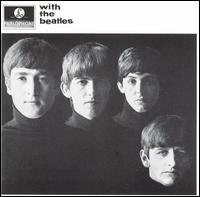
The album cover was enough to let you know that this was different. Compare the stark black and white cover of With the Beatles, with it’s all lowercase type and disembodied, serious faces staring at the listener from behind those ridiculously long bangs, to any pop/rock album cover of the time and you can see the difference immediately. The music on the album may not have risen all the way to the highest levels of art, but there was no denying that Robert Freeman’s cover photo was both unique and artistic, similar in many ways to the photographs taken by Astrid Kirchherr during the Beatles’ time in Hamburg. It was also instantly iconic. Cover art was one of the other ways the Beatles revolutionized the music industry, taking the job out of the hands of hack photographers and putting it into the hands of artists. Not all the Beatles album covers would make this bold a statement, but a line had clearly been drawn.

“It Won’t Be Long,” which kicks off the album, is the prototype for power pop. The propulsive bass underpinning a simple but strong guitar line, Ringo’s steady drumming and economical fills, the call and response yeahs, the beautiful melody and backing vocals of the brief bridge…it’s all there. The entire school of power pop, from early Who and Badfinger to the Raspberries and Cheap Trick, learned their trade from this song. The breathless pace of John Lennon’s vocals adds a touch of desperation to the song that elevates it above the standard “can’t wait to get home to see you” lyrics. I don’t know whether there’s ever been a better rock and roll singer than John Lennon during the early days of the Beatles. Paul McCartney may have had the better voice in technical terms but Lennon’s vocals, especially during these first few years, is so rich with emotion they defy belief. “When I Get Home” sounds like John’s life is depending on it.

Just when he’s turned up the voltage and belted out a hard and fast rocker, Lennon follows with the mid-tempo ballad “All I’ve Got To Do,” one of the most under appreciated of all Beatle songs. From the lightly strummed guitar that opens the song and provides the introduction for John’s plaintive vocals to the soaring chorus, “All I’ve Got To Do” is one of the most sublime ballads the Beatles ever constructed. As both songwriting and performance it is simply miles beyond anything from their first album.

And yet, it’s just a taste. Paul McCartney steps to the microphone with one of his greatest songs, “All My Loving,” with the furiously strummed triplets by John Lennon and a melody that most pop/rock songwriters would sell their children to write. Indeed, there’s more pure melody in these two minutes and twelve seconds than in the entire collected works of some famous bands. Even the quick guitar solo has a tune of its own. Curiously, this is the third consecutive song that opens with a brief blast of vocals with no instrumentation (aside from the single strum of “All I’ve Got To Do”). If nothing else, it shows the Beatles knew where their strengths lay.

“Don’t Bother Me” is the first song written solely by George Harrison and it’s a winner. It’s certainly not up to the level of the three songs the precede it on the album, and Harrison’s vocals are still heavy on the Liverpool youth side, but the melody is strong, Ringo plays some great fills, Lennon shakes a wicked tambourine, Paul keeps steady time banging claves (wood blocks), and George contributes a tasty guitar solo. It’s not brilliant, but it’s very good.

McCartney assumes piano duties on “Little Child,” doing a neat approximation of boogie-woogie. The song itself is a basic, by-the-numbers rocker, but takes off during the instrumental bridge when the tempo speeds up and Lennon takes off on harmonica. This is one song where Lennon sounds unconvincing, like he knows the material is somewhat sub par. It’s the kind of song he would later dismiss as “phony,” but the double-tracked vocals and the catchiness of the chorus make it an enjoyable, brief, rave up.

It’s at this point on the record where the flaws really stand out. After five consecutive original songs, there are three cover songs. The first, “Till There Was You” is a “please-the-Mums-and-Dads” show tune from The Music Man, sung in his sweetest tenor by Paul. It’s a nice song, and Paul sings it well over an acoustic backing, but it also displays the appalling sentimentality that would dog McCartney through his entire career. “Please Mister Postman” is considerably better. The Marvelettes cover song features a great Lennon vocal, while Paul and George supply the breathy “Ooohs” throughout the verses. The Beatles brought their own sensibilities to the Motown and girl group songs that they covered. Always a melodically inclined band, they naturally responded to the hooks and melodies those songs provided. But as scruffy little rock-n-rollers they added rough edges that the Motown and Phil Spector productions often lacked.

The Beatles were less convincing covering blues rockers, and “Please Mister Postman” is followed by their take of Chuck Berry’s “Roll Over Beethoven.” There’s nothing wrong with the cover, but it lacks the fire and inspiration that the Rolling Stones brought to their Berry covers. The Beatles were never a bluesy band, and were more at home with Buddy Holly and Little Richard than they were with Chuck Berry. “Roll Over Beethoven” has some great fills from Ringo, and a solid George Harrison vocal, along with a great hand clap track, but it’s a completely by-the-numbers cover. There are worse ways to kill 2:50 but that doesn’t mean there aren’t better ways, too.

“Hold Me Tight” is a return to original material, and the increased inspiration becomes immediately apparent. It’s not a great song, but it’s got all the ingredients of a great song. The vocal from Paul is a little wobbly, but the persistent hand claps and the ebullient backing vocals make for an improvement over the three tracks the precede it, although it pales in comparison to what follows.

The Beatles return to Motown for their take on Smokey Robinson’s epic “You’ve Really Got A Hold On Me,” and it’s one of their best cover songs. If anything, Lennon pulls off the astounding feat of surpassing Smokey’s original vocal, ably assisted by a prominent backing vocal from George. It is that grit that the Beatles bring that adds so much to this song. Lennon’s double-tracked vocals are simply staggering and the musical accompaniment, underpinned by producer George Martin’s piano, is perfect.

The band ethos of the Beatles—the idea that this was a group, not just a gathering of musicians—was cemented by the fact that every member would take his turn up front and “I Wanna Be Your Man” is Ringo’s turn. The song had been given to The Rolling Stones who turned it into an incendiary piece of garage rock with a Brian Jones slide guitar solo that scorched the landscape. In the hands of the Beatles, the song is a throwaway, but a good one. Ringo’s performance is hammy but fun, and the simple lyric sounds like it was written in about five minutes. Still, this one song provided the Stones with their first hit and directly inspired Bob Dylan’s “I Wanna Be Your Lover.” John Lennon provides the rhythm on organ while Ringo plays the hell out of the drums and George plays a stinging guitar solo. All filler songs should be this much fun.

One of the surprising things about the album is that George Harrison is as prominent a player as Paul McCartney. Macca sings lead on only three songs, and George does as well. “Devil In Her Heart” is a cover of a girl group song and an excellent one. It’s got George’s best vocal to this point and a solid percussion track from Ringo, and the backing vocals add great depth to the lead.

The original “Not A Second Time” is another gem. It’s also more evidence that as songwriters the Beatles were simply outpacing the competition. Only Smokey’s “You’ve Really Got A Hold On Me” is in a league with the originals the Beatles were turning out. It is “Not A Second Time” that inspired the London newspaper classical music reviewer to compare the Beatles to Schubert and discuss the “Aeolian cadences” in their work. I’m not quite sure I’d go that far and I don’t know what “Aeolian cadences” means but I do know that the inventive melodicism of the song is breathtaking. Once again, it’s George Martin’s piano that provides the musical heft to the song, including a solo that mimics the melody, a Beatle trademark. Lennon’s voice is superb, thrust even more to prominence by the absence of backing vocals from his bandmates.

The piano of “Not A Second Time” is the perfect introduction to the album closer. A cover of Barrett Strong’s Motown song, “Money (That’s What I Want)” begins with George Martin’s piano before the other instruments rumble in like a mudslide and Lennon snarls, “The best things in life are free…” On an album full of great vocal performances, “Money” is a standout, one of the best vocals of Lennon’s career, at least the equal of Please Please Me‘s “Twist and Shout.” His ending ravings where he’s ripping his throat out singing, “Yeah! I wanna be free!” while Paul and George chant “That’s…what I want…” is rock and roll nirvana.

There’s really no question that removing “Please Mister Postman,” “You’ve Really Got A Hold On Me,” “Devil In Her Heart,” “Roll Over Beethoven” and “Money” and replacing them with “I Want To Hold Your Hand,” “I Saw Her Standing There,” and “This Boy” makes Meet the Beatles a better album than With The Beatles. As great as “Hold” and “Money” are, they are dwarfed by the original singles the Beatles had released. With the Beatles is a flawed gem; Meet the Beatles is a masterpiece. I’d be willing to bet that if the original UK edition of the album been released in America Beatlemania might not have caught on in the States. This would be the last time an American version of the album was better than the UK version.

Grade: B+

The Monster Show: A Cultural History of Horror, by David J. Skal

When I was a kid I used to love Scooby Doo, but even as a young child there was always something that bothered me about that cartoon. It was the ending. For 25 minutes the Scooby Gang was battling it out with assorted ghosts, ghouls, and goblins. Sometimes they had help from the Harlem Globetrotters, but most often it was just them against this supernatural threat. And then, in the closing moments, the ghost would be revealed as a man with a costume and a projection device, cursing out those meddling kids for thwarting his plans to get his hands on the property/buried treasure/whatever.

Horror fiction, whether on film or in print, needs a payoff. For horror to be successful, you need to finish strong. Take, for example, The Blair Witch Project. For about 80 minutes there was a lot of shaky camera work and indistinct threat. Nothing special. But that final shot of the kid standing in the corner of the basement, tying the ending to a throwaway line from the beginning of the movie, was payoff. I remember very little from the first part of the movie, but that last shot will stick with me forever.

David J. Skal’s history of horror in the 20th century has a lot more Scooby Doo to it than Blair Witch. The Monster Show starts off very strong, recounting the story of Tod Browning’s days working in the freak show of a traveling carnival, storing up the images and experiences that he would bring to the screen in the genuinely disturbing Freaks. Skal expertly handles these early days of Hollywood horror. The stories of Lon Chaney’s unprecedented feats of movie makeup, the fascinating tale of how Dracula moved from book to stage to screen, the brilliant director James Whale’s beautifully subversive Bride of Frankenstein, The Wolf Man (my childhood favorite), and the tortured life of Bela Lugosi are recounted in lively prose and wonderful anecdotes. Skal obviously loves his subject and he’s done his research.

The 1950s era of giant lizard/big bug movies were clearly inspired by the ushering in of the nuclear age. Godzilla is not a particularly good film when compared to, say, Citizen Kane. But Godzilla is a fascinating look at the psyche of a country that had very recently been on the receiving end of nuclear warfare. The devastation of Hiroshima and Nagasaki echo in every frame of Godzilla. Here, too, Skal is on firm ground. His analysis of these movies, and the early TV era of schlock ghouls like Vampira, is excellent.

Then there’s the second half of the book. The fairly rigid chronology of the first half becomes a rough chronology in the second, as each remaining chapter races through the 1960s and beyond. Instead of concentrating on the films themselves, the book becomes a standard serving of academic lectures about the era under discussion. Lengthy discussions of AIDS, for example, are tied into horror fiction rather than the other way around. The first half of the book is a history of horror fiction with ties to the culture. The second half inverts this formula and suffers mightily because of it. It’s almost as if Skal stopped researching the films and instead wrote a half-baked sociological thesis and then inserted movie references to reinforce his points.

All of the standard clichés abound. Horror in the 1980s was a reaction to the conservative times (a particularly tired observation that denies that horror fiction has always been a very conservative type of fiction), vampire fiction was about AIDS, the demonic children school of movies (Rosemary’s Baby, Village of the Damned, The Exorcist, It Lives, etc) was brought about by a combination of The Pill, the generation gap, and thalidomide babies. With the exception of a single line that interestingly maintains that Terminator 2: Judgment Day was really an update of a battle between the mechanical Frankenstein and the shape-shifter Dracula, there isn’t a single observation in the second half of the book that you haven’t heard before in any documentary ever made about horror movies.

The near-total collapse of the book in the second half is too bad because the first half is so strong. The discussion of Stephen King’s fiction is cursory, and Anne Rice’s vampire chronicles get a more thorough analysis than the works of the great horror writers like Peter Straub, Clive Barker, James Herbert, or Ramsey Campbell. The superficial reading of King is surprising in that King is regarded by nearly everyone as the leading light of modern horror fiction while Anne Rice has long since moved on to other topics. Skal spends a few pages discussing the Broadway version of King’s Carrie and actually believes that putting this tale of torment and bloody revenge on the Broadway stage was a “can’t miss” idea that inexplicably failed. The entire discussion makes me wonder if Skal really gets his subject, as opposed to having a firm grasp on the research. Anyone with an understanding of what makes horror work could tell from the beginning that the idea of staging Carrie as a Broadway musical was as silly as the idea of a 50-foot woman rampaging through the city.

In the end, this is the greatest problem with the book. While Skal loves the early horror fiction, it seems that his interest in everything post-1960 is merely academic. The first half of the book is written by a fan who loves his subject and has done his research. The second half seems to have been written by a professor who is interested in the sociological meanings of his subject and whose research consisted of watching the DVD extras on a few of the more well-known movies. The Monster Show thrills for awhile, and then disappoints. Just like Scooby Doo.

Heroes Or Victims? The Pacific

As an avid devotee of Band of Brothers, probably the greatest war movie ever made, I was looking forward to The Pacific, which promised to do for the Pacific theater of operations what Band of Brothers did for the European theater. The Pacific was made by the same team (Steven Spielberg and Tom Hanks, in particular), and the coming attractions looked great.

Then, shortly before it aired, Tom Hanks had to open his mouth and spew some of the most mindless drivel anyone in Hollywood has ever vomited forth.

Suddenly, The Pacific was mired in controversy. I grit my teeth, but set my DVR to record the whole thing. In honor of Memorial Day, I watched all ten hours this past week.

Much of The Pacific is excellent, riveting film making. The characters were rich and deep, the suspense at times nearly unbearable, and the choice to over saturate the film to lighten everything and thus bring out the brightness of the tropical setting was inspired (and a direct contrast to Band of Brothers, which was desaturated to the point of nearly being black and white). It was also, unfortunately, disjointed and appeared like it was trying to do too much. What made Band of Brothers work was the unifying elements that tied together all ten episodes. Based on the true story of Easy Company, Band of Brothers followed the same group of men throughout their triumphs and tragedies as they made their inexorable way from the beaches of Normandy to Adolf Hitler’s mountaintop hideaway, the Eagle’s Nest. Because the war in the Pacific was fought so differently, it was not possible for the filmmakers to take the same approach.

The Pacific, instead, focuses on three individuals (Robert Leckie, Eugene Sledge, and John Basilone) who between them saw action in most of the major hot spots of the war: Guadalcanal, Peleliu, Iwo Jima, and Okinawa. The producers’ reasons for doing it this way are valid, but the result was having major characters appear and disappear for hours at a time. In essence, it was like watching three films about the Pacific, rather than one cohesive story.

The major difference between Brothers and The Pacific did come down to a certain political slant. Brothers first aired in September 2001 and in the intervening years America has become war-weary and Hollywood has been particularly strident in their view of all things war-related. There have been a plethora of movies released about the War in Iraq and almost all of them have been poorly disguised political broadsides. This mentality takes a toll on The Pacific, as well.

One of the most emotional lines in Band of Brothers is when one of the surviving veterans says, “I wasn’t a hero. But I served in a company of heroes.” After seeing what those men went through on D-Day, in Operation Market Garden, and most especially in The Battle of the Bulge, it’s almost impossible to hear that line and not weep with gratitude for these men and their incredible heroism. The sense that we are watching heroes who fought and died for our freedom is what was missing from The Pacific.

It’s not as if there are no battlefield heroics on display. The courage of Medal of Honor winner John Basilone is amazing to watch, and seeing how these men coped with the nightmarish conditions that they lived through day after day is awe-inspiring. What was missing from The Pacific was context.

In the ninth episode of Band of Brothers, Easy Company came upon a Nazi work camp, filled with emaciated Jews who had managed to escape death but were subjected to beatings and starvation and forced slave labor. The horror on the faces of the soldiers at finding this camp, soldiers who had been through the worst of the combat, told the story. The episode was called, simply, “Why We Fight,” and it put all the earlier episodes and the horrific battles into perspective. The war in Europe was not a series of disjointed battles, it was a large campaign to end the reign of one of the world’s worst monsters.

The War in the Pacific was fought for similar reasons. The military dictatorship in Japan was just as bloodthirsty and eugenicist as the Nazis, maybe even more so.

True to the idiotic statements by Tom Hanks, there was an accent on the racism of the American troops in The Pacific. Eugene Sledge, in particular, becomes increasingly hateful of his Japanese enemies. He wants to see them all dead and at one point wishes that he could strangle them rather than shoot them, presumably because strangling is more personal. The problem with The Pacific is not that it shows the American troops saying things about “yellow, slant-eyed monkeys” or wishing for the deaths of the entire Japanese race. The problem is that there is no explanation for why American troops might have felt this way.

By the time of Peleliu and Okinawa, American troops were all too familiar with the incredible brutality of the Japanese troops. American troops had seen the way the Japanese military treated native islanders throughout the Pacific, and had at least heard stories about what the Japanese did to American POWs. This brutal side of the Japanese, which was endemic to their code of warfare, is hinted at in The Pacific, most notably in a scene where an Okinawan woman with a baby is strapped with dynamite and sent to the American front line as a walking bomb. But all too often the Japanese military is portrayed as merely being brave fighters who don’t believe in surrender. While there’s no denying the bravery of the Japanese military, it was not their tenacity and strength that caused the Americans to hate them so much. It was their unbelievable cruelty towards anyone who was not Japanese, not to mention that it was the Japanese military that successfully, and sneakily, attacked America at Pearl Harbor. For many of the fighting men in the Pacific, the war against Japan was personal in a way that it was not for the men in Europe.

Racism in times of war is regrettable, but it is a very understandable human tendency to think of the enemy, whomever they may be, as monsters. The problem with the comments made by Tom Hanks, aside from the profound historical mistakes, is that it assumes that racism was the cause of the war and not a part of the result. For the Japanese, this is partially true. They did view other races as subhuman. For the Americans, the war was a defense of our freedoms. In the end, this idea of what we were fighting for is what The Pacific was missing. It was a crucial mistake on the part of the producers, because the reason the Americans fought, more so than just battlefield bravery, was what made them heroes. Without that context, the Marines in The Pacific often come across as mere victims of geopolitical war games.

The battle scenes were truly terrifying, and I was glad to see the largely forgotten battle of Peleliu get some overdue recognition. The acting was uniformly excellent, especially Joseph Mazzello as Eugene Sledge, James Badge Dale as Robert Leckie, and Jon Seda as John Basilone. It is unquestionably worth watching and a valuable addition to the canon of films about the war for its unflinching portrayal of the horrors of the Pacific campaign. But without a unifying thread, and without the context of the larger reason for the war, The Pacific was a series of set pieces and not a unified whole. What was shown on the screen was often extraordinary; what was left out was the difference between a great miniseries and a work of cinematic art.

In The End, They Didn’t Know Jack

Now that 24 has ended its run, it seems obvious that the man who truly knew the character of Jack Bauer was the series co-creator Joel Surnow. There’s no denying that 24 has always been a spotty show, but in the two seasons (or, on the show, days) that Surnow has been gone, the main character has evolved into someone entirely different from what he had been.

Some critics have blasted Jack’s “conversion” to Islam at the end of Day 7, but that’s wildly overstated. Yes, it was a blatant genuflection to the gods of Political Correctness to have the wise Imam provide the spiritual counseling to the terrorist hunter Bauer, but there’s no actual evidence that Jack “converted” or that he had any religious beliefs before meeting the Imam or after. In eight seasons I’ve never seen Jack so much as whisper, “Please God, get me out of this situation.”

What offended me more was the standard gimmick of revealing that the real threat was not the Middle Eastern terrorists blowing up bomb, but the American corporation that was financing the whole situation. On Day 7, after African guerrillas managed to take over the White House (!), it was revealed that the villain was really American fatcat Jon Voight and his Blackwater-style military mercenaries. Their plan was to explode warheads in America in order to prove how necessary they were to the nation’s safety. Gotcha.

But throughout the first seven seasons one thing remained rock steady: Jack Bauer. As played (brilliantly) by Kiefer Sutherland, Jack was the man who was never afraid to get his hands dirty, to play (very) rough, and to do whatever was necessary to get the job done. The job was to protect the United States from some type of serious threat. To meet his ends, Jack worked in tandem with several U.S. presidents, the fictional Counter-Terrorist Unit (CTU), the Secret Service, local police departments, and the FBI. He did what those others may have been unwilling to do, frequently breaking the law, but always doing it because the law was a hindrance to the greater good: saving the lives of thousands, or even millions, of Americans.

Well, I guess that the Imam at the end of Season 7 didn’t give very good spiritual advice. For the last quarter of this final season viewers were introduced to a brand new character, an evil twin of Jack Bauer. Physically he looked the same and sounded the same. He continued to say things like “Damn it, Chloe!” and “We are running out of time!” But that was where the resemblance ended.

The Jack Bauer at the end of Season 8 was an out-of-control killing machine. Far from being the tortured soul who agonized over his actions, this Jack was like a cross between the Terminator and John Rambo. Like the former he was unstoppable, killing nearly everyone in his path. Like the latter, he seemed less interested in doing the right thing than in exacting revenge for wrongs that had been done to him.

For those shocked by Jack’s casual murder of the single silliest villain in 24 history, Dana Walsh, this action was not isolated. Jack murdered Nina Meyers in cold blood as she lay defenseless on the floor, but Nina was the one who murdered Jack’s wife and created enormous trouble for both the United States and Jack personally. Jack also murdered an in-custody thug as a way of gaining admittance back into a terrorist cell at the beginning of Season 2. But the murder of Dana Walsh was different. He had what he needed from her, and shot her for no reason other than that she was a pain-in-the-butt who was the main focus of the worst subplot since Kim met the cougar. I wanted to kill her, too, but it still seemed out of character for Jack.

The following hours were a bloodbath, instigated by the assassination of former FBI agent Renee Walker. The writers of 24 tried to pass off Renee as the great love of Jack’s life, and her murder was the catalyst for the new Jack Bauer. But the relationship angle between Jack and Renee was weak at best.

In Season 7, Jack partnered with Renee who spent the first half of the season accusing Jack of being over-the-top and cruel. Impressed by results, she eventually came round to doing things Jack’s way and she ended up as a good partner. They parted at the end of Season 7 and were reunited a few hours into Season 8. This time around, Renee was the loose cannon. She was using Jack’s methods but didn’t understand that Jack would do these things only if there was no alternative. So for several hours Jack was accusing Renee of being insane (she clearly was not playing with a full deck). Finally he got her taken off the case, though she gathered her wits and made peace with herself in time to save Jack one final time.

With the situation seemingly resolved, Jack took Renee home and they had sex. Still basking in the afterglow, Renee was killed.

So what happened is Jack’s entire homicidal rage…right down to kidnapping a former President of the United States and threatening to kill him and nearly assassinating the President of Russia…was sparked by the murder of a woman he had known for less than 48 hours and hadn’t seen in the 18 months since the events of Season 7. A woman he spent several hours rightfully accusing of being crazy and suicidal.

I’m just not buying it. Jack Bauer would use torture to save lives. He would not assassinate a world leader, and likely spark a war, no matter how much he enjoyed his time in the sack with Renee Walker. It would go against everything that motivated him for Seasons 1-7.

The series finale was not without merit. The final showdown between Jack and Chloe O’Brien was worth its weight in gold. These two characters have always had a really interesting relationship, and Chloe’s final “Shut it down” was an appropriate conclusion. In the end, though, the show was Jack Bauer and the character who could always be counted on to do whatever was necessary for the greater good had become a merciless monster, slaughtering people and risking global war in the name of a woman he barely knew. The Jack Bauer I knew deserved better.