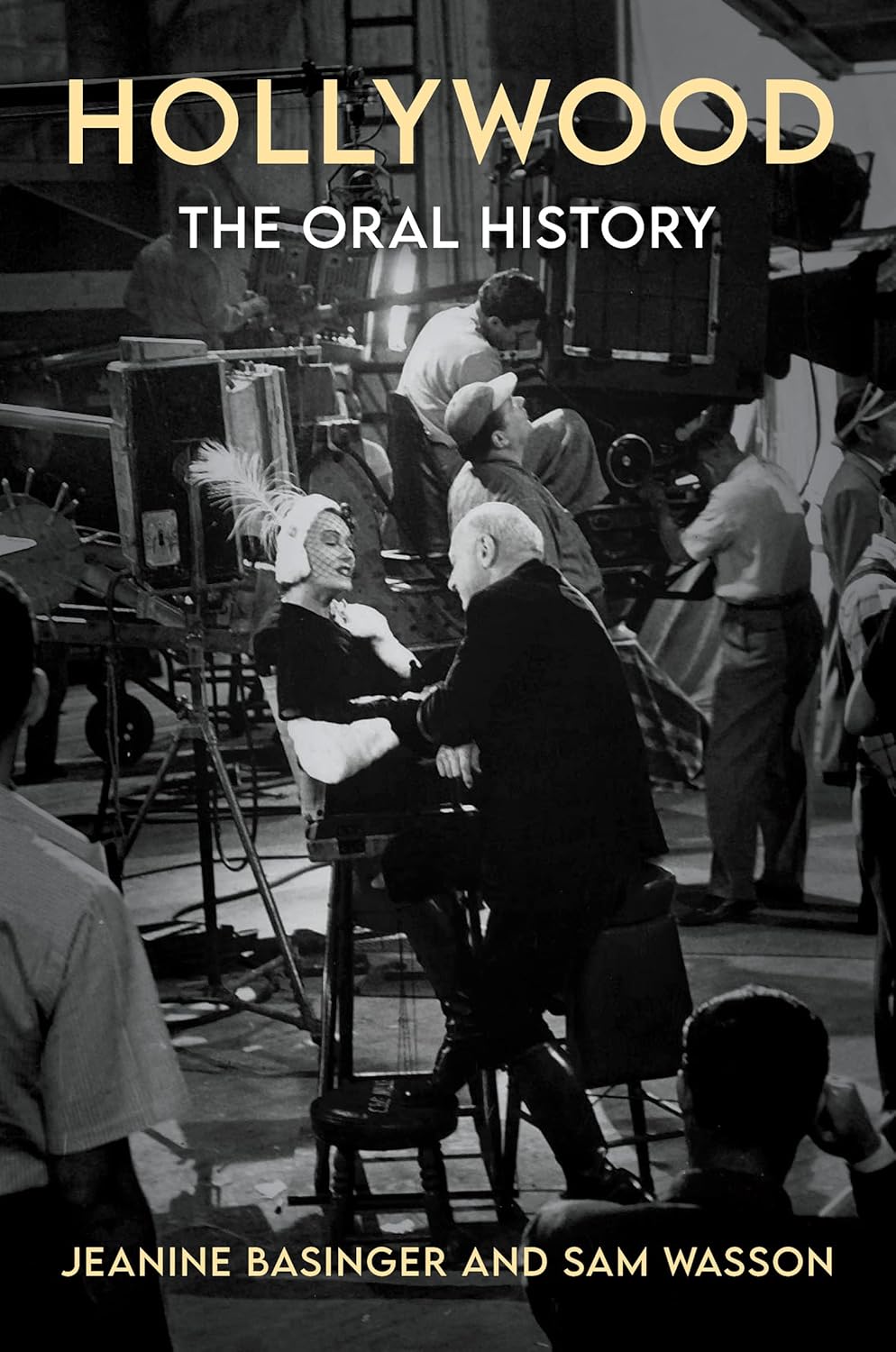
Hollywood: The Oral History, by Jeanine Basinger and Sam Wasson

Hollywood An Oral History by Jeanine Bsinger and Sam WassonI’ve been looking for a good history of the movie industry for a long time now, which makes Jeanine Basinger’s and Sam Wasson’s 2023 release Hollywood: The Oral History all that much more frustrating.

The book is excellent for what it is. Oral histories are as difficult to compile as they are easy to read, and the effort that Basinger and Wasson put in is Herculean. They scoured primarily the American Film Institute’s series of interviews with the movers and shakers of Hollywood. Everyone is accounted for here from studio heads to writers to producers to directors to stars to crew. As they tell their stories, a rough history of the movies takes shape. Unfortunately almost 800 pages later that’s what you’re left with…a rough history of the movies told from specific, and sometimes contradictory, points of view. Over 400 people are represented in the book so the story can get a little scattershot at times.

What this book is extraordinarily good at is providing a detailed look at how movies are made. From concept to script to screen, the journey of a film is explained in detail. Mysteries are solved, such as “What does a producer actually do?” The moguls, people like Irving Thalberg, Jack Warner and Sam Goldwyn, are also discussed at some length by people who knew and worked with them. This oral history approach brings the famous names of Hollywood to life in a way that a more conventional history might not have.

The evolution and dissolution of the studio system takes up the first half of the book, before giving way to the “New Hollywood” when the Hays Code was abandoned and filmmakers approached their jobs with newfound freedom. That freedom ushered in a lot of gratuitous nudity and violence but also enabled the moviemakers with the ability to make personal artistic statements in a way not seen since Orson Welles made Citizen Kane. The ending of Bonnie and Clyde, one of the first films from the New Hollywood, could never have been made during the studio system (one of the reasons it was so shocking in 1967) but it still has the power to shake the viewer almost 60 years later. From the studio system only the shower scene in Psycho compares, and that contained no shots of the knife piercing Janet Leigh’s skin.

The New Hollywood is deservedly discussed at some length, including the rise of the blockbuster films, led by Jaws. The tentpoles of the era are The Godfather, The Exorcist, Jaws, and Star Wars and all receive their due respect. Most other films are glossed over or mentioned in passing despite their influence on the cinema. While directors like Peter Bogdanovich are quoted extensively, there’s virtually nothing in the book about The Last Picture Show, Paper Moon, or What’s Up, Doc? and less to connect him to those movies. Stanley Kubrick gets a bit more respect, but not much. Even Martin Scorsese string of influential 70’s movies get a superficial treatment.

The book is basically the point of view of the studios. There is a great deal of talk about how Jaws opened in a record number of theaters, how it became the first summer blockbuster film, and how much money it made. There is very little, if any, discussion about the content of the film. If you were to read the book without being familiar with the movie, there would be no context whatsoever with the words on the page.

And this is the most frustrating part of the book. In the beginning there is a list of all of the designated narrators of the story, along with their role. So you get names like “Steven Spielberg, director” but there is nothing at all to tell the reader what films Spielberg actually directed. There is no filmography in the book so there is no way to connect the narrators with the final work that they did. More than once I had to go to IMDB to find out just who the narrators actually were. The director Allan Dwan is quoted at some length in the book but it wasn’t until I went to IMDB before I realized that he’d directed Brewster’s Millions and The Sands of Iwo Jima. Similarly, there is no sense of when the interviews were given. Some of them are decades old.  Directors will wax poetic about the good old days and the problems with movies in the current age, but there is no clue whatsoever about when the good old days were or when the current age is. When discussing movies in the present tense, it’s helpful to know when the present is.

A similar frustration is the lack of an index. It is historical malpractice to write an extensive, 800 page survey history of a time and place without including an index. So if you want to know the opinion of the Hollywood movers and shakers about Monroe, Marilyn (not a good opinion at all), you just need to remember in which chapter and pages those observations reside. It makes going back to fact check some of my opinions here impossible.

On the negative side, there is also the lack of pictures. How does one compile an oral history of moving pictures without including any pictures? It’s another missed opportunity for Basinger and Wasson. Perhaps they were worried that the inclusion of pictures, filmographies, and an index would pad an already overstuffed book, but it would be better to have a 900 page book with context than an 800 page without.

Finally, this is something of a whitewashed history. Hollywood’s notorious reputation of being a place where decadence and debauchery are not just accepted but expected, is nowhere to be found. There is no cocaine blizzard in the studios during the 1970s. There’s no casting couch or #MeToo movement. There are not even any closeted homosexuals married to beautiful starlets. No affairs, no divorce, no alcoholism, no mental breakdowns. Hollywood earned this reputation and not just recently. Nathanael West’s The Day of the Locust was written in 1940 and the hedonistic reputation of the city as both the maker and breaker of dreams was already set in stone.

Hollywood: The Oral History is a compelling and at times fascinating book. Unfortunately it is not the whole story and what is there is presented without much context. As such it is Hollywood 101. Deep dives into the history of the movies exist, but they are more likely to be focused on specific eras or filmmakers (e.g., Peter Biskind’s authoritative history of the New Hollywood in Easy Riders, Raging Bulls). An oral history may be the right approach for a history of such an unwieldy subject, but Basinger and Wasson fall several feet short of the mark.

Hot Wired Guitar: The Life of Jeff Beck, by Martin Power

Hot Wired Guitar Life Jeff BeckThere’s an old joke in music circles: If you want to drive a Jeff Beck fan crazy, ask him to name a good Jeff Beck album. There’s a soupçon of truth in that joke but, in fact, it’s easy to name a good Jeff Beck album. Or even a great one. It’s just as easy to name an album that is loaded with unbelievably great guitar playing but that still falls far short of the mark. Beck is nothing if not maddening.
Martin Power’s 2014 biography of the now late guitarist borders on hagiography at times, though it never quite succumbs. What is crystal clear is that Power considers Beck the greatest guitar player who ever lived, with the possible exception of Jimi Hendrix. And who’s to say that he’s wrong? Far more inventive than Clapton, Page, Allman, Vaughan and so many others, Beck has been lighting up the ears of guitar freaks and, maybe more importantly, other guitar players since he first burst onto the scene with the Yardbirds in 1965. His early experiments with feedback pre-dated Hendrix’s mastery over it while his lightning runs and otherworldly tremolo use set him up as a breed apart from his predecessor in the Yardbirds (Clapton) and his friend/successor (Page). The Yardbirds are known as the band that served as the minor leagues for Cream and Led Zeppelin, but the band’s best material, by far, was when Beck shook the strings. It’s really not even close. With Clapton the band was a fairly standard white blues band out of London, albeit one with a fiery guitar player. With Page the band was a spent force creatively until they broke up and the guitarist recruited three new players to fill the void. With Beck the band was frenetic and wild, incorporating sounds (like feedback) and tone (like Beck’s imitation of a sitar on “Heart Full of Soul”) that existed outside of the main music scene of the day.

Hot Wired Guitar focuses strongly on Beck’s career from his teenage years with The Tridents through the Yardbirds, the Jeff Beck Group, his brief dalliance with Vanilla Fudge’s Tim Bogert and Carmine Appice, and his solo career. It’s a well-written, excellent resource for the guitar player’s work, including the million and one guest spots he’s done with everyone from Stevie Wonder to Kelly Clarkson. A discography in the back of the book is a nice summary of Beck’s travels over a fifty-year career, and very handy if you want to stream his many guest appearances (who knew it was Jeff Beck providing the lead guitar work on Tina Turner’s “Private Dancer”? Not me).

Martin Power has clear favorites from the Beck discography, as his album by album reviews attest, and they’re the usual suspects: the Yardbirds’ Roger the Engineer, the Jeff Beck Group’s masterpiece Truth, the all-instrumental jazz fusion of Blow By Blow. The only album that Power criticizes as an album is 1985’s Flash, an attempt to get a hit record by pairing Beck up with a singer for the first time since 1972. Glossy, overproduced, and light on songs, Flash was a definite misfire despite a few good songs (an an excellent pairing, and near hit single, with his former lead singer Rod Stewart on “People Get Ready”). But other than Flash, Power focuses on Beck’s playing rather than the albums as a whole. So while Wired and There And Back, two more jazz fusion albums that are far less interesting than Blow By Blow, get criticized as being somewhat lacking, Power focuses on riffs and solos within the songs and in this area Beck could do no wrong. It is actually true that those albums, and most of his post-Blow By Blow efforts, do not measure up to what came before but the guitar playing is never less than brilliant. Long after Eric Clapton started playing it safe and Jimmy Page had all but retired, Beck was as playful, inventive, and incendiary as he ever was. Unique among musicians from that generation, Beck never rested on his laurels or settled into complacency. There is no sense of “heard it before” when discussing Jeff Beck.

Where Power fails in the book is the scant treatment he gives to the man himself. There is some talk about Beck’s prowess among the groupies in his time with the Yardbirds, but otherwise there’s no exploration of the man’s actual existence outside of his playing (and, later, his love of working on vintage cars). There’s no mention of drug use for example, and I don’t know whether that’s because Beck didn’t partake or because the author chose not to present him in a bad light. There’s a little bit of drinking, but not much and it seems never to have been a problem for the guitarist. One can write a book about a straight arrow, but there needs to be something in his life that’s of interest other than being a musician and a mechanic. Power discusses how mercurial Beck could be, dropping out of tours a few days into them, changing his mind about albums, recording, shows, and band members, but never really gets into what that meant for the people who surrounded him. The book is more about the life of a musician than that of a flesh-and-blood human being, and that’s a missed opportunity. Jeff Beck has always been an enigma. After reading Hot Wired Guitar, he’s still an enigma.

Love Becomes A Funeral Pyre: A Biography Of The Doors, by Mick Wall

514qxk7JaBL._SY344_BO1,204,203,200_

It’s now been 44 years since Jim Morrison shuffled off his mortal coil, and the story of his tumultuous life and early death has been told countless times. In books, magazines, interviews, and even a big budget feature film, it’s almost as if Morrison never left.

The band’s influence is still felt today, and that’s especially true of their lead singer, whose stage persona can be seen, in part or in whole, in the stylings of singers ranging from Perry Farrell to Scott Weiland to Eddie Vedder. When the Doors reunited in the late 1990s to perform on VH1’s Storytellers, there was no shortage of alternative rock gods lining up to pull on a pair of leather pants and do their best impressions of the Lizard King.

It’s a fair point, then, to ask if there’s a purpose to yet another Doors biography. Is there anything new that hasn’t been discussed before? Is there a single anecdote that Ray Manzarek, in the seemingly daily interviews he gave to everybody with a microphone or a pen in the years before he died, didn’t pontificate upon? Based on the latest, from British writer Mick Wall, the answer is no. This is the same story that was told (poorly and with a different ending) in No One Here Gets Out Alive, the Big Bang of Morrison biographies. It’s the same story that Stephen Davis told (very well) in Jim Morrison: Life, Death, Legend. It’s a similar story to the one told (bizarrely and with little regard for reality) by Oliver Stone in the movie The Doors.

This isn’t to say that Mick Wall brings nothing new to the party, but they’re mostly small anecdotes, like George Harrison inviting Morrison to Abbey Road Studios where the Doors singer met the Beatles while they were recording the White Album. But the main thrust of the story is still the same: pudgy young film student and poet discovers LSD, loses weight, starts writing songs, forms a band, becomes a sex god, has great success, and throws it all away (in one of the worst cases of alcoholism ever documented) while his band members fume indignantly (when they’re not making excuses for him).

Morrison was a star that eclipsed everything in his orbit. It’s why he appears on almost every page of this book, subtitled “A Biography of the Doors”, and the rest of the band drifts in an out. Morrison’s talent was, let’s be honest, limited. He couldn’t play an instrument, his voice was beautifully expressive when he sang in his range but that range was also very limited, his poetry was generally awful even as his lyrics, more disciplined, were often excellent. Forget Ray Manzarek’s constant talk of shamanism and Dionysian ecstasy and the fact remains that Morrison became an archetype. He was the tortured artist, doomed from day one, who transcended death and became a legend.

In many ways, Morrison was symbolic of the decade from which he emerged. He was vital and good-looking, filled with promise, bursting with creativity and a desire to challenge the established order. But, like the Sixties that began with JFK and Camelot, all of that potential was squandered with drugs, promiscuity, and alcohol. By the end of his life, Morrison was a burnt out husk. One of the last things he ever wrote was the scrap: “Last words. Last words. Out. Regret for wasted nights & wasted years. I pissed it all away. American music.” It was in his last journal, along several pages where he had written, over and over, “God help me.”

Love Becomes A Funeral Pyre is very good. It doesn’t add much to the story but it does flesh out one crucial aspect of Morrison’s life: how it ended. The story had first been told in Stephen Davis’s book, but there’s considerably more detail here. Since July 3, 1971, the story of Morrison’s death has been this: he went to Paris to get away from the rock and roll craziness and concentrate on his poetry and to be with the love of his life, Pamela Courson. One night they went to the movies and when they went back to their apartment Jim took a bath. He had a heart attack in the bathtub and passed away. That story has always seemed way too trite for me. I believed it because there was no contradicting story, but it never really seemed right somehow.

It’s not. People are talking now, including the ones who carried Morrison’s body out of the bathroom in a Parisian bar and deposited it in that bathtub. There’s far too many corroborating accounts now not to recognize the truth: Jim Morrison died of a heroin overdose while sitting on the toilet in a bar called the Rock and Roll Circus. In order to avoid police involvement and scandal, he was wrapped in a blanket and carried out the back door to a waiting car. His body was driven home at around 3:00 in the morning and carried up to his third floor apartment, dropped several times along the way. Pamela was mostly passed out, strung out on heroin. They stripped Jim, placed him in the tub, told Pamela what to do (get rid of all the drugs in the apartment) and what to tell the police, and left. Pamela did as she was told, and the French police weren’t really interested in pursuing the matter. It’s a more sordid tale than the myth, but far more believable. Morrison didn’t go to Paris to concentrate on poetry; he went because France wouldn’t extradite him back to the United States, where he was due to be sentenced for the infamous Miami concert. In Paris, he admitted that he was barely reading or writing anything. He was drinking an enormous amount, and had recently begun to try heroin. The heroin that killed him was nearly pure, supplied by Count Jean de Breteuil, Marianne Faithfull’s boyfriend (and former lover of Pamela…it was he who hooked Pam).

Mick Wall’s style is fluid and engaging, though perhaps more befitting a blog than a book. There are many asides and sarcastic comments scattered throughout, and Wall especially seems to hold an intense disdain for Ray Manzarek. While he readily acknowledges Manzarek’s musical skill and his gift of gab, he begins the book by telling how Manzarek had insinuated, in an interview with the author, the old trope that maybe Morrison was still alive somewhere. Rather than shrug it off as Ray being Ray, repeating something that he’s been saying to the punters for over 40 years, Mick Wall seems personally offended by the comment, and almost never fails to include snarky comments when he quotes Ray throughout the book. Some of the snark is funny, but not appropriate for what should be a more dispassionate biographical work. In contrast, the author holds John Densmore in very high esteem (deservedly so…Densmore’s autobiography Riders On The Storm is essential reading for Doors fans, and he is unquestionably the most level-headed and clear-eyed analyst of life with Jim Morrison).

Wall is also surprisingly critical of the music. While he thinks that Strange Days and L.A. Woman are complete triumphs, he’s strangely dismissive of a large part of the band’s brilliant first album, The Doors, and their hard-rocking return to basics, Morrison Hotel. He’s unfairly harsh with both Waiting For The Sun and The Soft Parade, admittedly the two weakest Doors albums but still containing many delights. He savages their performance at the Hollywood Bowl, which I’ve always found to be an extraordinary show, and the showcase they did on PBS (to my mind, one of their best performances on tape). But Wall is clearly a fan. As Morrison devolves, and the band starts to crack under the weight of playing with such a loose cannon, Wall finds it hard to disguise a sense of genuine anger that a band with so much talent could lose the thread so completely.

Wall also refuses to take a position on some of the many controversies of Morrison’s life. He shrugs and backs away from the idea that Morrison was bisexual, though the anecdotal evidence is very strong that the singer was, if not sexually attracted to other men, willing to overlook the gender of whoever was pleasuring him. Was he bisexual or just a drug-addled hedonist? It’s true that nobody will ever know but Wall seems to deliberately shy away from a stance. That’s fair enough, but he’s also agnostic on whether Morrison had been sexually abused as a child. Here there seems to be less room for hesitation. Aside from the fact that he exhibits almost all the signs of the abused child (the addictions, the sexual acting out, the violence toward women, etc), Morrison himself told his lawyer that he’d been abused. In No One Here Gets Out Alive, Jerry Hopkins and Danny Sugarman recall the many instances where a pre-teen Morrison had drawn sexually explicit (and often violent) pictures of children with adults in his notebooks. Sugarman, more a hagiographer than a biographer, dismissed these pictures as being wild and precocious, yet another manifestation of Jim’s towering intellect and Dionysian godhood, when they seemed to me to be a real cry for help. The evidence of Morrison’s abuse is all there, and Wall’s dismissal of it strikes me as cowardly (Wall says that the admission to his lawyer was possibly just more myth making, though by all accounts Morrison was in tears as he told the story). Stephen Davis did a much more thorough job of exploring this angle of Morrison’s life and behavior, including the story of the (male) Florida bar owner who would let the teenaged Morrison on stage to read his poetry in exchange for sex.

Throughout Love Becomes A Funeral Pyre, and most other good Doors books, Jim Morrison comes across as a man who is kind and personable, very witty, insecure (he was hesitant about meeting the Beatles—”What if they laugh at me?” he asked), and extremely intelligent. When he was sober. When he wasn’t sober, and he was drunk more often than not in the last few years of his life, a rage-filled monster emerged. In vino veritas. Today he would have managers shipping him off to rehab and therapy, but in 1971 nobody knew what to do with him, and he paid the price with his life.

Love Becomes A Funeral Pyre is a worthy, though ultimately redundant, addition to the story of the Doors. It doesn’t reach the level of Densmore’s Riders on the Storm: My Life With Jim Morrison and The Doors, Manzarek’s autobiography Light My Fire: My Life With The Doors, or Stephen Davis’s Jim Morrison: Life, Death, Legend, but it is far superior to the original Morrison biography, the grossly distorted, sycophantic No One Here Gets Out Alive. Wall has done fans a service by providing the comprehensive story of Morrison’s death, but there’s little else here that hasn’t been seen before.

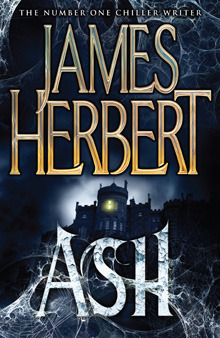
Ash, by James Herbert

8713500

It received scant notice on this side of the pond when James Herbert died at the age of 69 in March, 2013. I wasn’t even aware he had died until late in 2014. This demonstrates a considerable cultural difference between the States and England, where Herbert was the most successful and influential horror novelist of all time. His books have sold nearly 60 million copies and he was the leading stylist of what became known in Britain as “nasties”: horror novels that piled up gore, explicit sex, and far out plots, written in a breathless, fast-paced style. The sometimes extreme levels of gore and violence made the books difficult to read at times; the writing style made them impossible to put down. Once begun, you had to finish the book just to see what could happen next. In the 1980s, this movement reached America (by way of the English writer Clive Barker), in a more literary style that became known as “splatterpunk”.

James Herbert, whose first book came out the same time as Stephen King’s Carrie, was a talented writer who was responsible for some of the great horror novels of the past four decades. He started with real pulp, the go-for-the-throat, no-holds-barred horror of The Rats, but by his second novel he was creating believable characters and situations that took horror to new levels. The Fog, no relation to the John Carpenter film, is about a mist of chemicals traveling through the English countryside, turning everyone who comes into contact with it into homicidal or suicidal maniacs. In the most notorious section, a young woman attempts to commit suicide by drowning herself in the ocean, only to have second thoughts and begin to fight the powerful undertow and make her way back to shore. Blocking her way are thousands of people, the entire population of the beach town, walking into the sea like lemmings in a giant mass suicide shortly after the titular fog has passed through. The young woman never makes it back. It’s a genuinely chilling moment, and reveals a dark imagination at work. Herbert never really matched that scene, and his books swung wildly in quality from excellent (The Fog, Shrine, Domain, The Magic Cottage) to mediocre (Moon, The Dark, The Secret of Crickley Hall) to bad (Once, The Jonah, Portent, The Spear). Herbert’s books hurtle along at rocket speed, piling one horror on another, until the reader becomes exhausted. There’s nothing in any of his novels that qualifies as “literary”, but that’s fine. Herbert never made any claims to being literary. As a writer he’s far below the level of his American counterpart Stephen King, though even in his worst books nobody had ever accused Herbert of being boring (as some King books can be). If King is, as he described himself, the “literary equivalent of a Big Mac and fries”, then Herbert is the literary equivalent of a White Castle slider. If you like it, you love it, but nobody will ever make the mistake of calling it gourmet cuisine.

Ash is Herbert’s last book, barring any future posthumous releases. It is the continuing saga of ghost hunter David Ash, the protagonist of the earlier, excellent, novels Haunted and The Ghosts of Sleath. Unfortunately, David Ash’s saga and James Herbert’s career close not with the thunderous boom of a sarcophagus lid but rather the dull thud of a pine box.

In this novel, David Ash investigates the paranormal goings-on at a castle in Scotland. A man has been found crucified against a wall, held firmly in place by nothing. There is far more going on at Comraich Castle than a malevolent spirit, however. The castle has been used for over a hundred years by a cabal of extremely powerful people who go by the name the Inner Court and who specialize in making problems disappear. The castle is home to criminals, dictators, and those who could prove harmful or otherwise detrimental to those in power. Adolf Hitler’s aged daughter is kept in a cell in the basement, as are a high-ranking Church of England bishop who is also a notorious pedophile, Moammar Ghadafi who was secretly escorted out of Libya after his body double was assassinated, and Princess Diana’s first-born son (and heir to the throne), Louis, who suffered a severe birth defect that left him with nearly transparent skin. There is also a paid assassin who works for the Inner Court but who is determined to destroy the castle and everyone inside of it before the cancer in his body kills him.

The problem with Ash is that the title character is a ghost hunter and, while there are some supernatural events happening at the Castle, being channeled through the aforementioned unknown daughter of Hitler, those events are few and far between and then largely forgotten as the book winds down.

And this is the biggest issue with the book: as bombs are going off and castle walls are collapsing, as the main characters are desperately looking for a way out of the inferno, the supernatural elements of the book all but disappear and never threaten the heroes. There is a very creepy scene where Ash and his fellow protagonists need to make their way through a spider-infested cave, but that’s it. And even this scene may only be creepy to arachnophobes. A few of the less savory characters, the all-too-human villains, meet their ends at the hands of malevolent spirits but this seems to be almost an afterthought, as if at the last moment Herbert remembered that he was writing a ghost story and backfilled a few chapters with token appearances of the supernatural.

It’s a satisfying end to the story of David Ash, a likeable character whose experiences in earlier books would put Job to shame. It’s not a satisfying end to Herbert’s career, a book from the bad section of his lengthy bibliography. That’s unfortunate because, at his best, James Herbert crafted some of the most intense, horrifying scenes in the entire genre of horror fiction. None of those scenes appear in this book, a too-long, flat, novel that wants to go somewhere but never gets off the ground. James Herbert’s career has sadly ended with his first truly boring book.

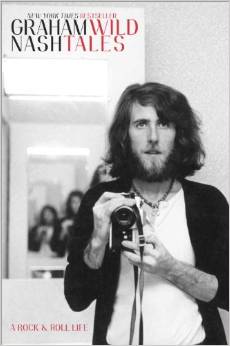
Wild Tales, by Graham Nash

nash

Honestly, Graham Nash has always kind of annoyed me. He seemed to be the weakest member of Crosby, Stills, Nash & Young, though most of their hits were written by him. Even more than David Crosby, Nash was the “hippie” in the band. He could sing beautifully and his harmony vocals were never short of amazing, but there was just something that seemed very lightweight about him. Maybe it was hearing the execrable “Marrakesh Express” one too many times when I was growing up that made me anti-Nash. Or maybe it was just that he was the quietest, most laid back member of a group notorious for their egos and volatility.

At the same time, I absolutely love The Hollies, the band Nash formed in England in the early 1960s. Yes, they were strictly second-string in the British Invasion, and their filler-to-fabulous ratio is a bit high, but The Hollies’ Greatest Hits is one of the most flawless pop albums ever released. It shines in its perfection. So when a friend of mine lent me Nash’s autobiography I decided to read it to learn more about The Hollies as much as for any other reason. Surprisingly, I’m less anti-Nash now.

He’s still annoying. The political tangents he goes off on throughout the book are unbelievably strident and reveal a man who doesn’t so much think about these issues than absorb and parrot whatever his fellow travelers and friends tell him. Nash also has an ego the size of Jupiter and he’s not shy about his talent. The book is full of bragging about his vocal abilities and songwriting. On the first of these, his bragging is justifiable. Nash does have a great singing voice and is as good a harmony singer as anyone in the business. On the latter, his songwriting, his boasts are a bit much. Nash has written some really good songs and a few great ones. He’s also written a lot of junk. Despite his claims to the contrary, only Neil Young went on to do considerably greater work after CSNY released Deja Vu in 1970.

Nash is a musical figure so locked into the 1970s it’s hard to picture him beginning in much the same way the Beatles or Stones did. Nash met Allan Clarke in grade school and they discovered that they could sing together. In forming the Hollies, they combined their talents with a love of the Everly Brothers. Nash’s stories here are charming, especially the one about how he and Clarke staked out the hotel where the Everlys were staying in England and actually got to meet them and talk to them. Nash’s love of music is readily apparent, and he makes it very clear that what he always loved most was harmony. In the early days of the Hollies Nash and Clarke perfected two-part harmonies but when guitarist Tony Hicks joined the band, and proved he could sing equally well, they branched out past the Everly Brothers and started working on three-part harmonies, which created a very different dynamic and sound. In this sense, the Hollies were the perfect training ground for Nash.

When Nash met David Crosby, another singer deeply versed in harmony singing from his time in The Byrds, and Stephen Stills, a multi-talented musician, songwriter, and singer, he was able to instantly blend his voice with theirs. Their vocal tones were so perfectly complementary that they sounded like nobody else. It was harmony singing, but a style and level of ability unheard in rock music.

Shortly after they recorded the Crosby, Stills & Nash album, Ahmet Ertegun floated the idea that Neil Young join the band. Nash protested vehemently, afraid that Young’s voice would not blend and worried that Young’s reputation as a somewhat mercurial character would upset the balance. It was only after Nash met Young that he agreed. But in some ways, Nash was right. Neil Young was far too beholden to his own instincts to be a good member of any band. While Young brought a harder edge and some truly great songs to the band, he was far too difficult to work with.

It sounds like a really big deal, but the truth is that in 1969 Neil Young was far from being famous. He’d left Buffalo Springfield and was floating around doing session work and his first, unsuccessful, solo album. Today, Crosby, Stills, Nash & Young is considered a “supergroup” but then Crosby, Stills, and Young were journeymen. Arguably the biggest star in the band was Graham Nash, and his star shone brightest in England.

For a band that did very little work together in the 1970s (they released only two studio albums and one live album), they remained hugely popular. Their 1974 tour was the first stadium tour in rock music. They toured and recorded in various permutations. Stills recorded an album with Young, Crosby and Nash worked together and apart. This was how Nash originally envisioned the band: CSNY would be a home base that they could all return to while being free to make music in any other outlet they wished. But through it all, none of the side projects carried the same weight as when three or four would collaborate. The 1977 album CSN was meant to be the followup to Deja Vu, but ended up the sequel to 1969’s Crosby, Stills & Nash after Young dropped out of the sessions. Neil Young didn’t record with the band again until 1988’s American Dream (and the less said about that godawful mess the better). At this point, the band is thought of as CSN and sometimes Y.

Throughout the book Nash is almost exactly how you imagine him to be. He’s still very much enamored of the hippie mentality and still pays a lot of lip service to that long ago ethos. The political lectures scattered throughout the book are annoying, even if you admire Nash’s exuberance and beliefs. Graham Nash is a musician who was at the beginnings of the English rock scene (The Hollies played Liverpool’s Cavern Club more than any band except the Beatles). He played at Woodstock and was at Ground Zero for what became the California sound of the 1970s. More Woodstock, fewer lectures about nuclear power, please. (His lectures might have been more palatable if he didn’t sound like all of his information came from a Greenpeace pamphlet.)

The book is somewhat misnamed. A better title might have been Mild Tales. The truly wild tales of decadence and licentiousness were the ones starring Crosby. Long Time Gone, the autobiography of David Crosby, is a far better book, both for his musical reminiscences and for the genuinely terrifying portrait of drug addiction Crosby paints. In fact, the wildest tales in Nash’s books are the ones about Crosby’s descent into an unparalleled Hell of addiction. Graham Nash had a taste for women and drugs, but never seemed to really lose control. He was remarkably self-possessed and self-assured as a young man breaking into the music business and remained so for his entire career. This, and his basic charm, make him likable (although it also fuels his unlikable ego). His love of music and photography, and his restless creative spirit are also abundant. The book makes a nice companion piece to Long Time Gone, and I’d be curious to see a good autobiography of Stephen Stills, another character blessed with musical genius and titanic ego. (Neil Young is too eccentric to write a decent autobiography, but Shakey by Jimmy McDonough is a fascinating biography.) Separate and combined, their lives are one of the most interesting rock stories ever written, spanning almost every music scene from England’s 1950s to Greenwich Village in the early 1960s to Los Angeles in the late sixties and throughout the seventies. For now, only Crosby and Nash are speaking up.