Michael Jackson, RIP

The news is everywhere and spreading fast that the self-proclaimed King of Pop, Michael Jackson, is dead at the age of 50. I can’t claim with any kind of a straight face to be a fan of the man or his music. For so long he has been a living cartoon, the Face That Launched A Thousand Punch Lines. The child molestation charges against him, coupled with his bizarre child-like manner, and his admitted fondness for cuddling up in bed with small boys, put a sinister edge on the man’s increasingly freakish visage. He may have been a cartoon, but he was far from child-friendly.

But then there is the music. I’m not a fan, and never was, but there are shining exceptions. “Beat It” was a great song, punctuated with Eddie Van Halen’s guitar solo, “Black Or White” (ably assisted by Slash ripping off the Rolling Stones’s “Soul Survivor”) also rocked well. “Thriller” was a great dance track, and “Billie Jean” is one of the greatest of all funk songs and the one towering masterpiece in his solo career. His early work with the Jackson Five was, at times, transcendent. “I Want You Back,” “I Don’t Know Why,” “ABC,” “The Love You Save,” and “Never Can Say Goodbye” are all about as close to perfect as pop music gets. His early solo hits of “Rockin’ Robin” and “Ben” were also great tunes. No, I was not a fan of his music or his image, but there was no denying that the man had an enormous amount of talent. It wasn’t my cup of tea, but he was exceptionally good at what he did.

It is one of the great mysteries of life that such explosive talent could be contained in a man so troubled. I don’t know whether he was guilty of child molestation or not. I have my suspicions, but that’s all they are. Really, really strong suspicions. But the truth has gone with him, whatever it may be. A sad death, to be sure, but a sadder life. RIP.


Michelle Malkin remembers him well.

UPDATE: Over at The Corner, Jonah Goldberg brings some needed perspective.

The Rolling Stones: The Rolling Stones, Now!

nowThe Rolling Stones released five albums in their original guise as a tough British blues/R&B/soul band (I’m going by the American releases which were slightly different than their British counterparts). Of the five, The Rolling Stones, Now! is their best.

The formula hasn’t changed very much. The album is still a collection of cover songs with a smattering of less-than-spectacular original songs. That said, the cover songs are among the best they’ve ever done, and the originals contain the first genuine Jagger/Richards classic, “Heart Of Stone,” and another near-classic with “Off The Hook.”

The album also continues to mine the band’s increasing interest in soul music. From the opening salvo of Solomon Burke’s classic “Everybody Needs Somebody To Love” to “Pain In My Heart” the Stones were fast proving themselves just as adept at soul music as they were at blues and R&B. The major difference between their R&B-oriented first album and their more soul-infused second album is that the two roots are beginning to fuse together in the hands of the band. The soul is being played by bluesmen, the blues being played by a soul band.

There are two Chuck Berry numbers on Now! which suggests that the Stones may have been running low on material that they were adept at covering. But the Berry covers are their best yet: “You Can’t Catch Me,” and “Down The Road Apiece,” which Berry didn’t write but which he had covered. “Down The Road” especially is a prime example of early Stones. “You Can’t Catch Me” features a great guitar solo layered over a propulsive rhythm that shows clearly the one thing the Stones were always masters of: the art of performing with two guitars. Rhythm was crucial to the music of the Stones and Keith’s rhythm guitar (and occasional leads) were every bit as important to the sound of the song as Brian Jones’s lead guitar (and occasional rhythm). So many bands relegate the rhythm guitar to a subsonic point in the mix, letting the lead guitar take over so much that it becomes the only guitar you can hear. But the interplay between Richards and Jones is dazzling (listen to the dueling between Richards’s picked guitar lead and Jones’s short, sharp slide in “What A Shame”).

Of the other covers, “Mona” may be somewhat pale in comparison to Bo Diddley’s fierce original, but the cover of “Little Red Rooster” is sharp enough to slice through tin cans and tomatoes, and would make The Wolf proud. “Down Home Girl” is a solid blues while “Oh Baby (We Got A Good Thing Going)” is probably the weakest cut. Not bad, but nothing to write home about.

Of the originals, “Heart Of Stone” is a great soul ballad and the first “great” Jagger/Richards original. “Off The Hook” is a terrific rock and roll number. Those two songs are clearly head and shoulders above any other originals the Stones had recorded to this point. “What A Shame” and “Surprise, Surprise” are lesser songs, but at least equal to, if not better than, the best Stones originals on 12 X 5. While the originals may prove that Jagger and Richards were not writing on the same level as Bo Diddley or Chuck Berry at this point, they were at least not embarrassing themselves by putting the songs on the same album.

The full flowering of the Jagger/Richards songwriting partnership would begin on their next album, and the covers would start to seem less vital than the originals. At this point in time, covers and originals stood side by side. Soon the covers would become much less important.

Grade: A

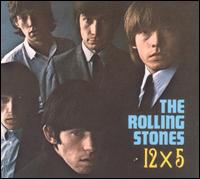
The Rolling Stones: 12 X 5

12 X 5The second album from The Rolling Stones is sonically a continuation of England’s Newest Hitmakers. The huge difference here is the inclusion of four songs by the Jagger/Richards team (and one, the disposable instrumental ode to Chess Records, “2120 South Michigan Avenue,” credited to the group pseudonym, Nanker Phelge).

Chuck Berry gets another shout out with the leadoff position on the album. The Stones version of “Around And Around” matches their earlier version of Berry’s “Carol” in terms of intensity. It’s further proof that nobody did Chuck Berry as well as the Stones. The rest of the album is a combination of blues, early rock ‘n’ roll and, strangely, a vocal group song (“Under The Boardwalk,” the classic song by The Drifters).

What’s of most interest on this album are not the originals. The four songs written by Jagger and Richards (“Empty Heart,” “Good Times Bad Times,” “Congratulations,” and “Grown Up Wrong”) indicate nothing more than that as songwriters they were still finding their voice by imitating their idols. All four of the songs are okay (“Empty Heart” is the best of the lot), but none are really all that remarkable.

What is of interest is the two cover songs that can rightfully be considered the first Rolling Stones classics. Bobby Womack’s “It’s All Over Now” was a good soul song that the Stones turned into a magnificent rock song. It was a clear case of a band finding a “sound” of their own, despite it being a cover song. When one thinks of the early Stones classic songs like “Satisfaction” or “Get Off Of My Cloud,” the sonic template is found first on “It’s All Over Now.” Much like Jimi Hendrix’s version of “All Along The Watchtower” forever banished Bob Dylan’s original song to the record collections of hardcore Dylan fans, the Stones’s version of “It’s All Over Now” became the standard that the original only hinted at.

The second Stones classic is more problematic. “Time Is On My Side” is one of the most famous songs in Rolling Stones history…but not the version that’s on 12 X 5. The famous, classic version of the song was released as a single. The version on the 12 X 5 album sounds like a pale, lifeless imitation. I mention it here because the single appeared nowhere else at the time, and it was the hit and far superior even to “It’s All Over Now.” But you’d never know that if the album version was all you had ever heard.

For the rest of the album, it was more of the same from the first album. A version of “Suzie Q” is good, “Under The Boardwalk” isn’t. What is stressed by “Under The Boardwalk,” “It’s All Over Now” and a cover of Wilson Pickett’s “If You Need Me” is just how strongly the Stones were starting the move away from pure blues. In contrast to the first album, only a couple of songs on 12 X 5 could really be considered blues (“Around and Around” which was considered rock by most people, and “Confessin’ The Blues”). The rest show an increasing fascination with rock and soul music. As such, this is the beginning of the transition from blues/R&B to rock. It was a move that would speed up as Jagger and Richards got more comfortable as writers.

Grade: B

The Rolling Stones: England’s Newest Hitmakers

g60332e9yd5

In the era of mega-concerts, massive stages, backup singers, extra musicians, clockwork efficiency, Pirates Of The Caribbean cameos, and knighthoods, it’s very easy to forget where and how the Rolling Stones started.

England’s Newest Hitmakers is the first Rolling Stones album and is typical of the time it was released (1964). The Jagger/Richards songwriting combination was still in utero at this point, so the album is a collection of cover songs, with one Jagger/Richards original (“Tell Me”) thrown in. (Two other songs, “Now I’ve Got A Witness” and “Little By Little” were credited to “Nanker Phelge” and Phil Spector—Phelge was a pseudonym for a song written by the entire group.)

What distinguishes this album from similar debut albums by bands like The Kinks is the utter conviction with which the Stones ply their trade. The Beatles may have been the best, most original band in England at the time, but the Stones were the most savage, honest practitioners of authentic American blues and R&B. There’s no confusing this album with Howlin’ Wolf or Muddy Waters, but it’s clear from the opening notes of “Not Fade Away” that the Stones were a band who understood the idiom in which they practiced. Mick Jagger never plowed a field or picked cotton, but he clearly had an empathy for the blues that was lacking in bands like The Yardbirds, who were copying their heroes without ever truly getting to the heart of the matter. As a result, the early Yardbirds (before Jeff Beck showed up and turned them into a great rock band) sound like young, white, English boys trying desperately to sound like old, American, black men, while the early Stones sound like…well, maybe not like authentic bluesmen but at least like guys who hung around with authentic bluesmen.

The blues authenticity comes from Brian Jones. At the time Jones was a polymathic musician, steeped in Elmore James and Muddy Waters and in these early days it was clearly Jones’s band. Jagger may have been the voice, but Jones was the heart and soul.

Nearly as important was Keith Richards who loved blues, but who was just as partial to the Chuck Berry school of blues as he was to the Muddy Waters school. The love of early rock ‘n’ roll shared by Richards and Jagger ensured that the Stones would be more than just a blues cover band. Indeed, their brilliant take on Buddy Holly’s “Not Fade Away” opens the album. By toughening up the Bo Diddley beat that Buddy Holly was nearly parodying, and by replacing Holly’s anemic picked guitar with percussive acoustic rhythms, the Stones took the rock song and turned it into a blues. Their version of Chuck Berry’s “Carol” is nearly the equal of the original and served notice that nobody would ever do Chuck Berry songs as well as the Stones would (indeed, one of my favorite moments from the Berry movie Hail! Hail! Rock ‘N’ Roll is when Keith Richards shows Chuck the correct way to play one of Berry’s own songs).

Early rock and roll was clearly blues-based, but the magic of the early Stones was that the rock tunes sat alongside the pure blues and emerged as a cohesive whole. Even the Motown song “Can I Get A Witness,” a pure pop song, emerges as a mutant Muddy Waters tune right down to the Otis Spann-ish piano that starts off the track. Willie Dixon or Bobby Troup, Chuck Berry or Holland/Dozier/Holland…all the songs ended up sounding distinctly like the Stones. Some of the covers (e.g., “Not Fade Away” and Rufus Thomas’s “Walking The Dog”) surpass the original versions. Whether they were a blues band playing rock songs or a rock band playing blues song, the result was seamless. Surprisingly, the most “pop” moment on the album is the sole original song, but even “Tell Me” sounds like some sort of country blues song.

The album’s empathy for the blues is what allows it to hold up forty-five years (!) later when so many similar albums have been forgotten. The only criticisms of this album are the useless filler instrumental “Now I’ve Got A Witness” and the one handicap that the Stones would soon rectify: a dearth of original material. Had they continued covering blues and R&B songs, the Stones today would be a forgotten band, albeit a good one. That this fact was recognized by their manager, Andrew Loog Oldham, and they were pressured into writing original compositions is what saved the Stones. For this brief moment the Rolling Stones were the finest practitioners of genuine blues in England, even if they weren’t the most original.

Grade: A
The Listening Post: May 2009

For those interested, brief reviews of what’s been in heavy rotation lately:

  • Parallel PlaySloan. The Canadian power poppers album took a little while to sink in, mainly because it was in competition with Rooney’s instantly likable debut album. However, this is the deeper, richer collection of songs. Very catchy melodies matched with lyrics that are clever without being “cute.” The song “I’m Not A Kid Anymore” is particularly heartbreaking when you hear it while waiting for the train to work on a cold and rainy morning. Grade: B+
  • RooneyRooney. From 2003, the debut album by Rooney has more great hooks than a tackle box. Beach Boys-inspired harmonies (dig “Blue Side”) and Beatles-inspired music make a great combination. The album is, however, somewhat insubstantial. Unlike the Sloan album, the lyrics here go for “cute” in a style very reminiscent of Fountains Of Wayne. It’s good for a band to have a sense of humor. It’s not so good when you feel like they’re cracking jokes. Putting that aside, it’s a fine album. Grade: B
  • Modern GuiltBeck. Maybe Beck’s strongest album. The production by Danger Mouse adds a very cold feel to the overall sound of the album, but it’s mixed with some of Beck’s warmest melodies. It’s like standing in the middle of an ice cold rainforest, or perhaps a blazing hot Arctic tundra. The lyrics are unrelentingly dark, but the music is bright. The result is an album that holds up very well to repeated listens. Grade: A
  • Attack And ReleaseThe Black Keys. Speaking of Danger Mouse, he also produced this extraordinary collection of molten blues-based tunes. There’s just enough Danger Mouse weirdness throughout the album to give the songs a little more color than you’d expect from a Keys album, but all the strengths of the Keys are plainly evident: crunching guitar, gutbucket drums, bluesy vocals, and great, great songs. Grade: A+
  • RocksAerosmith. More than 30 years after this album was released, I feel like I’m arriving a little, erm, late to the party. But the truth is that I was never that much of an Aerosmith fan. I liked their 70s singles, and hated their 80s and 90s comeback. But I finally succumbed to pressure and put Rocks in heavy rotation. I don’t quite take back all the negative things I’ve said about Aerosmith over the years, but jeez, this album is great. But then, you probably already knew that. Grade: A+
  • CommunionThe Soundtrack Of Our Lives. Due to the enormous glut of music I’ve gotten my hands on lately, combined with various iPod and computer problems that seem to have finally ironed out, my opinion may change as I catch up. But Soundtrack’s latest is my favorite album of 2009…even if it did come out at the tail end of 2008. This is their most consistently great album since Behind The Music, and maintains that consistency over a sprawling 2 CDs. Soundtrack sound kind of like every great band you’ve ever heard all rolled into one package, and this is their finest album. Hopefully it won’t be years before the next album. Grade: A+
  • Deaf PriscillaBeauregard Ajax. Talk about arriving late to the party. The sole album by Beauregard Ajax was recorded in 1968, but never released until 2006. The master tapes had been damaged so there are a couple of sonic glitches on the album, but overall this is a surprisingly good collection of psychedelic pop. Less avant garde than early Floyd, less frightening than Jefferson Airplane, it’s fairly safe with a twist of odd. There’s nothing spectacular here, but there’s nothing really bad, either. Grade: B-
  • WarpaintThe Black Crowes. For their reunion album, the Crowes managed to pull off something the Smashing Pumpkins could not: deliver a strong album that ranks with their best. It sounds like no time at all has passed since the Crowes broke up (which is understandable, because when the Crowes debuted it sounded like no time had passed since 1972). The bluesy tunes, strong guitar work (dig the great slide on “Whoa Mule”) and Chris Robinson’s weathered vocals are finally matched to a set of songs that deserve them. I’m in a tiny minority when I claim that Three Snakes And One Charm is a great album, but this is their best since then. If you’re one of the many who weren’t partial to that album, then this is their strongest since The Southern Harmony And Musical Companion. Following this with a live version of the album was really lame, though. Grade: B+
  • Turn OnThe Music Machine. From 1966, the sole album from the original lineup of The Music Machine is a fuzzed-out, garage rock classic. While it can’t compare to any of the real classic albums of the 1960s, Turn On is a strong collection of originals and covers (including a blistering “Taxman” and a pre-Hendrix bluesy version of “Hey Joe”). There’s nothing on the album that stands shoulder to shoulder with the Machine’s one moment of sheer brilliance, the incomparably raunchy “Talk Talk,” but the rest of the album holds up pretty well. Grade: B
  • Bridge Of SighsRobin Trower. I don’t know how this album got past me when I was a young, guitar-besotted music geek with a Hendrix fixation. It’s not like I’d never heard of Robin Trower. In fact, I nearly ran to the record store to buy the two albums he did with Jack Bruce in the early 80s, and I loved them. All that time I heard from people who told me to listen to Bridge Of Sighs, but I never listened until the last few months. Well, you were right. It is an excellent album full of soulful vocals and Hendrix-ish guitar playing. It sounds like Trower spent most of his time listening to the post-Electric Ladyland Hendrix, because it’s that very heavy string distortion that he picks up on. The cat can play, but the limits are also evident here. Trower may be a great guitar player, but he’s always going to make you think of Hendrix. On this album he’s got really strong material, but without strong songs it’s evident he’d be just a slightly better Frank Marino. Grade: A