Vintage Trouble: Heavy Hymnal

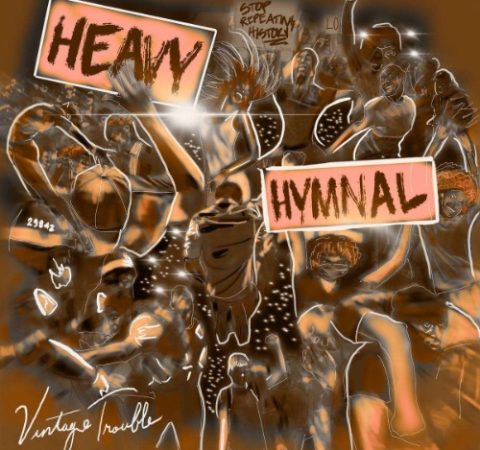
Vintage Trouble Heavy HymnalIn the world of streaming music it’s virtually impossible for a band to break through into the public consciousness. Artists nowadays hope that their songs will be licensed to a commercial, or a video game, or a movie. Satellite radio exists, of course, but with so many stations to choose from, bands easily get lost in the shuffle. Today, albums are no longer the coin of the realm. The single has returned. Albums are still being made but that almost seems like a tradition more than an expression of artistry. The sad truth is that unless you’re selling (and streaming) in Taylor Swift-like numbers, a band today can’t make much (if any) money based on record sales. Money must be earned on the road, playing large and small clubs and theaters to a hopefully packed house.

In my mind this sets up an unfortunate conflict between the entertainers (the guys jumping around on stage singing their hearts out) and the artists (the guys sitting in a small room agonizing over which chord should come next in the song they’re writing). There’s just no money in artistry these days.

So it is that Vintage Trouble, a band that released their first record way back in 2011, took twelve full years by the time they got to their third album. For context, that’s as long as the Beatles entire career from their skiffle days until their breakup. Sadly, it also appears to be the last Vintage Trouble album, as the band announced that they are “on hiatus” in early 2024. While “on hiatus” can mean many things, their website has essentially shut down with only a message that they are pursuing individual and family endeavors. “We’ll miss you for sure. May we all continue as friends and supporters of one another” sounds a lot more conclusive than “See you soon!”

It’s a shame that this band was forced by the times to spend so much more effort on the road than in the studio. They released only three proper albums (a fourth, Juke Joint Gems, was collected from old recordings and released only digitally), so in the wake of their dissolution we have only a few records to fall back on. Equally sad, their final album, Heavy Hymnal, may be their best, pointing to a bright future that is no more.

More than their previous albums, The Bomb Shelter Sessions and 1 Hopeful Road, this is an album that feels like they’ve got something to say. From the machine gun rapid fire rapping of opener “Who I Am” to the Marvin Gaye-inspired closer “Repeating History” the album is by turns defiant and melancholy, sometimes within the same song. But regardless of the lyrical themes, every song has an infectious groove guaranteed to get you moving. Like all the best soul albums, Heavy Hymnal flows like a party from the boisterous opening salvo of “Who I Am” and “You Already Know” (which features two molten metal guitar solos from Nalle Colt) to the reflective closing of “Shinin'” and “Repeating History” with its mournful guitar solo that evokes Eddie Hazel’s legendary turn on Funkadelic’s “Maggot Brain”.

There are torch songs for slow dancers, like “Not The One,” and the beautiful “The Love That Once Lingered” but the accent here, more than on their previous albums, is on get-your-hands-in-the-air bangers. Elsewhere, the band channels Prince channeling Stevie Wonder (“Baby, What You Do”), explores dance rhythms (“Feeling On”), and even merges a slinky funk groove with power pop (“Shinin'”).

Vintage Trouble was a band with talent to burn. They approached their music fearlessly and in their time delivered three of the best soul/funk albums ever recorded. Their albums stand as testament to a love for music of many different genres. While at their core they were a soul band, they also touched on rap, rhythm and blues, dance music, and rock and roll. In this era of girl pop, streaming, and iTunes, they deserved better.

Grade: A

Hot Wired Guitar: The Life of Jeff Beck, by Martin Power

Hot Wired Guitar Life Jeff BeckThere’s an old joke in music circles: If you want to drive a Jeff Beck fan crazy, ask him to name a good Jeff Beck album. There’s a soupçon of truth in that joke but, in fact, it’s easy to name a good Jeff Beck album. Or even a great one. It’s just as easy to name an album that is loaded with unbelievably great guitar playing but that still falls far short of the mark. Beck is nothing if not maddening.

Martin Power’s 2014 biography of the now late guitarist borders on hagiography at times, though it never quite succumbs. What is crystal clear is that Power considers Beck the greatest guitar player who ever lived, with the possible exception of Jimi Hendrix. And who’s to say that he’s wrong? Far more inventive than Clapton, Page, Allman, Vaughan and so many others, Beck has been lighting up the ears of guitar freaks and, maybe more importantly, other guitar players since he first burst onto the scene with the Yardbirds in 1965. His early experiments with feedback pre-dated Hendrix’s mastery over it while his lightning runs and otherworldly tremolo use set him up as a breed apart from his predecessor in the Yardbirds (Clapton) and his friend/successor (Page). The Yardbirds are known as the band that served as the minor leagues for Cream and Led Zeppelin, but the band’s best material, by far, was when Beck shook the strings. It’s really not even close. With Clapton the band was a fairly standard white blues band out of London, albeit one with a fiery guitar player. With Page the band was a spent force creatively until they broke up and the guitarist recruited three new players to fill the void. With Beck the band was frenetic and wild, incorporating sounds (like feedback) and tone (like Beck’s imitation of a sitar on “Heart Full of Soul”) that existed outside of the main music scene of the day.

Hot Wired Guitar focuses strongly on Beck’s career from his teenage years with The Tridents through the Yardbirds, the Jeff Beck Group, his brief dalliance with Vanilla Fudge’s Tim Bogert and Carmine Appice, and his solo career. It’s a well-written, excellent resource for the guitar player’s work, including the million and one guest spots he’s done with everyone from Stevie Wonder to Kelly Clarkson. A discography in the back of the book is a nice summary of Beck’s travels over a fifty-year career, and very handy if you want to stream his many guest appearances (who knew it was Jeff Beck providing the lead guitar work on Tina Turner’s “Private Dancer”? Not me).

Martin Power has clear favorites from the Beck discography, as his album by album reviews attest, and they’re the usual suspects: the Yardbirds’ Roger the Engineer, the Jeff Beck Group’s masterpiece Truth, the all-instrumental jazz fusion of Blow By Blow. The only album that Power criticizes as an album is 1985’s Flash, an attempt to get a hit record by pairing Beck up with a singer for the first time since 1972. Glossy, overproduced, and light on songs, Flash was a definite misfire despite a few good songs (an an excellent pairing, and near hit single, with his former lead singer Rod Stewart on “People Get Ready”). But other than Flash, Power focuses on Beck’s playing rather than the albums as a whole. So while Wired and There And Back, two more jazz fusion albums that are far less interesting than Blow By Blow, get criticized as being somewhat lacking, Power focuses on riffs and solos within the songs and in this area Beck could do no wrong. It is actually true that those albums, and most of his post-Blow By Blow efforts, do not measure up to what came before but the guitar playing is never less than brilliant. Long after Eric Clapton started playing it safe and Jimmy Page had all but retired, Beck was as playful, inventive, and incendiary as he ever was. Unique among musicians from that generation, Beck never rested on his laurels or settled into complacency. There is no sense of “heard it before” when discussing Jeff Beck.

Where Power fails in the book is the scant treatment he gives to the man himself. There is some talk about Beck’s prowess among the groupies in his time with the Yardbirds, but otherwise there’s no exploration of the man’s actual existence outside of his playing (and, later, his love of working on vintage cars). There’s no mention of drug use for example, and I don’t know whether that’s because Beck didn’t partake or because the author chose not to present him in a bad light. There’s a little bit of drinking, but not much and it seems never to have been a problem for the guitarist. One can write a book about a straight arrow, but there needs to be something in his life that’s of interest other than being a musician and a mechanic. Power discusses how mercurial Beck could be, dropping out of tours a few days into them, changing his mind about albums, recording, shows, and band members, but never really gets into what that meant for the people who surrounded him. The book is more about the life of a musician than that of a flesh-and-blood human being, and that’s a missed opportunity. Jeff Beck has always been an enigma. After reading Hot Wired Guitar, he’s still an enigma.

Smashing Pumpkins: Aghori Mhori Mei

Alghori Mhori Mei

In some ways I feel bad for Billy Corgan. The man is following his muse wherever it takes him, but the places he’s going are very different than the places where he established his stardom. His last album, ATUM, is a synthesizer-heavy, triple disc, concept album about space. Or something. He sold it as a sequel to the albums Mellon Collie and the Infinite Sadness and Machina/The Machines of God, explaining in a 33-part podcast that the main character in ATUM, Shiny, was Zero on Mellon Collie (not a concept album) and Glass on Machina (also not a recognizable concept album). Man, that’s a lot of Billy Corgan to digest. The problem for Corgan is that, except for his instantly recognizable vocals, the album swapped out the heavy guitars of his heyday in favor of washes of synthesizer and didn’t sound anything like the alternative rock masterpieces of Gish or Siamese Dream. The fact that ATUM followed three previous albums that were increasingly reliant on synths was not good news to fans of the old band. This was at a time when he had reunited most of the original band but seemed to be running as fast as he could in the opposite direction of their original sound. His primary audience largely forgot about the band, relegating them to warm feelings of nostalgia. New audiences are hard to come by these days in the age of streaming.

Now Corgan has responded to the pleas of his old audience and released an album that sounds like it would have fit very comfortably on the radio in 1994. On Aghori Mhori Mei, the twin guitar attack of Corgan and James Iha is back, and Jimmy Chamberlin has been turned loose to attack his drum kit once again. The album sounds loose and freewheeling, released from the confines of synths and click tracks. This is a band that is once again firing on all cylinders.

Which isn’t to say that the album is as good as their work from 1990 to 1995, only that it sounds of a piece. The Pumpkins in that golden era of alternative rock were one of the brightest stars in the galaxy, fusing bone-pulverizing riffs and dreamy psych-pop, releasing some of the best singles and albums of the decade. Aghori Mhori Mei is not Siamese Dream Part Two. It is, however, an excellent return to form.

Lyrically this may be the most cryptic Pumpkins album. As if the title of the collection wasn’t enough, song names include “Edin”, “Sighommi”, “999”, “Goeth the Fall”, “Sicarus”. The final track, “Murnau”, is apparently named after F.W. Murnau, the director of the original silent movie Nosferatu. What the lyrics have to do with the director, or his films is a mystery to me. There’s also reference made to Corgan’s interest in Hinduism, with the title word “Aghori” meaning a devotee of Shiva, and “Sicarus” containing the plea “Kali, let’s touch beyonds with us” and “Kali of dawn satnam shri ram” which translates to something George Harrison might have understood. Who really cares when the song has a terrific guitar solo and a cool stun gun riff that heralds the chorus? Not me. I learned in the 1990s to just go with Corgan’s lyrical flow. And what’s a “labyrinth milk syringe” (“Pentagrams”)?

Musically it’s all here, as if preserved in amber from the outtakes of Mellon Collie and the Infinite Sadness. Riffs abound (“Edin”, “Pentagrams”, “Sighommi”, the brutal “War Dreams of Itself”, “Sicarus”), there’s slower, sludgy tracks (“999”), and floaty ballads (“Pentecost”, “Who Goes There?”, “Goeth the Fall”, “Murnau”).

Corgan is not the only star of this show. While it’s impossible to differentiate Corgan’s guitar leads from James Iha’s, Jimmy Chamberlin’s drums stand out from the distortion. Rolling, tumbling, and crashing like a tsunami on the shore, Chamberlin proves again that he’s one of rock’s greatest drummers ever. On the previous Pumpkins albums he sounded restrained, held in check by the synthesizers. On Monuments to an Elegy he was briefly replaced by the ham-fisted Tommy Lee, who can’t even pronounce the word “subtlety”. On Aghori he’s back and completely fired up, clearly thrilled to be rocking with abandon again.

In an interview with Kerrang this past July, Corgan announced this album and said that “old-school fans will be happy, for once”. It is, in a way, a sad comment. It makes one feel that this triumph of an album is just a throwaway to Corgan, something to get the “old-school fans” off his back so he can go back to space operas and synth-pop. It would be a shame if that were the case. The next album will tell, I suppose, but for now it’s a pleasure hearing two great guitarists and one great drummer turned loose.

Grade: A-

X: Smoke & Fiction

smokeWhen X first came on the scene in 1980 they were hardscrabble punk poets who had the good fortune to be noticed by former Doors keyboardist Ray Manzarek, who was always a sucker for a band that wore their Doors influences on their sleeve. Those first four X albums (Los Angeles, Wild Gift, Under The Big Black Sun, and More Fun in the New World), all produced by Manzarek, still stand at the top of the Los Angeles punk scene from the late 1970s and 1980s. They were less aggressive than Black Flag, more tuneful than the Circle Jerks, less obnoxious than Fear, and, unlike the Germs, had written actual songs with melodies and choruses. Their combination of poetic lyrics, a punk rock rhythm section, and a Chuck Berry-loving rockabilly guitar player were unlike anything else on the scene. Their vocal harmonies were borrowed from Jefferson Airplane, their lyrical content from Jim Morrison. Though they came from the hardcore punk rock underground, that had more to do with their location than their actual sound. They were punk in attitude, but a rock and roll band in practice.

Unfortunately, X then signed to a major label and fell into the hands of less sympathetic producers than Manzarek. In the mid-80s all the rough edges were sanded down and X started to sound like every other band on the planet. Many of the songs were good, but the production was just awful and completely generic. Shortly after, guitarist Billy Zoom decided to retire from the music business. By the time the alternative rock explosion of the early 1990s was happening, they were barely performing or recording and they split.

It was a surprise when X announced a new album in 2020, and an absolute shock when Alphabetland was so good. The rough edges were back, the songwriting was as good as ever, Billy Zoom was back. In  30 minutes, X issued a defiant statement to the usual second-rate reunion album. While it may not quite measure up to X classics like Los Angeles or Under the Big Black Sun, it’s clearly a return to form for a mostly forgotten band.

Smoke & Fiction picks up where their previous release, Alphabetland, left off and proceeds to surpass that effort. This is X sounding as good as they ever did. I don’t know whether they had any “help” in the studio, but both John Doe and Exene Cervenka sound the same as they did in 1980, and Billy Zoom reels off one great guitar part after another.

From the opening whiplash riff and tight guitar solo of “Ruby Church” to the Chuck-Berry-on-speed recurring lick that marks the chorus transition of “Baby & All,” X races through one of the year’s best albums in less than 30 minutes. Along the way there are several self-referential lyrics that reflect on their career. 

“We were never just kids/We did what we did/To set each other free” they harmonize in “The Way It Is.” It could be about a relationship but easily doubles as a look back to the band that was featured in the 1981 Penelope Spheeris documentary about the L.A. punk scene The Decline of Western Civilization. In “Big Black X” they complete the circle to their first album with a reminiscence of their career (“Drivin’ state to altered state/Holdin’ foldin’ maps/On another pay phone break/A big black X on a white marquee”) and a love song to the city of Los Angeles 44 years ago, when the Hollywood sign was in disrepair and the Hillside Strangler was making his presence known. “We knew the gutter,” they sing, but “also the future.”

But it’s not all backwards-looking. On “Sweet Til The Bitter End,” the second track on the album but really the spiritual kickoff, they state “Let’s go around the bend/Get in trouble again/Make a commotion.” On the terrific title song, Exene sings of the fire that still burns inside her: “My soul still goes out walking/Over bridges that are burning/There’s lessons I keep learning/All the leaves are turning” before calling out faith in faithless times (“I still pray a little bit/But there’s no saint for this”).

Even the slower songs (“Face in the Moon,” “The Way It Is”) have power behind them. “Face in the Moon” rides a chugging riff as John Doe sings again about California, flying into Los Angeles from San Francisco and driving down the Hollywood freeway. It is, as always with X, an unflinching look at a California they love, but that they also feel is doomed: “From the freeway to the sky/You get your way with a thousand lies/An ugly life that seems so pretty/Stealing through this tin can city.”

Smoke & Fiction is, according to the band, their final effort. It’s as good a way to go out as any. X compromised their sound in the mid-80s under pressure from corporate suits but on their final two albums, released 27 and 31 years respectively after 1993’s Hey Zeus, they managed to do a nearly impossible feat: release new music that stands shoulder-to-shoulder with their music from nearly a half century ago, when they were young, talented, and burning with ambition. If you want to call them punk because they emerged from the same Los Angeles club scene that birthed hardcore, then they’re America’s greatest punk band. I prefer to think of them as just a rock and roll band with some punk rock nuance. Even with that broader classification they’re still one of America’s best bands.

Grade: A

Jack White: No Name

Rock’s most notorious prankster has struck again. On July 19th (my birthday) anybody who bought a vinyl album at the Third Man store received a free gift with purchase: a vinyl record in a plain white sleeve, bearing the words “No Name” with song titles as “Side One, Track One”, “Side One, Track Two”, etc. There was no other information, but there was a picture of the record on Third Man’s Instagram page with the command to “rip it.” Copies of the album immediately began appearing on YouTube as the lucky owners realized that they were holding a brand new, unannounced, Jack White album. A week later the album appeared, with song titles and the official name of No Name, only on streaming services…quite a switch from the current king of vinyl who has a somewhat undeserved reputation as being a Luddite.

White’s recent solo releases have leaned towards heavier, bordering on industrial, music, as if you were hearing the White Stripes playing Nine Inch Nails. The creative misfire, 2018’s Boarding House Reach, was both the zenith of this style and the nadir of his career. Noisy, harsh, and largely tuneless, Reach set the tone for 2022’s Fear of the Dawn, which was just as noisy and harsh but had a few more tunes.

Dawn was the first half of a musical diptych, followed only a few months later by Entering Heaven Alive, a beautifully paced collection of acoustic-tinged ballads and mid-tempo songs that was White’s best album since the magnificent Blunderbuss, his initial foray into solo work. Now, two years later, comes No Name, an album that received no hype whatsoever. There was no marketing, and no physical release at all until earlier this month. There have been no videos. News of the album was strictly word of mouth. Many fans, not knowing what they had in their possession, probably assumed the album was a throwaway.

It wasn’t.

No Name eclipses Entering Heaven Alive as the best Jack White solo album since Blunderbuss. In many ways, it harkens back to the White Stripes of Elephant and Icky Thump. This is the most minimalist album White has done since the Stripes. Most songs feature just three musicians. Only one song (“That’s How I’m Feeling”) features a full band of guitar, bass, multiple drummers, and keyboards, but the stars of this show are White and his fellow Raconteur Patrick Keeler on drums. It’s also a family affair with White’s wife, Olivia Jean, playing bass on “Old Scratch Blues” and “That’s How I’m Feeling,” while his teenage daughter Scarlett adds the bottom end to the delightful “Archbishop Harold Holmes” and “Underground.” Perhaps best of all is “Number One With A Bullet” which features just White and Keeler in a tantalizing glimpse of what the White Stripes would have sounded like with a more conventional drummer.

The minimalism extends to the packaging, featuring the same blue-tinted image on both the front and the back cover, a simple black inner sleeve, and a white-on-black lyric sheet. The name of the artist and album appear only on the spine of the album.

This is the hardest rocking album in White’s career. There are no ballads to soften the blows that come fast and furious in the thirteen tracks. Even the songs that start gently explode into a fury before too long. Throughout the album the musicians are in overdrive, from the Stripes-ish mutant blues of “Bless Yourself” to the punky thrash of “Bombing Out” and “Missionary”, which cops the opening riff from the Clash’s “Clash City Rockers.”

White’s sense of humor is also present. “It’s Rough on Rats (If You’re Asking)” mourns the world we’re leaving behind for our furry brethren. “The world is worse than when we found it/It sure must be rough on rats…But I should stop complaining every time it’s raining/’Cause I’m still not food for cats.” Meanwhile, “Archbishop Harold Holmes” takes the form of a letter from the title parson who promises the answers to all life’s questions “If you’ve been crossed up by hoodoo, voodoo/The wizard or the lizard/You got family trouble?/Man trouble?/Woman trouble?” But the solution is a Ponzi scheme, the prosperity gospel that promises wealth if you first give all you’ve got: “By sundown, Monday/You who come will be blessed with the big money blessing/You will be doubted by all the unbelievers/On all the things I’m addressing/But you must tell seven friends/You must first bring seven friends.”

“What’s the rumpus?” White asks before harkening back to his younger days as a musician. “When will the label dump us?/They tried to stump us/What genre will they lump us?” It’s a sincere question coming from a musical iconoclast like Jack White. His music skips merrily from heavy rock to blues to rap to country to bluegrass…sometimes all in the same song (e.g., “Lazaretto”). He’s spent his entire career blurring distinctions between genres while still sounding like himself. From the cheap plastic guitars and red/white/black color scheme of the White Stripes to the suit-wearing, blue-haired troubadour of Entering Heaven Alive, White has remained his own man and has achieved great success by doing things his way. While No Name calls back to his earlier days in terms of sound and distortion, it’s very much the work of a mature artist who, after twenty-five years making music, still has a lot to offer and a lot to prove to himself.

Grade: A