“My, but that little country boy could play…” Chuck Berry, RIP

I first heard Chuck Berry when I was a child, unfortunately. The song came out of the radio constantly, hitting number one on the charts. But even as a child, I thought it was inane and stupid, a joke so bad and crude that it was below even those of us in second grade.

Astoundingly, “My Ding-A-Ling” was Chuck Berry’s only number one hit. Fortunately, it has now taken its rightful place as a freak novelty number better left in the dustbin of history.

My next exposure to Berry came via the soundtrack album to American Graffiti, the two record set (41 songs!) that sparked a great love of early rock ‘n’ roll for many people my age. “Almost Grown” and “Johnny B. Goode” immediately and forever banished the idea that the guy who sang that dopey dick joke song was a one-hit wonder.

ChuckberrysgoldendecadeIt was several years before I found a good compilation in a used record store. Released in 1967, Chuck Berry’s Golden Decade was the first comprehensive collection of Berry’s classic songs and the gold standard of Berry’s greatest hits until The Great Twenty-Eight was released in the early 1980s. It was missing several songs now acknowledged as classics (no “Carol”, no “Little Queenie” or “Sweet Little Rock ‘N’ Roller”, among others), but included some lesser known songs like the bluesy “Deep Feeling” and the boisterous “Too Pooped To Pop”.

Two things were immediately apparent on listening to Golden Decade. The first was that Chuck Berry was an extraordinary guitar player. The second that he was an equally amazing lyricist.

More than Little Richard, Jerry Lee Lewis, Buddy Holly, the Everlys, Roy Orbison, Carl Perkins, and even Elvis Presley, Chuck Berry was the definitive 1950s rock ‘n’ roller. He was the first “guitar hero”, and singlehandedly made the guitar the primary instrument of this new music. His showmanship, culled from guitarists like T-Bone Walker and Guitar Slim, set the standard for rock ‘n’ roll that is still in use today. His voice was smooth and clear, making even his made up vocabulary (“motorvatin'”, “botheration”, etc) easily understood. Chuck Berry was the defining sound of rock ‘n’ roll music, and every rock guitarist since then must pass through the School of Chuck.

Roll-Over-Beethoven-Chuck-Berry

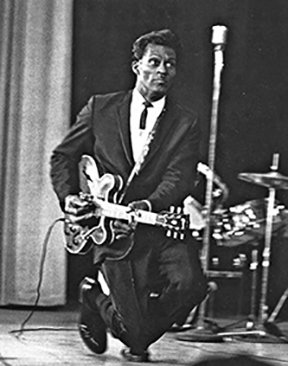
The personification of rock ‘n’ roll

But as much as his music, what also set Berry apart were the lyrics. Already in his late-20s and early-30s when he had his greatest success, Berry was the poet laureate of the decade he helped define. Most of the early rock ‘n’ roll songs concentrated more on a good beat to get people on the dance floor; the words were strictly a secondary concern. But Berry’s lyrics were perfect encapsulations of the lives of his young audience. At a time when the subject matter of pop and rock songs was love and, well, more love, Berry was writing about life (including, of course, love). And importantly, he was writing about life in the 1950s. In the song “Me and the Devil”, Robert Johnson brought blues out of the cotton fields and into the 1930s by adding details like getting on “a Greyhound bus”. Berry did the same for rock ‘n’ roll, by writing about the culture of the 1950s: Oldsmobiles and Cadillacs on the highways, jet-propelled airplanes, televisions, drive-in movies, jukeboxes playing the really hot records, malt shops, high school, teenagers dancing on American Bandstand…all of it taking place in an America where hamburgers sizzle on an open grill night and day.

Compare the nonsense lyrics of so many early rock ‘n’ roll songs with any of Berry’s. The simple, practically cretinous, rhymes of “Be-Bop A-Lula”, the novelty nonsense lyrics of “Jailhouse Rock” or the sanitized versions of “Hound Dog” and “Tutti Frutti”, the raw lust of “Great Balls of Fire”…all of these are great songs. None of them can hold a candle to the lyricism here:

Runnin’ to and fro, hard workin’ at the mill
Never failed in the mail, yet come a rotten bill…

Salesman talking to me tryin’ to run me up a creek
Says you can buy it, go on try it, you can pay me next week…

Blonde haired, good lookin’ tryin’ to get me hooked
Wants me to marry, get a home, settle down, write a book…

Same thing every day, gettin’ up, goin’ to school
No need to be complainin’, my objections overruled…

Pay phone, somethin’ wrong, dime gone, will mail
I ought to sue the operator for tellin’ me a tale…

I been to Yokohama, been a fightin’ in the war
Army bunk, Army chow, Army clothes, Army car…

Workin’ in the fillin’ station, too many tasks
Wipe the windows, check the tires, check the oil, dollar gas

Each of these lines is punctuated with some exasperated version of “Ahhh” and the refrain of “too much monkey business for me to be involved in”. It’s a lyric that could be written today, with only a few details changed, describing life in a hectic world. The song is rooted firmly in the 1950s, however, not too far past World War II, where you spoke to operators via pay phones, and were helped by gas station attendants who wiped your windows, checked your tires, and pumped a dollar’s worth of gas into your car at a time when that could get you a few gallons. Berry is describing life at the time in a way that has more meaning to more people than the combined writings of Jack Kerouac or Allen Ginsberg.

Berry’s music defined guitar rock for all time. His songs have been covered by everyone from the Beach Boys and Beatles to Green Day and The Killers. Berry’s lyrics notified the Dylans and Lennons of the world that you didn’t have to be tied down to moon/June/croon rhymes. His showmanship set the precedent for the Hendrixs and Townshends that came later. (You can even see Townshend imitating Berry’s famous “duck walk” a few times in the movie The Kids Are Alright, and Hendrix tearing through a jaw-droppingly ferocious “Johnny B. Goode” in Jimi Plays Berkeley.) The Rolling Stones, more than any other band, worshiped at the shrine of Chuck Berry; his “Come On” was their first single and they covered “Carol”, “Little Queenie”, “Confessin’ The Blues”, and “Down the Road Apiece” among others. The band’s most famous lyric, “I can’t get no satisfaction”, was a direct rip of Berry’s “I don’t get no satisfaction from the judge” in “Thirty Days”.

Elvis Presley is the King of Rock ‘N’ Roll. His style was utterly unique, not least because he was a white kid who sang like a black man. But Chuck Berry was the man who truly defined both the music and the decade. Elvis spawned hundreds of impersonators after he died; during his lifetime, Berry had tens of thousands of disciples who ran his music through the prism of their own experiences and lives, and took his timeless riffs and stagecraft from the shores of California and the Liverpool docks to the Hollywood Bowl and Wembley Stadium.

There is no rock ‘n’ roll without him.

The Rolling Stones: Voodoo Lounge

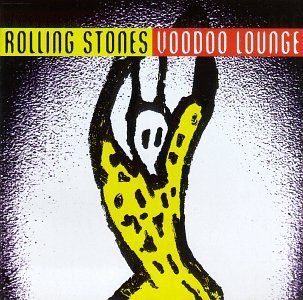
VoodooLounge94The Steel Wheels tour (later dubbed the Urban Jungle Tour when it hit Europe) was a long, grueling exercise in money-making for the Rolling Stones. At the time it was the most lucrative tour ever done, grossing nearly $100 million dollars. But it was also a musically valid tour, with the Stones not only selling out arenas but rocking them with abandon. Yes, in some ways it was The Rolling Stones On Ice: lots of supplemental musicians and singers, fireworks, huge projection screens so the guys in Row ZZ could feel like they were there, and even two massive inflatable women that bounced and swayed while the band played “Honky Tonk Women”. It was also true that the band was very tight and in fine form.

After the tour Richards went back to the X-Pensive Winos and released a second solo album in 1992, Main Offender, which was a worthy successor to the excellent Talk Is Cheap. In 1993 Mick Jagger released his third solo album, Wandering Spirit, and, much to everyone’s surprise, it was as good as Keith’s efforts. But the Stones were also shocked after the tour when Bill Wyman announced that he was retiring, possibly to provide daycare for his wife. Wyman’s departure wasn’t announced until 1993, when the band reconvened to begin work on a followup to Steel Wheels. Partially as a reaction to the overproduction on their comeback, the Stones chose to go with producer Don Was, the guiding light behind the band Was (Not Was), whose own 1989 album What Up, Dog? was a bizarro funk/soul classic. Was wanted to bring the band back to their earlier sound, the sound of Exile on Main Street and Sticky Fingers, much to Jagger’s chagrin. The sessions were fraught with tension between the singer and the producer. Jagger’s always been obsessed with keeping the Stones contemporary, and this throwback to 1970s-style production was anathema to him. Richards, however, wanted the band to get back to basics with a stripped-down sound and raw production.

The result was Voodoo Lounge. The album has a more live, organic sound than Steel Wheels, but production isn’t everything. Overall, it’s a better album than its predecessor but it’s also bloated. At over an hour in length, it’s longer than any previous Stones album with the exception of Exile which makes Voodoo Lounge a de facto double album. Exile it’s not. The earlier album breezed by, an effortlessly enjoyable listening experience. By the time Voodoo Lounge reaches its conclusion, you’re exhausted. Had four or five songs been trimmed, Lounge might be talked about as the undisputed best Stones album since Some Girls, but the album’s excessive length and the mediocre quality of some of the songs ensure that the album remains a good, but lesser, effort in the band’s canon.

There is some material that comes close to greatness here, though. “Love Is Strong” opens the album with a superb groove and bluesy harmonica. The production is much cleaner but the song itself wouldn’t have sounded out of place on Exile. It was released as the first single, their strongest since “Miss You” in 1978, but flopped in the charts despite a lot of FM and MTV airplay. Jagger’s vocal is a sultry seducer’s voice and his harmonica playing is, as usual, excellent. New bassist Darryl Jones makes his presence felt immediately; he and Charlie Watts provide the groove that Keith and Ron Wood punctuate with short, stabbing leads and chunky chords. If there’s a flaw on the track it’s the too professional backing vocals, but it’s churlish to complain about a band sounding too good. Don Was’s production is perhaps best seen here: the separation between Richards and Wood is clear and every instrument can be heard clearly and cleanly, but without the plastic sheen of Steel Wheels or Dirty Work. Voodoo Lounge is the best produced Stones album since Some Girls.

“You Got Me Rocking” follows. It’s a by-the-numbers song that extols the joys of, you guessed it, rocking. It’s stadium-ready, with its “Hey! Hey!” hook, and has become something of a concert staple for the band since 1994, but it’s not a particularly interesting song. Jagger bellows sad sack lyrics about how miserable he was until [cue the big anthemic hook]. Richards and Wood play great guitar throughout, and once again Darryl Jones shines. He’s a better bass player than Wyman was (which shouldn’t be understood as a slam of Wyman, who could be extraordinary), and for the first time since Undercover the bass is actually clearly audible in the mix. But the song itself is still a bit flat, the Stones addressing the need for another “Start Me Up” for the forthcoming World Tour. “Sparks Will Fly” is better, with an actual melody in the chorus and bridge. It’s most reminiscent of the sound of Some Girls, and would have fit perfectly on that earlier album. Three songs in and it’s clear that Voodoo Lounge is classic Stones in sound and form, even if not in song quality.

This impression continues with the band’s return to country for the first time in many years. “The Worst” is a Keith Richards-sung country ballad with some exquisite pedal steel from Ron Wood and acoustic guitar from Keith. But it’s the following song that truly signals the band’s march back to their past. “New Faces” takes the band all the way back to 1966’s Aftermath. After a hushed count in, Jagger sings of a doomed love over a musical backing that mimics “Lady Jane”. Some very nice acoustic guitar work from Richards and Wood compete with the harpsichord. Jagger had gone this route on his Wandering Spirit solo album with the “Lady Jane” knockoff “Angel In My Heart”, but it works better here. Still, it’s an almost shocking anachronism in 1994: an Elizabethan ballad whose musical heft is borne by an instrument Bach would have recognized. It’s redeemed somewhat by those acoustic guitars, but it sounds like an obvious effort to regain that classic sound of the band in their peak years of 1966–1972. On Aftermath “Lady Jane” fits perfectly with the eclectic times; on Voodoo Lounge “New Faces” sticks out like a sore thumb.

Things get back to normal with “Moon Is Up”, a mid-tempo, mostly nondescript song that neither offends nor inspires, and the second single from the album, “Out Of Tears.” The single was another flop, despite some considerable airplay on FM radio. It’s a nice, piano-driven ballad and yet another broken heart lyric delivered by Jagger. Credit Don Was for getting the best vocal performance out of Jagger in years, especially noticeable here. Jagger’s mannerisms are most noticeable on the slow tracks, and here they’re kept to a minimum. Vocally it’s far from “Wild Horses” but it’s still effective. There’s also a lovely pedal steel guitar solo from Wood, but at five plus minutes it’s a song that drastically needs some pruning. The song’s got a nice melody on the chorus, but that’s not enough to save it from being somewhat boring. “Out Of Tears” is followed by “I Go Wild” which is an almost totally pro forma rocker. Charlie’s drums are good as always, but the guitars are repetitive and Jagger’s back to his debauchery in the lyrics. There’s also a stadium sing along ending that is pretty transparent in its effort to create a “moment” for the stage.

“Brand New Car” is more musically interesting, but lyrically it’s atrocious. The metaphor of a car for a woman and driving for sex is bad enough, but “nudge nudge wink wink” lyrics like “Give it some stick”, “Slinky like a panther you can hear her purr”, and “Fill it with juice” are cringe-worthy. Better is “Sweethearts Together”, a song that could have been done by Buddy Holly. There’s a nice Mariachi/country vibe to the music, complete with a subtle accordion, while Charlie shuffles along on the drums. Keith is heard singing harmonies on the chorus, rather than the usual complement of backup singers. It’s a quiet gem of a Stones ballad, with a good vocal from Mick.

The professional backup singers return to put a too-polished spin on “Suck On The Jugular”, which may just be the worst song title in Stones history. The song itself isn’t bad, a funky shuffle that once again lets Jagger show his skill as a harmonica player. Charlie’s drumming is, as usual, stellar, but his snares sound like they were airlifted from the Steel Wheels era. Daryl Jones provides a good bottom end, and little touches of wah-wah guitar, keyboards, and horns add to the retro-70s party feel of the song.

“Blinded By Rainbows” follows, a pretty ballad that has a smooth vocal from Jagger. Lyrically it’s a bleak assessment of the Troubles in Northern Ireland, and the violence described in the lyrics only serves to make the song more poignant..

Did you ever feel the blast
As the Semtex bomb goes off?
Do you ever hear the screams
As the limbs are all torn off….

You’re blinded by rainbows…

It’s a much heavier subject than the Stones usually embrace, seemingly coming down on the side of the English Protestants against the Catholic IRA.

Do you see the light?
Is the end in sight?
See the face of Christ
enter paradise?
I doubt it

As is usual for the Stones, their politics offer no solutions, just commentary. Still, it’s one of the best lyrics on the album, and one of Jagger’s best performances. Keith’s opening guitar licks wouldn’t have sounded out of place on Let It Bleed, and Charlie’s drums and Daryl Jones’s subtle bass kick the chorus into a higher gear before the song settles back down in the verses. There’s also a nice keyboard throughout, played by Heartbreaker Benmont Tench, and a distorted, bluesy guitar solo from Keith. “Blinded By Rainbows” is one of the highlights of the album.

The highlights continue with “Baby Break It Down”, a bluesy shuffle with a simple, but irresistible, chorus. Vocal hooks were never really the band’s strong suit; they tended to leave the catchy choruses to the Beatles. But even though it’s lyrically simple, the chorus is a nice earworm. There’s a really nice pedal steel solo from Ron Wood, and more than any other song on the album, “Baby Break It Down” catches the spirit of Exile on Main Street that Don Was seemed determined to recapture. If it had been rocked up a bit, with a sleazier production and Keith a little more prominent in his backing vocals, this track would have fit almost perfectly on side three or four of Exile.

Keith puts a ravaged vocal over the top of the torch song “Thru and Thru”. The electric guitar is a series of delicate, circular, licks, but it’s Keith’s vocal that carries the day. Only Keith, with his weathered, hoarse tones could get away with a verse like:

I only found out yesterday
I heard it on the news
What I heard really pissed me off
‘Cause now I got those fucking blues
I got those awesome blues
Babe I got those nothing blues

At around the four minute mark the rest of the band kicks in and brings no small degree of power to the finale. At just over six minutes, “Thru and Thru” is a tad long, but there’s enough tension in the music and vocals to get away with it.

“Thru and Thru” would have been a fine album closer, but the Stones rolled out one more rocker with “Mean Disposition.” It’s another Exile-style throwback with a great, jamming finale. As with the other tracks, it’s lacking the damp basement, raw, junkie blues vibe of Exile. It’s a fast rocker that would have been well-served by making it even faster, à la “Rip This Joint”. As it is, it’s a fine song, though not particularly memorable.

Voodoo Lounge was the sound of the Rolling Stones trying to sound like the classic, pre-Ron Wood version of the band. Unfortunately the technology of 1993 and 1994 was just too advanced. Don Was got a great sound from the band but, try as he might, the Stones caught lightning in a bottle in that era. The production matched the songs and the final albums were a part of a larger zeitgeist. Despite Mick Jagger’s later insistence that he wished Exile had “sounded better”, it was that grit that gave the album much of its power. Voodoo Lounge is what Exile would have sounded like if the production had been cleaner and clearer, but it’s an unfair comparison because the songs weren’t anywhere near the caliber of classics like “Rocks Off”, “Torn and Frayed”, or “Tumbling Dice”.

Still, this was a good effort. Trim some songs, cut some songs completely, and whittle down the album to forty minutes and it’s actually got a lot to recommend.

But not the album cover. The album cover is awful.

Grade: B
“Parties weren’t meant 2 last”: Prince, RIP

In 1973, the band Argent had a mild hit single called “God Gave Rock and Roll To You”. It seems that in 2016 God’s decided to take it back.

The death of Prince was as shocking and unexpected as that of Michael Jackson, and shook the musical landscape nearly as hard. For someone who was so outrageous on stage, who celebrated and struggled between carnality and spirituality, and whose appearance was so flamboyant, Prince was very circumspect about his life. Aside from the protégés he dated, he mainly avoided the gossip mill despite being one of the most successful musicians in the world. This, and his seeming devotion to being a Jehovah’s Witness, was why everybody bought the “flu” excuse his publicist made when Prince was treated for an “emergency” a few days before he died, even though it made no sense. It’s beginning to look more like the standard rock star death: opioids are the cause; whether it was an overdose or just a cumulative toll of addiction remains to be seen.

I’ll confess that I was never a big Prince fan. I wasn’t crazy about the synthesizer-heavy sound of many of his 80s hits, the length of his album cuts, and I thought the salacious lyrics of his songs bordered on cartoonish at times. But I’ve always respected Prince as one of the rock music immortals. He was a musical polymath, a virtuoso musician on any number of instruments. He wrote, recorded, and produced his albums mostly alone, playing the lion’s share of the instruments and bringing out a full band when live shows beckoned, but his music never sounded like the work of one man in a studio. There was a fresh, live intensity to his recordings even if it was Prince going from guitar to bass to drums to keyboards. It was the sound of a party, and Prince was the DJ.

prince

All respect for a virtuoso and complete original.

The first video I ever saw on MTV was Prince’s “1999”. I’d never heard of him. As I was flipping through channels I caught a glimpse of a black man wearing a bandanna around his head, holding a guitar, and singing into a microphone. “Was that Hendrix?” I clicked back to that channel and was confronted with Prince. I didn’t care for the song at first; it was too dance-oriented, too synthesized, and not a bit like Hendrix. But as the song took off I learned to like it, and eventually love it. Not as much as “Little Red Corvette”, the radio-friendly pop hit whose raunchy lyrics sailed over the heads of radio and MTV programmers. That song I loved right away; its chorus was irresistible. Prince eventually became a huge part of the soundtrack of my college years. Purple Rain was released as an album and a movie, and while the movie is pretty forgettable (Prince was no actor), the soundtrack is a modern rock classic, spinning a dizzying collection of sounds from the dance metal (?) of “Let’s Go Crazy” with its frenetic guitar solo ending to the weird, off-kilter hit “When Doves Cry” to the plaintive rock ballad of the title track. Only Prince could have pulled off something like “I Would Die 4 U”, a song about God set to a slinky retro-disco beat.

But while Purple Rain was likely his peak with tight, concise, focused, and powerful songs, for me his greatest statement was the song “Sign O’ The Times”, a percussion- and bass-heavy funk ballad that surveyed life in 1987 and saw the coming Apocalypse. It’s a thrilling song with an unusual semi-spoken lyric that proved there was more to Prince than an endless party. Commercially he trailed off after that, enjoying hits, but never again reaching the apogee of the Purple Rain era. He became known as an eccentric, writing the word “Slave” on his face and changing his name to a symbol, eventually becoming known as “The Artist Formerly Known As Prince”. Few understood the bruising battle and lawsuits with his record company that led to these actions. To the outside observer it just seemed weird, and became the fodder for late night TV snark. But when the lawsuits were settled and the battle ended, he became Prince once again. Through it all, Prince was an original. He sounded like nobody else on the scene, and nobody could sound like him. He was influenced by everything he listened to, and filtered it all through his music. A disco beat, a New Wave synthesizer, a heavy metal guitar solo, gospel vocals on an X-rated lyric…sometimes all in the same song. He was as unpredictable and wild as his peer Madonna, but his skill as a musician made it all valid. His like will not pass this way again any time soon.

“From that point on, it was mayhem…” George Martin, RIP

Perhaps the greatest lucky break in rock history is when a young producer named George Martin had an affair with his secretary. Contrary to the oft-related story of how Martin was so impressed by their wit he signed them to a contract, the truth is that Martin was assigned to the Beatles, largely as punishment by his bosses for the affair. He had no great love for the music he heard on their original tapes, or in the audition tapes. He thought they were raw, their songs were lacking, and their drummer was terrible. But the voices…now that was something that came through the amateurish noise he heard.

George Martin turned out to be exactly what the Beatles needed. His first order of business was convincing them to fire Pete Best, which they did. But his most important contribution at that stage was to trust them. Martin gave the band a Mitch Murray song called “How Do You Do It?” and told them to learn it and record it. He assured them it was a hit single. The Beatles recorded the song against their better wishes, protesting bitterly the whole time, and Martin agreed to release “Love Me Do”, a song he didn’t like, instead. When it was time to release a followup, Martin again suggested “How Do You Do It?” Building on the fair success of “Love Me Do”, Martin told the band that “How Do You Do It?” would be a number one hit. The Beatles hated the song and refused to release it. Martin, whose word was final, challenged them to come up with something better. The result was “Please Please Me”. Martin admitted that the song was better.

He was right about “How Do You Do It?” The song was a chart topper for Gerry and the Pacemakers, Liverpool’s also-rans in the wake of the Beatles. But it bears saying how extraordinary this was in 1962-63. Artists, especially newly signed artists with a four-song contract, never contradicted their producer. Producers of that time in England functioned more as Artists & Repertoire experts, matching songs to performers, while engineers did the real recording work. In the studio the producer’s word was gospel; he was the boss and the artists did what he said. Had the Beatles been given to any other producer their weak, disinterested recording of “How Do You Do It?” would have been their first single. It’s almost certain they’d have been told to follow with another cover, hand-chosen by the producer from a pool of songs whose copyrights belonged to EMI. The recording studio was no place for real creativity; EMI Studio was a laboratory (the engineers wore white lab coats) where everything was highly regimented…microphones were placed a precise distance from instruments, drums were recorded with a specific microphone setup, etc. The studio was where music was recorded professionally, quickly, and at little cost.

And this was truly Martin’s greatest achievement: he was willing to break the rules. He listened to the band and worked with them to make their musical vision come true. He’s often said to be the “fifth Beatle” and if anyone can lay a claim to that title it was George Martin. He brought order to the band’s chaotic creativity. He harnessed their energy and focused it. He made their musical ambition a reality because he was the only trained musician in the studio. It was Martin who suggested that “Please Please Me” be sped up and turned from a Roy Orbison-like ballad into a smash hit rocker. It was Martin who suggested and scored the strings for “Yesterday”, and turned the song from a ballad into a standard. It was Martin who had the genius to record the piano solo of “In My Life” at half-speed, then speed it up, turning it into a baroque harpsichord solo. It was Martin who transcribed McCartney’s humming into the gorgeous French horn solo on “For No One.” It was Martin who figured out a way to stitch together two versions of “Strawberry Fields Forever” that were in different keys and different tempos, and got it to work.

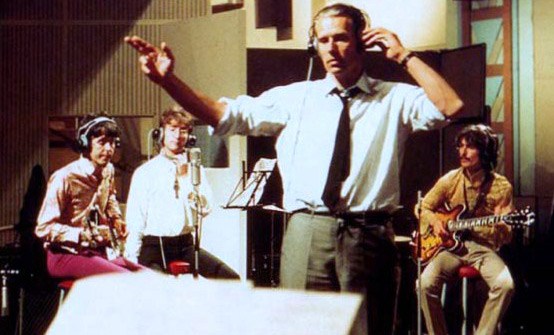
George-Martin-conducting-Beatles-554-46

His imagination, and his own musical creativity, were fueled by the Beatles, and he returned the favor by acting less like a studio boss and more like a collaborator. What the band wanted, he made happen even if there was no precedent for what they requested. What he suggested, the band took very seriously and, more often than not, tried (usually to great effect). The Beatles smashed all the rules of the recording studio. They were such a money machine for EMI that they couldn’t be refused. George Martin, naturally rebellious, musically creative, and in sync with the band, played a huge part in that. As the band threw out the rule book for a musical artist, Martin rewrote it for a producer. Before Martin, pop music producers tended to be either martinets like Phil Spector who insisted that everything be done their way or disinterested clock-punchers who hit the record button and let those no-talent rock and rollers sing their song until the serious jazz and classical musicians arrived; after Martin and the phenomenal success of the Beatles producers listened to the band’s ideas while offering suggestions for improvement. Producers were there to shape the final product, not to create it.

The Beatles and George Martin were the perfect yin and yang of popular music. Four young, long-haired, drug-fueled, musically immature, creative artists and one older, short back and sides, straight-arrow, musically mature, creative producer. Rarely, if ever, in rock or pop music has the marriage of band and producer been so complementary or so fruitful. Had the Beatles recorded with anyone else at the helm their career would have had a remarkably different path. One need only listen to Let It Be, the album recorded by Glyn Johns and produced (dreadfully) by Phil Spector to hear the difference. If Spector had produced “Yesterday” it probably would have featured a bombastic forty-piece orchestra and choir instead of the sympathetic and tasteful string quartet Martin suggested. Listen to the band’s recordings compared to anyone else from that era, and you’ll be able to hear the difference. One of the reasons the Beatles were so dominant in the Sixties was not just that they had better songs than anyone else. They also sounded better, and that was the result of working with George Martin. As my friend novelist (his Broken Glass Waltzes is a great combination of noir and rock and roll; you should buy it), Berries drummer, and fellow garage rock enthusiast Warren Moore wrote in his encomium:

Despite the technical limitations of the period (remember, Sgt. Pepper was recorded on a pair of four-track machines), and despite the increasing complexity of the instrumentation as the band developed…things don’t get lost in Beatles cuts — they get found. Martin’s work allowed space for a variety of nuance that other producers lost.

Martin went on to record other artists (he actually worked with others in the Sixties, as well). He produced Jeff Beck’s landmark fusion album Blow By Blow and it’s worthy, but lesser, sequel, Wired. He worked with Cheap Trick, America, Ringo, and Paul McCartney. He even worked with Neil Sedaka and Celine Dion, but nobody’s perfect. He will always be remembered for his work with the Beatles. It’s too flip to say that Martin made the Beatles what they were; their talents existed even without him. But Martin made their musical dreams come true, and that made ours come true, too.

The Listening Post: January 2016

  • Higher TruthChris Cornell. The last time we heard from Chris Cornell the Solo Artist was 2009’s Scream. It took him six years, a reunion with the mighty Soundgarden, and a solo acoustic tour, to recover from that steaming mess. Scream, a train wreck collaboration with Timbaland that buried Cornell’s songs under a mountain of electronic dance music, was such an embarrassing fiasco it would have killed the career of a less established star. It took 2012’s excellent Soundgarden reunion album King Animal to gain back Cornell’s credibility. Fans didn’t shrug off Scream as a misstep in a long career; it was almost universally hated. This just makes Higher Truth that much sweeter. Cornell has followed up what is certainly one of the worst albums ever released by a major artist with the best album of his solo career. cornellInspired by his recent solo tours, Cornell strips down the production on Higher Truth to focus on the subtler, more acoustic side of his sound. That’s not to say that this is an acoustic singer/songwriter album. There’s no shortage of indications about who Cornell really is on the album, and he’s not Jack Johnson or James Taylor. He’s the howling banshee lead singer of Soundgarden and Audioslave, two of the heaviest rock bands of all time, whose voice could peel the paint off your walls. Taken as a whole, Higher Truth sounds like a serious rock band playing a mostly acoustic set before the big show starts (there are electric instruments amid the mandolins here: check out the buzzsaw guitar solo on the first single, “Nearly Forgot My Broken Heart”). There are many ballads (“Dead Wishes”, “Before We Disappear”, “Through the Window”, “Let Your Eyes Wander”) but there are also plenty of songs that blend balladry with the intensity of heavier rock, held in check by the acoustic presentation (“Murderer Of Blue Skies”, “Higher Truth”, “Circling”) . There’s even a song (“Our Time In The Universe”) that successfully blends rock and electronic dance music, the synthesis Cornell failed to create on Scream, by sticking to conventional rock instruments and melodies and attaching them to a beat and chorus that wouldn’t sound out of place in the world of strobe lights, DJs, and Ecstasy (as a bonus track there’s a more straightforward rock mix of this track, as well as three other songs that maintain the quality and sound of the main album). This variety has the benefit of keeping the album fresh. Too many acoustic albums are sleepy affairs, as if the electric guitar was meant for rock and the acoustic was meant for slow, confessional ballads. Cornell reminds the listener that this is not the case: acoustic instruments can rock, too.
    Grade: A
  • The Bootleg Series, Vol. 12: The Best of The Cutting Edge, 1965-66Bob Dylan. Most bands are lucky if they have an album’s worth of first-rate outtakes collecting dust in some studio archive. There’s usually a very good reason the songs that don’t make an album are left unheard. Traditionally, the best of them have been released as the flip sides of singles and sometimes when there is enough stuff that’s really good it gets released in some sort of rarities package. For years the gold standard of this was the Who’s Odds And Sods, a 1974 collection of unreleased songs that contained real Who classics like “Long Live Rock”, “Naked Eye”, and “Pure and Easy” alongside odd treasures like “Now I’m A Farmer”, the early pass at Tommy of “Glow Girl”, and Townshend’s anti-smoking song for the American Cancer Society, “Little Billy”. But rarities collections are invariably hit-or-miss affairs, at least until Bob Dylan unleashed The Bootleg Series on an unsuspecting world. dylanThere are some previously unreleased songs on the twelve (and counting) packages, but most of the tracks are alternate or live versions of songs that have been previously released. All too often, alternate versions are a letdown: a slightly different mix, a poorly recorded demo. But this is Bob Dylan and his alternates are usually radically different takes on familiar songs. Take, for example, the version of “Visions of Johanna” on The Best of the Cutting Edge. The Blonde On Blonde version is a stately, haunting ballad dripping with some of Dylan’s best wordplay. A previous package (Vol. 4: The “Royal Albert Hall” Concert) featured a beautiful, live acoustic version that downplayed the music and highlighted the words. The version here (a rehearsal) is a rollicking, fast-tempo rocker so unlike the other versions that it may as well be a different song. Or the version of “Just Like Tom Thumb’s Blues” that sounds like it could be played by the house band at a Mexican cantina, tying the music to the opening line about being lost in Juarez in the rain when it’s Easter time, too. Or the solo acoustic version of Bringing It All Back Home‘s electric “She Belongs To Me.” Every one of the songs here is noticeably different than the previously released versions, and every one is a gem. One of the interesting things about it is how many of the songs sound like kissing cousins of “Like A Rolling Stone”, particularly the songs recorded after Highway 61 Revisited. Both the music and the phrasing of lyrics, in many cases, bear a strong resemblance to the most famous of all Dylan songs. The final versions are, of course, very different, but in these early workouts and rehearsals, the music had really not yet finished its journey. Some of these songs are early versions with incomplete, or different lyrics (for example, Dylan has yet to add the word “just” to the song “Just Like A Woman”, and “Tombstone Blues” has a slightly different chorus); some are demos (there’s an abbreviated but wonderful piano demo of “Desolation Row” as well as a full band version of what became the acoustic conclusion to Highway 61). The Bootleg Series has been truly extraordinary, and there are still depths to be explored. The quality of the material stands on its own, revealing just how restless and creative Dylan was at every stage of his career, and this latest collection culls material from the zenith of his musical output, when Dylan was burning across the cultural landscape and leaving a scorched earth in his wake. Twelve illuminating and musically valid compilations of Dylan outtakes later, it’s almost possible to construct an alternate history of Dylan’s entire career. There are still gaps, mainly from about 1973 to the mid-80s, although 1975’s Rolling Thunder tour has a package and a few songs from this era appear on Vol. 2 and Vol. 3, but rumors abound that the next package will begin to address this with outtakes from the Blood on the Tracks/Desire era. Amazingly, the alternate history is nearly as interesting as the real one. Dylan may be the only musician in the world to be able to claim that.
    Grade: A
  • Song ReaderVarious Artists. Rock music has always had its eccentrics and musical iconoclasts. Bob Dylan is one, as is Neil Young. In recent years, Jack White has garnered a reputation as a musical maverick who does what he wants with little regard for convention. Add to this Beck, who emerged in the 1990s with an oddball folk rap song and who has proceeded to hopscotch his way across the musical landscape, following his whims and his muse wherever they take him. In 2012 word got out that Beck was going to release a new album, which he did. Being a musical eccentric, Beck didn’t release Song Reader in any physical form meant for listening. It was not released as an LP, a CD, or in any digital format. Beck released his album as sheet music. beckIt was an odd stroke of genius. YouTube became the home for the album, as thousands of people posted videos of themselves performing new Beck songs. The record industry being what it is, a physical release was inevitable, and in 2014, Song Reader was released, featuring twenty different artists performing the songs in their own style. Categorically, this is a Beck album, although only one song (“Heaven’s Ladder”) is actually performed by the songwriter. Stylistically it’s all over the map with artists as diverse as Laura Marling, Pulp’s Jarvis Cocker, Norah Jones, David Johansen, Jack White, Jack Black, Sparks, Loudon Wainwright, soul singer Swamp Dogg, and Wilco’s Jeff Tweedy all taking their turn interpreting the songs Beck wrote. This is not a tribute album, one of those well-meaning but usually artistically bankrupt compilations where artists do soundalike versions of a performer’s best-loved songs. Because there was no Beck template outside of notes on a page, the artists here were able to make the songs their own, and it shows. Norah Jones’s “Just Noise” is a wonderful, sweeping shuffle. Jack White puts his standard guitar crunch on “I’m Down” and it sounds like a track from one of his solo albums. Jack Black, no great musical talent, tackles the humorous “We All Wear Cloaks” like a drunken Tom Waits. Marc Ribot does an old-fashioned jazz turn on “The Last Polka.” Colombian star Juanes provides a Spanish language version of “Don’t Act Like Your Heart Isn’t Hard”. Perhaps the most affecting song here is Swamp Dogg’s beautiful version of “America, Here’s My Boy”, the heartbreaking, angry, and bitter tale of a father whose son has died in combat. The diversity of sound and feel on the album makes it hard to imagine that the songs are all the product of one man, and that works in the album’s favor. It allows the listener to hear Beck with fresh ears, and realize just how talented the man behind the curtain really is.
    Grade: B+