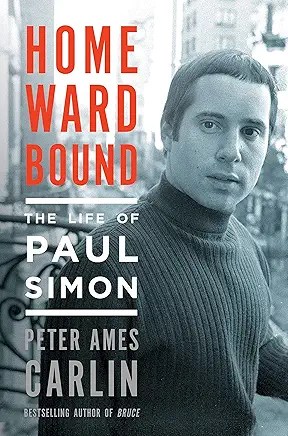
 The poet half to Art Garfunkel’s one-man band has always been an interesting guy. Like Bob Dylan, he was a rock ‘n’ roll fan who went deep into the folk music scene only to reemerge with a sublime combination of the two genres. He achieved massive levels of fame and fortune, gathering critical hosannas the entire time, was inducted into the Rock and Roll Hall of Fame twice and now, in his 80s, is still releasing music. All of this, but Peter Ames Carlin’s 2016 biography was the first serious attempt at capturing this life on the page. The story covers Simon’s entire life from his days as a baseball fanatic kid growing up in Queens, New York through his years with Garfunkel and on through his solo career. Simon was not a particularly prolific artist, his solo albums being years apart, but the high quality of the work from “The Sound of Silence” to Graceland and beyond is unassailable.
The musical journey begins in 1957 when an unknown duo calling themselves Tom and Jerry released a standard ’50s vocal group tune called “Hey! Schoolgirl.” Credited to Jerry Landis and Tom Graph, these were pseudonyms designed to obscure the obviously Jewish roots of Paul Simon and Art Garfunkel. The song became something of a regional hit, allowing Simon to namedrop it when attempting to make his way into the music industry. Simon struggled for years attempting to cash in on the success of “Hey! Schoolgirl” to no avail. He and Garfunkel parted ways as musical partners, though they remained friends.
Much like Bob Dylan had, Simon threw the dice on a career in folk music when that scene exploded in the early sixties, reuniting with Garfunkel. Unlike Dylan, success came slowly, resulting in an album called Wednesday Morning, 3 AM that went nowhere. Disheartened, he made his way to England where he had had success on a solo jaunt the year before. In England he attracted a large following, and even recorded an album called The Paul Simon Songbook, which was not released in the United States at the time but is a fascinating glimpse at many Simon and Garfunkel classics in their early stages.
When Simon achieved success he was unaware. Unbeknownst to him, the producer of Wednesday Morning, Tom Wilson, had decided to add some electric guitars, bass, and drums to the all-acoustic song “The Sound of Silence.” It was released as a single and Simon’s original reaction was anger, which abated once the royalty checks started flowing. From there Simon and Garfunkel were off to the races, scoring hit after classic hit.
The duo split, acrimoniously, in 1970 when Garfunkel decided to try his hand at acting, leaving Simon alone with his thoughts and a guitar. The result of that abandonment was Paul Simon, an excellent collection of tunes that proved Simon didn’t need the crystal-clear tenor of Garfunkel to succeed. As the seventies rolled on, Simon released only two more albums, both of which were extraordinary. One of them, 1975’s Still Crazy After All These Years even featured a reunion with Garfunkel on the brilliant “My Little Town.”
After two more albums, Simon released Graceland in 1986. The album generated an enormous amount of controversy because it was recorded in South Africa using musicians from that country at a time when artists were actively boycotting the apartheid regime there. The kerfuffle was overblown. Simon had fallen in love with the music coming out of Africa and wanted to share it with the world. He used black South African musicians, paying them twice what they normally would make, and brought more attention to the racist government of the country. Graceland was wildly successful and assured Simon’s place in the pantheon of rock and roll greats. His subsequent solo albums, despite critical acclaim, never matched that success.
Peter Ames Carlin’s book does an excellent job of assessing the career and events of Paul Simon’s life. It is comprehensive in its inclusion of detailed discussion of the music and is not afraid to discuss both the positive aspects of Simon’s life and the negative side of his personality (he wasn’t above claiming credit for the work of others). It also spends a lot of time, perhaps too much, on Simon’s relationship with Garfunkel, a lifelong series of reconciliations, reunions, and breakups that seems to have settled on a respectful distance. As Simon said in his Rock and Roll Hall of Fame induction, maybe he’d even record with Garfunkel again, before slyly adding, “No rush.”
There are a few obvious errors in the book, but those errors are minor in the whole. For example, in his discussion of the Simon and Garfunkel album, Parsley, Sage, Rosemary and Thyme, Carlin writes about the brilliance of some of the album tracks and then proceeds to list four songs from the Bookends album. At another point, he has Simon and Garfunkel performing on the same night as Jimi Hendrix and the Grateful Dead at the Monterey International Pop Festival. The errors may be insignificant, but they’re also sloppy and should have been caught in the editing stages. They also call into question the veracity of the author’s other claims.
Paul Simon is something of an anomaly in popular music. A short, balding, Jewish, well-read man who would seem to be most at home in the English department of New York University in Greenwich Village, he nonetheless emerged as one of the biggest, most successful stars of the last half of the 20th century. His work with Garfunkel, his initial splash in the industry, probably reverberates the most because their amazing singles created his legend, but it’s Simon’s solo work that truly transcends. He may never have written songs as good as “Bridge Over Troubled Water,” “Mrs. Robinson,” or “The Sound of Silence” in his solo career, but he and Garfunkel never came close to putting out albums as consistently remarkable as There Goes Rhymin’ Simon or Graceland. From a lyrical perspective, only Bob Dylan was as literate, and Simon’s words are far, far more accessible.
Carlin’s expansive tome is a well-researched and engaging summary of Paul Simon’s life up until 2015 or so. It misses a few albums, including the beautiful Seven Psalms which Simon wrote, recorded, and released at the tender age of 81, but provides deep looks into everything up until that point. The book aims to be the definitive look at Simon’s life, but can any biography be classified as such if the subject in question is still alive, active, and capable of great work? Regardless, though it may be incomplete, Homeward Bound: The Life of Paul Simon succeeds in giving the reader an in-depth understanding into the life and work of a legendary songwriter.

 In the world of streaming music it’s virtually impossible for a band to break through into the public consciousness. Artists nowadays hope that their songs will be licensed to a commercial, or a video game, or a movie. Satellite radio exists, of course, but with so many stations to choose from, bands easily get lost in the shuffle. Today, albums are no longer the coin of the realm. The single has returned. Albums are still being made but that almost seems like a tradition more than an expression of artistry. The sad truth is that unless you’re selling (and streaming) in Taylor Swift-like numbers, a band today can’t make much (if any) money based on record sales. Money must be earned on the road, playing large and small clubs and theaters to a hopefully packed house.
 There’s an old joke in music circles: If you want to drive a Jeff Beck fan crazy, ask him to name a good Jeff Beck album. There’s a soupçon of truth in that joke but, in fact, it’s easy to name a good Jeff Beck album. Or even a great one. It’s just as easy to name an album that is loaded with unbelievably great guitar playing but that still falls far short of the mark. Beck is nothing if not maddening.
 shabby-road.com