The Rolling Stones: December’s Children (And Everybody’s)

decembersThis is the final album from what I will call the “early years” of the Stones. Released late in 1965, December’s Children isn’t really an album. Much like a few of Capitol Records’ Beatles “albums,” Children is a patchwork quilt of singles, live tracks, and songs from English EPs. It contains only one bona fide classic, and six of the twelve songs are cover songs.

Strangely, the first side of the record (I’m clearly kickin’ it old school here) contains five of the six covers, leaving side two as the real harbinger of what the Stones were really working on at the time.

As usual, the covers are excellent. “She Said Yeah” is played with a ferocity and aggression that would not be commonplace until the English punk movement arrived more than a decade later. The obligatory Chuck Berry cover, “Talkin’ About You” similarly has more grit than the original. The Stones always brought an innate aggression to their cover songs that frequently elevated their versions to levels above the originals. In comparison, the covers done by the Beatles were, with some exceptions ( e.g., “Money,” “Boys,” “Twist And Shout,” “You Really Got A Hold On Me”), usually close approximations of the original tunes, and paled in comparison to the brilliance of Lennon and McCartney’s originals. For the Stones, the covers frequently saved their early albums from being somewhat lightweight. (What the 1963 Stones did to Lennon and McCartney’s “I Wanna Be Your Man” is downright frightening, turning a fairly soppy song given to Ringo as a throwaway into a song of nakedly sexual urgency. It is akin to what Jimi Hendrix did to the utterly banal “Wild Thing” a few years later.)

Covers of Arthur Alexander’s “You Better Move On” and Muddy Waters’s “Look What You’ve Done” are a step down. “You Better Move On” is a very good soul song, but “Look What You’ve Done” sounds like an English band doing blues (and even though that’s exactly what they were, the Stones were always better than that). The vocal on “Look What You’ve Done” is excellent, and Jagger deserves much more credit than he is ever given as a blues singer. The harmonica, likely played by Brian Jones, is on overdrive. It drowns out all the other instruments and does little more than detract from Jagger’s compelling performance.

The sole original on side one, “The Singer Not The Song,” is a throwback to the earlier days of the Jagger/Richards songwriting combination. It’s a good song, but can’t be viewed as anything less than a letdown after “(I Can’t Get No) Satisfaction.” And the high note squealed in the fadeout is just brutal. The Stones had mastered blues and rock singing, but were light years behind the Beatles, Beach Boys, and Byrds when it came to singing high harmonies.

Side one ends with a live recording of “Route 66.” At least I think it’s live. It’s got that “studio recording with overdubbed screams” sound to it. Either way, it’s not much to write home about. Without the shrill screams, it’s not a bad performance. But it sounds muddy.

While side one may end with a whimper, side two kicks off with one of the greatest drums licks in rock history, followed by Keith’s unstoppable rhythm guitar and Bill Wyman’s McCartney-esque bass as Jagger sings one of rock’s greatest anthems, “Get Off Of My Cloud.” A hymn to the desire to be left alone, the lyric actually has some nice imagery (“I sit at home/Lookin’ out the window/Imagining the world outside” “The parking tickets/Were like a flag/Stuck on my windscreen”). “Cloud” is really nothing less than a continuation of the saga in “Satisfaction.” Jagger takes a shot at the world of television advertising (“In flies a guy all dressed up like a Union Jack/Says I’ll have five pounds/If I have his kind of detergent pack”), and seems to have decided that his best chance for satisfaction is in being left alone. It’s a thrilling song, even now after all these years and all these listens. Perhaps because it was not as famous as “Satisfaction,” “Get Off My Cloud” can still be heard with fresh ears.

“I’m Free” follows and this also seems to run with the theme. In pursuit of satisfaction, Jagger has chased all hangers-on from his cloud. The result is that he is now free to sing his song, any old time. Earlier he had complained “I can’t get no satisfaction;” now he “can get what I want.” Frankly, the song is a little repetitive, but the vocal is convincing and the music is great. The early song, “As Tears Go By” follows. They’d written this old geezer anthem and given it to the ingenue Marianne Faithfull to sing. From her teenage lips, or from the lips of the young Stones, the lyrics seem a bit precious, as if they were consciously trying to write a song that was “mature.” The string arrangement, undoubtedly done with one eye clearly looking…um, yesterday…is quite nice, and Jagger’s delivery is as good as usual, but the song overall is way too old for the young Stones. In fact, it’s old for the current Stones.

The remaining original songs, “Gotta Get Away” and “Blue Turns to Grey” are both good performances. “Gotta Get Away” is not a particularly compelling song. It feels rushed and underwritten, but the Stones carry it with the strength of their convictions. “Blue Turns To Grey” is the better song, but carries some of the same criticisms that can be applied to “As Tears Go By.” It seems self-consciously “mature” and one can’t help but wonder whether they were trying to catch up to the ever-escalating songwriting prowess of Lennon and McCartney by writing more “adult” songs.

Unfortunately, side two ends with yet another live, or perhaps “faux live” track, “I’m Moving On.” With this song, the album ends as it began—with a full blast of punk rock fury. The performance once again is just plain mean. The ever-present screams of thousands of young girls itching to satisfy Mick make it hard to listen to, though.

The next Stones single, released two months after December’s Children was the epochal “19th Nervous Breakdown.” The song would both cap the Unholy Trinity of Stones classics that began with “Satisfaction” and continued with “Get Off My Cloud” and set the stage for the middle period of the Stones, where the cover songs would all but disappear and Jagger and Richards would refine their songwriting until it began turning out one classic after another.

Grade: B

The Rolling Stones: Out Of Our Heads

outofourheads

Not to be confused with Ron Nasty’s first book, Out Of Me Head, the fourth Rolling Stones album finds them mining the same fertile grounds they had on the previous records, with a few exceptions that are nothing short of magnificent.

Once again, as on 12 X 5, the accent here is less on pure blues and more on soul music. Don Covay’s “Mercy Mercy” and Marvin Gaye’s classic Motown hit “Hitch Hike” start off the album in a familiar style. As usual, the Stones are still one of the very best cover bands that ever played. Jagger may not be a particularly great soul singer in comparison to the originators, but he still manages to be pretty convincing, especially on “That’s How Strong My Love Is.” You won’t forget Otis Redding’s version after hearing Jagger’s, but for a pasty white English boy, Jagger more than delivers.

The other covers are consistently excellent, including an outstanding version of Sam Cooke’s “Good To Me.” The Stones bring their blues roots to the soul mix with the Solomon Burke hit “Cry To Me.”

The covers are not as smartly chosen as the ones on The Rolling Stones, Now! but they are played with the same raw style. Brian Jones and Keith Richards continue to be the best two-guitar attack in rock music.

The thing that separates Out Of Our Heads from the earlier albums are the original songs. On prior albums, the Stones were clearly finding their way as songwriters. Even as recently as Now! there were only four original songs. At some point the Jagger/Richards combo started clicking. There are seven original songs on Out Of Our Heads, including a raw, funny blues dedicated to the unsung heroes of the music business, “The Under Assistant West Coast Promotions Man.” Of the remaining originals, “One More Try” is a quick shuffle and not all that indistinguishable from a mediocre Yardbirds track, minus the searing Clapton leads, and “I’m All Right” is really nothing more than a groove, and not a terribly interesting groove at that.

Where Jagger and Richards really start to get close to the target is with the two near classics: “The Spider and The Fly” is an original song that sounds as if it is a cover of a blues standard. Finally the Stones have come genuinely close to the heart of blues music in an original song. The lyric is both funny and clever and is one of the earliest examples of Jagger’s notorious satyriasis. Poor Mick, lured to the bed of an older woman (almost 30!).

“Play With Fire” is even closer to the mark. Not really a blues, it is more of an attempt at an original, slow-burning soul song. The excellent lyric serves as a warning to a rich, spoiled, high-society woman who is used to getting whatever (and whoever) she wants. Most unusual is the quiet harpsichord throughout the song, an early example of the kind of instrumental stretching that Brian Jones was starting to explore. The choice of harpsichord is perfect, adding a stately, almost Victorian, air to a song directed at a member of the British upper crust.

With “The Last Time” and “(I Can’t Get No) Satisfaction” the Stones not only hit the target, they obliterated it. These two songs are so much higher in their quality than the surrounding songs that they stand out as sore thumbs. The only parallel I can think of is the inclusion of the devastating “You Really Got Me” on the first Kinks album (a completely unremarkable collection of mediocre Merseybeat songs).

“The Last Time” begins with one of the most recognizable Stones guitar licks of all time. Then the band comes in firing on all cylinders. The Jones/Richards guitar interplay in the solo is breathtaking, as are the backing vocals that chime in at the end as Jagger starts shouting and scatting in a style that he would later perfect in “Sympathy For The Devil.” Probably most unusual is the fact that the chorus on “The Last Time” veers strongly towards country music. There’s nearly a twang to Jagger’s delivery, and shows that even at this early stage exposure to American radio was shaping the music of the Stones as they assimilated the many sounds around them.

“Satisfaction” needs no introduction really. It may be one of the most overheard songs of the last 44 years. It’s been played at every Stones concert and is one of the pillars of classic rock radio. The fuzz guitar riff that starts the song like a rocket engine is probably the single most easily-identified riff in the history of popular music. There’s probably nobody over the age of 14 who can’t name that tune in five notes, and nobody over the age of 30 who can’t name it in two. Richards wrote probably the single greatest riff in rock and roll history, with all due respect to “Smoke On The Water,” “Sunshine Of Your Love” and a couple of dozen Led Zeppelin songs.

Most importantly, the music connects perfectly to the lyrics. The chorus of the song reflects Satyr Mick’s longing for satisfaction, but the verses imply that the satisfaction being sought is more than purely sexual (though that plays a big part). The whole of the lyric implies a search for meaning in everything that was going on around the Stones. Radio DJs with their mindless blather leave Mick longing for something deeper (probably wishing Murray the K would shut up and play some music), television advertisements similarly leave him confused and wanting more (with the brilliant lyrical swipe at advertising “Some man comes on to tell me/How white my shirts can be/But he can’t be a man/’Cause he doesn’t smoke/The same cigarettes as me”). The whirlwind of touring in both England and the States is leaving our singer disoriented and clamoring for something more. Even in the final verse, when the Stones are touring and appearing on promotional jaunts (“doing this and signing that”), the solace of a woman is out of reach. Rumors of the day implied that the woman in the song rejected our young Lothario because it was that time of the month for her (“Better come back/Maybe next week/’Cause you see I’m on a losing streak”). If I ever get the chance to ask Mick I will, because that reading of the lyric makes perfect sense.

Far from being the easily caricatured song of sexual frustration that many people assume, “Satisfaction” is actually a brilliant lyric set to an apocalyptic riff. It is hard to imagine that Jagger and Richards would write better songs, and it is only overexposure that knocks “Satisfaction” down a few pegs from where it rightly belongs, near the pinnacle of rock songwriting craft and, importantly, rock recording. The world of rock music is filled with one-hit wonders, but any band capable of writing “Satisfaction” was clearly going to be around for the long haul. It’s too bad the rest of the album falls short of “Satisfaction” and “The Last Time,” but it’s also understandable.

Grade: B+

The Rolling Stones: The Rolling Stones, Now!

nowThe Rolling Stones released five albums in their original guise as a tough British blues/R&B/soul band (I’m going by the American releases which were slightly different than their British counterparts). Of the five, The Rolling Stones, Now! is their best.
The formula hasn’t changed very much. The album is still a collection of cover songs with a smattering of less-than-spectacular original songs. That said, the cover songs are among the best they’ve ever done, and the originals contain the first genuine Jagger/Richards classic, “Heart Of Stone,” and another near-classic with “Off The Hook.”

The album also continues to mine the band’s increasing interest in soul music. From the opening salvo of Solomon Burke’s classic “Everybody Needs Somebody To Love” to “Pain In My Heart” the Stones were fast proving themselves just as adept at soul music as they were at blues and R&B. The major difference between their R&B-oriented first album and their more soul-infused second album is that the two roots are beginning to fuse together in the hands of the band. The soul is being played by bluesmen, the blues being played by a soul band.

There are two Chuck Berry numbers on Now! which suggests that the Stones may have been running low on material that they were adept at covering. But the Berry covers are their best yet: “You Can’t Catch Me,” and “Down The Road Apiece,” which Berry didn’t write but which he had covered. “Down The Road” especially is a prime example of early Stones. “You Can’t Catch Me” features a great guitar solo layered over a propulsive rhythm that shows clearly the one thing the Stones were always masters of: the art of performing with two guitars. Rhythm was crucial to the music of the Stones and Keith’s rhythm guitar (and occasional leads) were every bit as important to the sound of the song as Brian Jones’s lead guitar (and occasional rhythm). So many bands relegate the rhythm guitar to a subsonic point in the mix, letting the lead guitar take over so much that it becomes the only guitar you can hear. But the interplay between Richards and Jones is dazzling (listen to the dueling between Richards’s picked guitar lead and Jones’s short, sharp slide in “What A Shame”).

Of the other covers, “Mona” may be somewhat pale in comparison to Bo Diddley’s fierce original, but the cover of “Little Red Rooster” is sharp enough to slice through tin cans and tomatoes, and would make The Wolf proud. “Down Home Girl” is a solid blues while “Oh Baby (We Got A Good Thing Going)” is probably the weakest cut. Not bad, but nothing to write home about.

Of the originals, “Heart Of Stone” is a great soul ballad and the first “great” Jagger/Richards original. “Off The Hook” is a terrific rock and roll number. Those two songs are clearly head and shoulders above any other originals the Stones had recorded to this point. “What A Shame” and “Surprise, Surprise” are lesser songs, but at least equal to, if not better than, the best Stones originals on 12 X 5. While the originals may prove that Jagger and Richards were not writing on the same level as Bo Diddley or Chuck Berry at this point, they were at least not embarrassing themselves by putting the songs on the same album.

The full flowering of the Jagger/Richards songwriting partnership would begin on their next album, and the covers would start to seem less vital than the originals. At this point in time, covers and originals stood side by side. Soon the covers would become much less important.

Grade: A

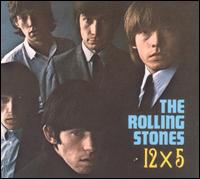
The Rolling Stones: 12 X 5

12 X 5The second album from The Rolling Stones is sonically a continuation of England’s Newest Hitmakers. The huge difference here is the inclusion of four songs by the Jagger/Richards team (and one, the disposable instrumental ode to Chess Records, “2120 South Michigan Avenue,” credited to the group pseudonym, Nanker Phelge).

Chuck Berry gets another shout out with the leadoff position on the album. The Stones version of “Around And Around” matches their earlier version of Berry’s “Carol” in terms of intensity. It’s further proof that nobody did Chuck Berry as well as the Stones. The rest of the album is a combination of blues, early rock ‘n’ roll and, strangely, a vocal group song (“Under The Boardwalk,” the classic song by The Drifters).

What’s of most interest on this album are not the originals. The four songs written by Jagger and Richards (“Empty Heart,” “Good Times Bad Times,” “Congratulations,” and “Grown Up Wrong”) indicate nothing more than that as songwriters they were still finding their voice by imitating their idols. All four of the songs are okay (“Empty Heart” is the best of the lot), but none are really all that remarkable.

What is of interest is the two cover songs that can rightfully be considered the first Rolling Stones classics. Bobby Womack’s “It’s All Over Now” was a good soul song that the Stones turned into a magnificent rock song. It was a clear case of a band finding a “sound” of their own, despite it being a cover song. When one thinks of the early Stones classic songs like “Satisfaction” or “Get Off Of My Cloud,” the sonic template is found first on “It’s All Over Now.” Much like Jimi Hendrix’s version of “All Along The Watchtower” forever banished Bob Dylan’s original song to the record collections of hardcore Dylan fans, the Stones’s version of “It’s All Over Now” became the standard that the original only hinted at.

The second Stones classic is more problematic. “Time Is On My Side” is one of the most famous songs in Rolling Stones history…but not the version that’s on 12 X 5. The famous, classic version of the song was released as a single. The version on the 12 X 5 album sounds like a pale, lifeless imitation. I mention it here because the single appeared nowhere else at the time, and it was the hit and far superior even to “It’s All Over Now.” But you’d never know that if the album version was all you had ever heard.

For the rest of the album, it was more of the same from the first album. A version of “Suzie Q” is good, “Under The Boardwalk” isn’t. What is stressed by “Under The Boardwalk,” “It’s All Over Now” and a cover of Wilson Pickett’s “If You Need Me” is just how strongly the Stones were starting the move away from pure blues. In contrast to the first album, only a couple of songs on 12 X 5 could really be considered blues (“Around and Around” which was considered rock by most people, and “Confessin’ The Blues”). The rest show an increasing fascination with rock and soul music. As such, this is the beginning of the transition from blues/R&B to rock. It was a move that would speed up as Jagger and Richards got more comfortable as writers.

Grade: B

The Rolling Stones: England’s Newest Hitmakers

g60332e9yd5

In the era of mega-concerts, massive stages, backup singers, extra musicians, clockwork efficiency, Pirates Of The Caribbean cameos, and knighthoods, it’s very easy to forget where and how the Rolling Stones started.

England’s Newest Hitmakers is the first Rolling Stones album and is typical of the time it was released (1964). The Jagger/Richards songwriting combination was still in utero at this point, so the album is a collection of cover songs, with one Jagger/Richards original (“Tell Me”) thrown in. (Two other songs, “Now I’ve Got A Witness” and “Little By Little” were credited to “Nanker Phelge” and Phil Spector—Phelge was a pseudonym for a song written by the entire group.)

What distinguishes this album from similar debut albums by bands like The Kinks is the utter conviction with which the Stones ply their trade. The Beatles may have been the best, most original band in England at the time, but the Stones were the most savage, honest practitioners of authentic American blues and R&B. There’s no confusing this album with Howlin’ Wolf or Muddy Waters, but it’s clear from the opening notes of “Not Fade Away” that the Stones were a band who understood the idiom in which they practiced. Mick Jagger never plowed a field or picked cotton, but he clearly had an empathy for the blues that was lacking in bands like The Yardbirds, who were copying their heroes without ever truly getting to the heart of the matter. As a result, the early Yardbirds (before Jeff Beck showed up and turned them into a great rock band) sound like young, white, English boys trying desperately to sound like old, American, black men, while the early Stones sound like…well, maybe not like authentic bluesmen but at least like guys who hung around with authentic bluesmen.

The blues authenticity comes from Brian Jones. At the time Jones was a polymathic musician, steeped in Elmore James and Muddy Waters and in these early days it was clearly Jones’s band. Jagger may have been the voice, but Jones was the heart and soul.

Nearly as important was Keith Richards who loved blues, but who was just as partial to the Chuck Berry school of blues as he was to the Muddy Waters school. The love of early rock ‘n’ roll shared by Richards and Jagger ensured that the Stones would be more than just a blues cover band. Indeed, their brilliant take on Buddy Holly’s “Not Fade Away” opens the album. By toughening up the Bo Diddley beat that Buddy Holly was nearly parodying, and by replacing Holly’s anemic picked guitar with percussive acoustic rhythms, the Stones took the rock song and turned it into a blues. Their version of Chuck Berry’s “Carol” is nearly the equal of the original and served notice that nobody would ever do Chuck Berry songs as well as the Stones would (indeed, one of my favorite moments from the Berry movie Hail! Hail! Rock ‘N’ Roll is when Keith Richards shows Chuck the correct way to play one of Berry’s own songs).

Early rock and roll was clearly blues-based, but the magic of the early Stones was that the rock tunes sat alongside the pure blues and emerged as a cohesive whole. Even the Motown song “Can I Get A Witness,” a pure pop song, emerges as a mutant Muddy Waters tune right down to the Otis Spann-ish piano that starts off the track. Willie Dixon or Bobby Troup, Chuck Berry or Holland/Dozier/Holland…all the songs ended up sounding distinctly like the Stones. Some of the covers (e.g., “Not Fade Away” and Rufus Thomas’s “Walking The Dog”) surpass the original versions. Whether they were a blues band playing rock songs or a rock band playing blues song, the result was seamless. Surprisingly, the most “pop” moment on the album is the sole original song, but even “Tell Me” sounds like some sort of country blues song.

The album’s empathy for the blues is what allows it to hold up forty-five years (!) later when so many similar albums have been forgotten. The only criticisms of this album are the useless filler instrumental “Now I’ve Got A Witness” and the one handicap that the Stones would soon rectify: a dearth of original material. Had they continued covering blues and R&B songs, the Stones today would be a forgotten band, albeit a good one. That this fact was recognized by their manager, Andrew Loog Oldham, and they were pressured into writing original compositions is what saved the Stones. For this brief moment the Rolling Stones were the finest practitioners of genuine blues in England, even if they weren’t the most original.

Grade: A